
An ADHD decluttering system works when it removes the three things that stop you: not knowing where to start, sessions that never end, and decisions you keep putting off. This guide shows you how to break your home into small zones, clear one in 20 minutes, and turn the whole thing into a cleaning schedule that actually sticks. There is a free room-by-room decluttering checklist below you can use today.
On This Page
Quick answer
Declutter in zones, not rooms. Break every room into spaces you can finish in 20 to 60 minutes, start with Quick Wins, set a timer, give undecided items a deadline in a Maybe Box, and leave sentimental items for last. Once a zone is clear, add it to a monthly cleaning checklist so it stays that way.
By Dr. Mueed Akhtar, PhD (Chemical Engineering), founder of HawkInc · Last updated 13 October 2026
Key takeaways
- Declutter tiny, pre-defined zones instead of whole rooms.
- Work in timed sessions of 20 to 60 minutes and stop when the timer goes off.
- Start with quick, low-emotion zones such as surfaces, bathroom products and the entryway, then move to bigger storage zones like the kitchen and garage.
- When you feel overwhelmed, pick the smallest zone you can see and set a 20-minute timer.
Why decluttering with ADHD keeps stalling
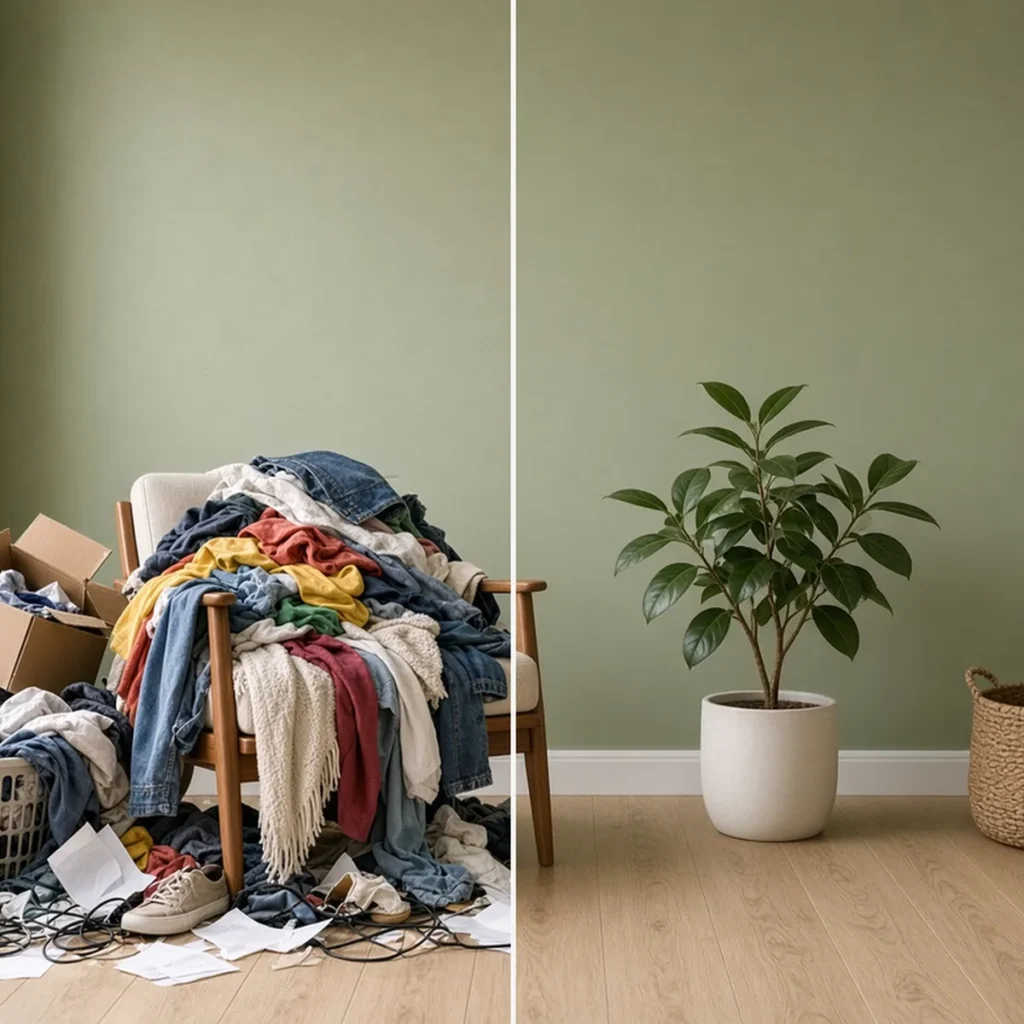
If you have ever started with the garage on a Saturday morning and ended the day with a half-emptied room and a pile in the hallway, the problem was not willpower. It was the plan. Most decluttering advice assumes you can hold a whole room in your head, stay on task for hours, and make hundreds of decisions in a row.
- “Declutter the kitchen” is not a task. It is dozens of tasks with no clear first step, so your brain stalls before you begin.
- There is no visible finish line. Without one, a session stretches until you run out of energy, usually mid-sort.
- Decision fatigue piles up. Every “keep or not?” costs energy, and the hard ones get pushed back until the whole project stops.
A good ADHD cleaning and decluttering system fixes all three by making every task small, finishable and pre-decided.
Step 1: Break your home into decluttering zones
A zone is a single, specific spot you can finish in one sitting. “The drawer under the microwave” is a zone. “The kitchen” is not. Aim for 20 to 60 minutes per zone. If a zone keeps getting postponed, it is too big, so split it in two.
Most homes break into 30 to 70 zones across the entryway, kitchen, living room, dining room, bedrooms, kids’ rooms, bathrooms, home office, laundry, garage, basement, attic, outdoors and your digital life (yes, your phone photos count).
Free room-by-room decluttering checklist (starter zones)
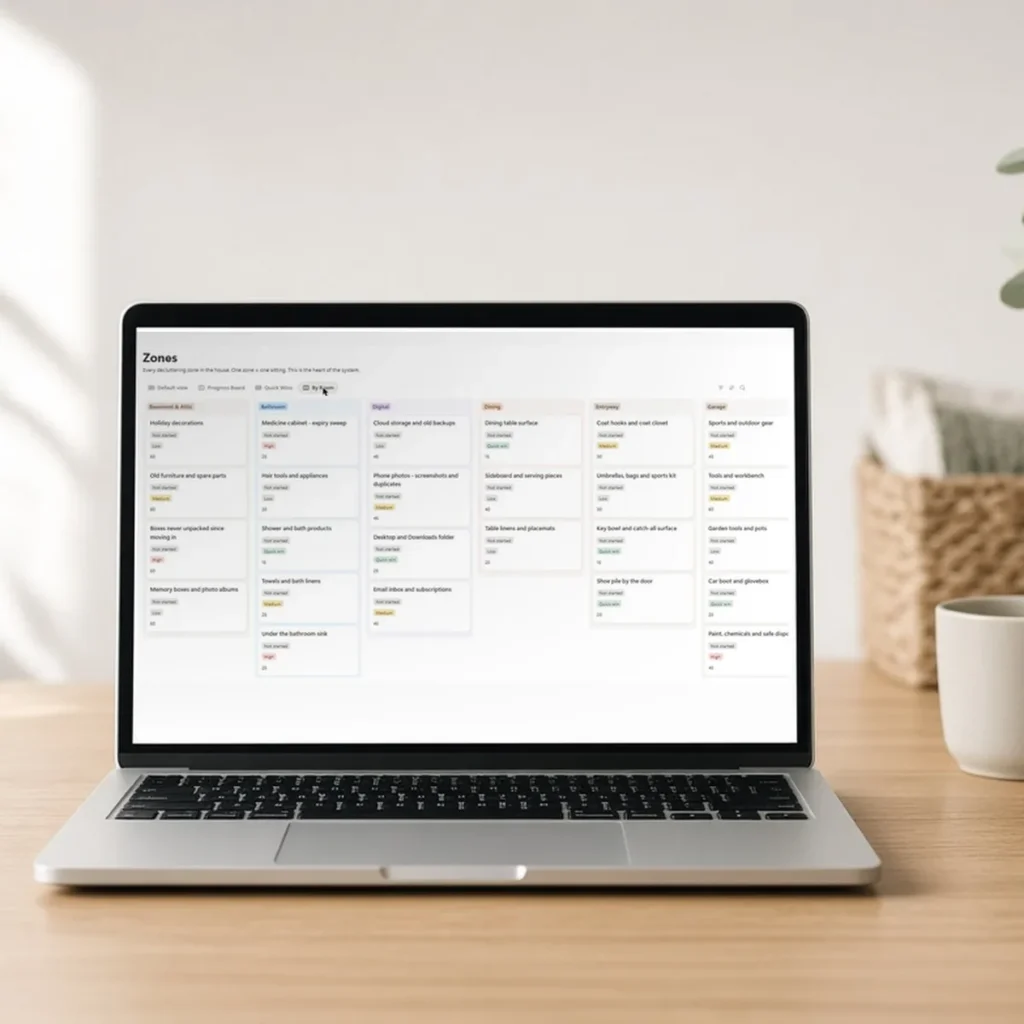
Here are real zones and time estimates taken straight from our Notion decluttering template. Copy them onto paper, a notes app or a spreadsheet and you have a working plan.
| Area | Zone | Time |
|---|---|---|
| Entryway | Key bowl and catch-all surface | 15 min |
| Entryway | Shoe pile by the door | 20 min |
| Entryway | Coat hooks and coat closet | 30 min |
| Entryway | Umbrellas, bags and sports kit | 30 min |
| Dining | Dining table surface | 15 min |
| Dining | Table linens and placemats | 20 min |
| Dining | Sideboard and serving pieces | 40 min |
| Kitchen | Spice rack | 15–20 min |
| Kitchen | Plastic containers and lids | 20–30 min |
| Kitchen | The junk drawer | 20–30 min |
| Living room | Coffee table and side tables | 15–20 min |
| Living room | Throw blankets and cushions | 15–20 min |
| Bathroom | Shower and bath products | 15 min |
| Bathroom | Hair tools and appliances | 20 min |
| Bathroom | Medicine cabinet: expiry sweep | 25 min |
| Bathroom | Towels and bath linens | 25 min |
| Bathroom | Under the bathroom sink | 25 min |
| Bedroom | Nightstands | 15–20 min |
| Laundry | Odd socks and the mending pile | 15–20 min |
| Home office | Desk surface | 15–20 min |
| Digital | Desktop and Downloads folder | 25 min |
| Digital | Email inbox and subscriptions | 40 min |
| Digital | Phone photos: screenshots and duplicates | 45 min |
| Digital | Cloud storage and old backups | 45 min |
| Garage | Car boot and glovebox | 20 min |
| Garage | Garden tools and pots | 40 min |
| Garage | Sports and outdoor gear | 45 min |
| Garage | Paint, chemicals and safe disposal | 45 min |
| Garage | Tools and workbench | 60 min |
| Basement and attic | Holiday decorations | 60 min |
| Basement and attic | Old furniture and spare parts | 60 min |
| Basement and attic | Boxes never unpacked since moving in | 60 min |
| Basement and attic | Memory boxes and photo albums | 60 min (do last) |
Step 2: Run a 20-minute declutter session
- Pick one zone. On a low-energy day, pick one of the 15-minute quick wins.
- Set a timer for 20 minutes (or the zone’s estimate).
- Take everything out of the zone. Seeing it all at once makes decisions faster.
- Sort into four bags or boxes: keep, relocate (belongs in another room), donate or sell, and trash or recycle.
- Put the keep pile back neatly. Walk the relocate pile to its rooms.
- Take the donate bag to your car or the front door right away.
- Log it: minutes spent, items removed, bags out. Then stop, even if you feel like continuing.

Step 3: Make decisions faster (and stop re-deciding)
When you are stuck holding an object, run through a few quick questions instead of debating it:
- Have I used this in the last year?
- If I lost it, would I buy it again at full price?
- Do I already own something that does the same job?
- Am I keeping it for who I am, or for who I think I should be?
- Would someone else get more use from it today?
Use a Maybe Box with a deadline
Some items genuinely need time. Put them in a Maybe Box, write a review date on it (30 or 90 days works well) and add that date to your calendar or planner. If you have not opened the box by then, donate it without re-sorting. The deadline is what stops “maybe” turning into “forever”.
Step 4: Work rooms in the right order
Order matters more than motivation. Start where decisions are easy and wins are visible, and save the emotional zones for when you have built the habit.
- First: surfaces and quick wins such as the dining table, key bowl, nightstands and bathroom products.
- Next: everyday storage like kitchen cupboards, closets, the home office and digital folders.
- Then: bulk storage in the garage, basement and attic.
- Last: sentimental items including photos, memory boxes and gifts. Starting here is the most common reason people quit in week two.

Step 5: Turn it into an ADHD cleaning schedule
Decluttering is a project; staying decluttered is a rhythm. Once a zone is clear, move it to a maintaining list and give it a quick pass about once a month. Your decluttering zones become a rolling cleaning checklist, so no room silently refills. Here is a simple weekly rhythm to start with:
| Day | Task | Time |
|---|---|---|
| Monday | One Quick Win zone | 15–20 min |
| Tuesday | Ten-minute reset of one busy surface | 10 min |
| Wednesday | One standard zone | 30–45 min |
| Thursday | Donation run or list items for sale | 15 min |
| Friday | One Quick Win zone | 15–20 min |
| Saturday | One bigger zone (garage, closet, attic) | 45–60 min |
| Sunday | Review the Maybe Box and pick next week’s zones | 10 min |
Low-energy week? Keep only Monday and Friday. Two small wins still move the house forward.

Step 6: Track progress so you can see it
ADHD brains run on visible progress. Log every session with the minutes spent, items removed and bags out, and keep a simple donation list with receipts if you plan to claim a tax deduction. Watching the total climb is often what gets you to start the next session.
Paper checklist vs a Notion decluttering template
| Paper or notes app | Notion decluttering template | |
|---|---|---|
| Setup | Write every zone yourself | 70 zones pre-written; delete what you do not have |
| Quick Wins on low-energy days | Scan the list manually | One filtered view |
| Progress totals | Add them up by hand | Calculated automatically |
| Maybe Box deadlines | Easy to forget | Review date on every item |
| Donation tracking | Separate list | Built in, with receipt uploads |
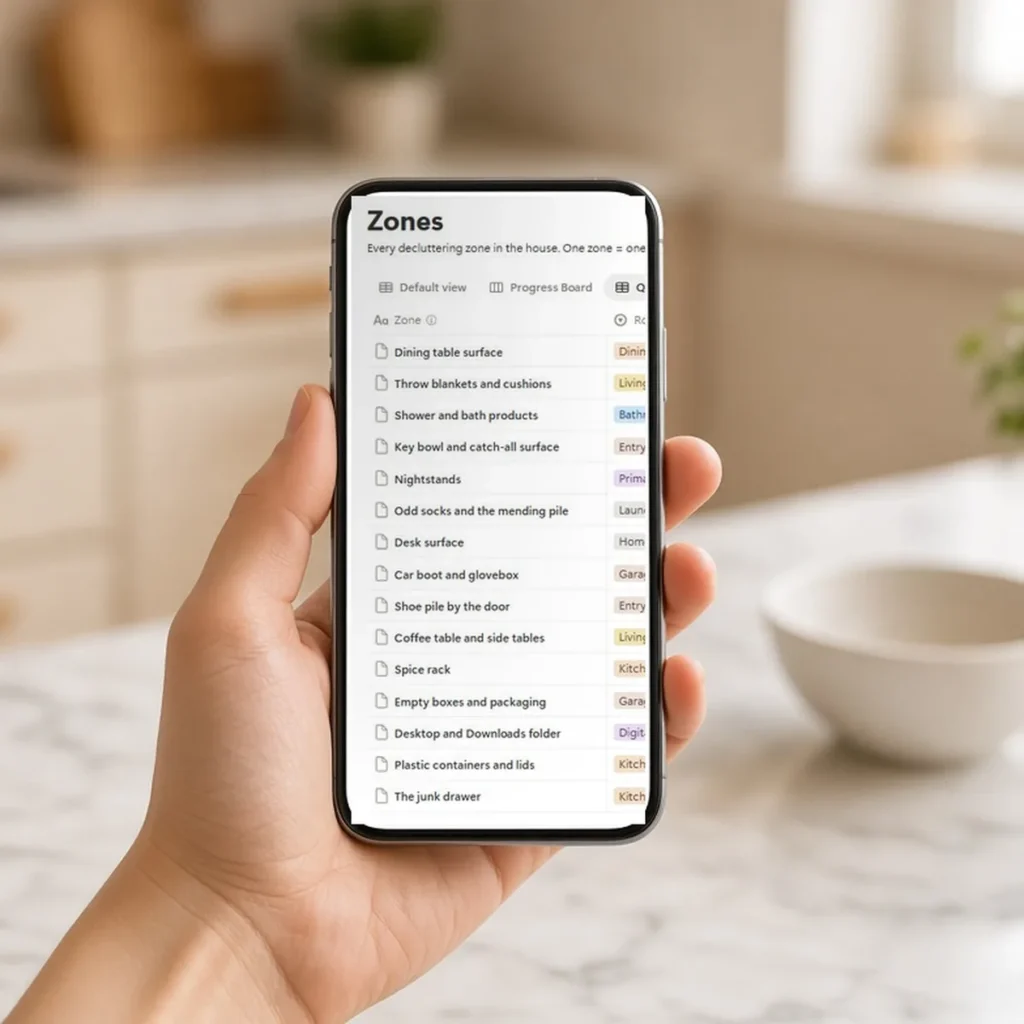
| Works on phone | Depends on the app | Desktop, tablet and phone |
| Cost | Free | One-time purchase, free Notion plan |
Get the done-for-you Notion decluttering template
If you would rather skip the setup, the HawkInc Notion Decluttering Template has this whole system ready to go: 70 room-by-room zones across 14 areas, a Quick Wins view, a session log with automatic totals, a Maybe Box with review deadlines, a donation and sales tracker, and the method written into the page. It works on the free Notion plan and doubles as a cleaning planner once your zones are clear.
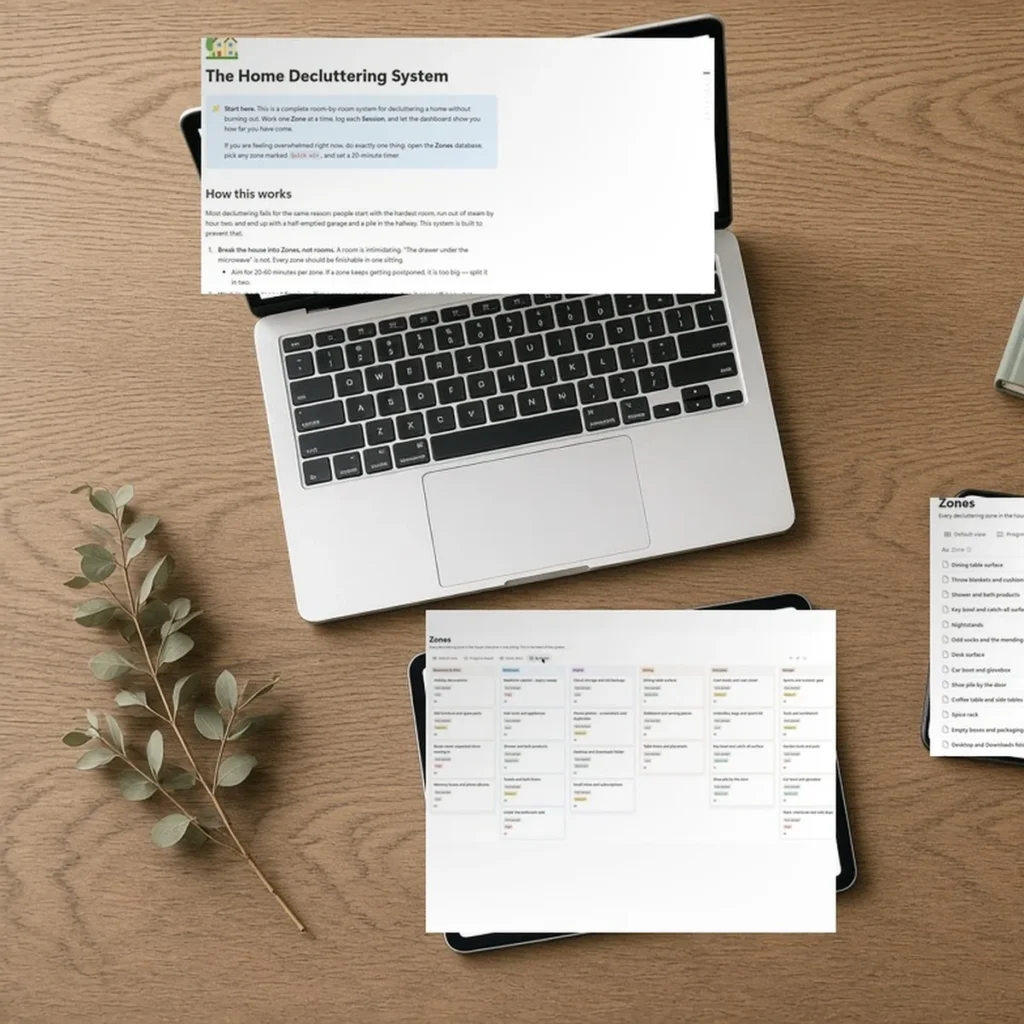
Prefer the full feature list and screenshots first? See the Notion decluttering template product page.
Frequently asked questions
What is an ADHD decluttering system?
It is a way of decluttering built around how ADHD brains work: tiny, pre-defined zones instead of whole rooms, short timed sessions, a visible finish line, one decision at a time, and a deadline for anything you cannot decide on yet.
How do you declutter with ADHD when you feel overwhelmed?
Pick the smallest zone you can see, such as the key bowl or the dining table surface, set a 20-minute timer, and stop when it goes off. Finishing something small builds momentum; trying to clear a whole room usually ends in a half-done pile.
What are decluttering zones?
A zone is one small, specific area that can be finished in a single 20 to 60 minute sitting, like the drawer under the microwave, the shoe pile by the door or your Desktop and Downloads folder. A typical home breaks into 30 to 70 zones.
What order should I declutter my house in?
Start with quick, low-emotion zones such as surfaces, bathroom products and the entryway. Move to bigger storage zones like the garage and kitchen next, and leave sentimental items like photos and memory boxes until last.
How long should a decluttering session be?
Between 20 and 60 minutes. Short sessions are easier to start, easier to finish, and less likely to leave a mess half-sorted in the hallway.
What is a maybe box in decluttering?
A maybe box holds items you cannot decide on yet. The key is giving it a review date, for example 30 or 90 days out. If you have not needed the item by then, it goes.
Can I use a decluttering plan as a cleaning schedule?
Yes. Once a zone is decluttered, move it into a maintaining list and give it a quick pass about once a month. Your declutter zones then double as a rolling ADHD cleaning schedule.
Is there a Notion template for decluttering?
Yes. The HawkInc Notion Decluttering Template includes 70 pre-built zones across 14 areas, a Quick Wins view, a session log, a Maybe Box with deadlines and a donation tracker, and it works on the free Notion plan.