
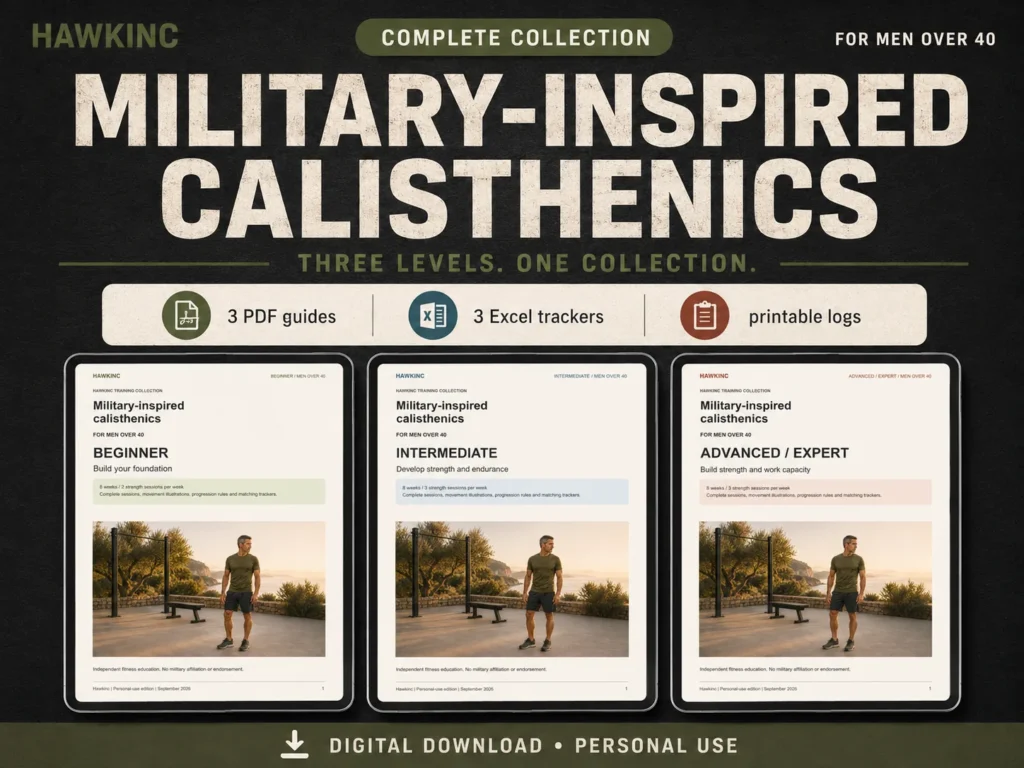
Quick answer: the best calisthenics for men over 40 is a structured, joint-friendly bodyweight workout plan: two or three full-body strength sessions a week, exercises with easier and harder options, steady progression over eight weeks, and lighter recovery weeks built in. Start at the level that matches your experience, track your sessions, and only increase difficulty once your form and recovery are consistent.
By Dr. Mueed Akhtar, PhD (Chemical Engineering), founder of HawkInc · Last updated 13 October 2026
If you are over 40 and want to get strong again without a gym membership, a rack of dumbbells, or joints that ache for two days after every session, bodyweight training is one of the smartest tools you have. This guide explains how a military-inspired calisthenics workout works, why calisthenics for men over 40 is such a good fit, and how to follow a structured 8-week home workout plan across three levels.
In This Guide
Calisthenics for men over 40 at a glance
| Detail | Military-Inspired Calisthenics Complete Collection |
|---|---|
| Who it is for | Men over 40, from beginners returning to training to experienced trainees |
| Levels | Beginner, Intermediate, Advanced / Expert |
| Plan length | 8 weeks per level, with lighter weeks 4 and 8 |
| Strength sessions | 2 per week (Beginner) or 3 per week (Intermediate and Advanced) |
| Session length | About 25–40, 35–50 or 45–65 minutes, depending on level |
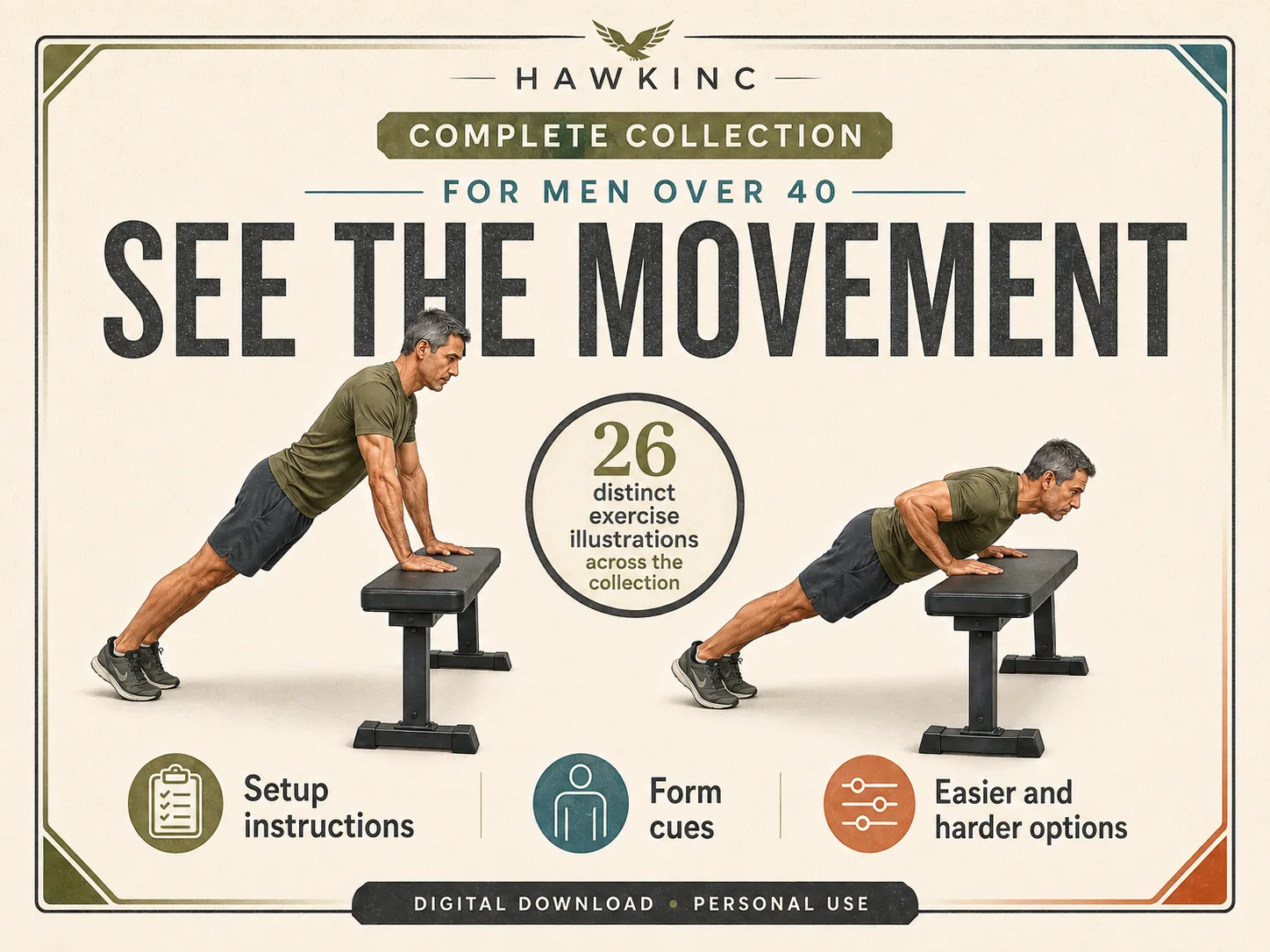
| Exercise guidance | 26 distinct exercise illustrations with setup instructions, form cues and easier or harder options |
| Workout tracker | 3 macro-free Excel workbooks, 6 tabs each (Microsoft Excel required) |
| Printable workout logs | A4 and US Letter, for handwriting |
| Equipment | Mostly bodyweight; mat, resistance band and step or low bench help (not included) |
| Format | Digital download for personal use; no physical item or coaching |
| Price | $5.99 on Etsy at the time of writing |
Why calisthenics works so well after 40
In your 40s and beyond, the goal shifts. You are no longer training just to look a certain way for the summer. You are training to move well, stay strong, protect your joints, and keep the energy to do everything else in your life. Calisthenics fits that goal almost perfectly.
A good bodyweight workout builds real, usable strength through full ranges of motion, it is gentle on the joints when it is scaled correctly, and it can be done at home, in a park, or in a hotel room while travelling. The catch is that most free workouts online are written for 22-year-olds. They skip the warm-up, ignore recovery, and assume you can already do 20 clean push-ups and a set of pull-ups. What men over 40 actually need is a workout plan that meets them where they are and progresses sensibly from there.
What “military-inspired” calisthenics really means
Military-inspired does not mean punishing yourself with endless burpees until you are sick. It means borrowing the parts of military physical training that actually build durable fitness: consistency, progressive overload, movement quality, and a balance of strength, endurance and mobility. It is disciplined and structured, but it is scaled for a 40-plus body, not a boot-camp recruit.
Every exercise earns its place: push-ups and their easier incline variations, rows, squats, hinges, planks and carries. Each one comes with setup instructions, form cues, and both an easier and a harder option so you can match the difficulty to how you feel on any given day.
Three levels of calisthenics for men over 40
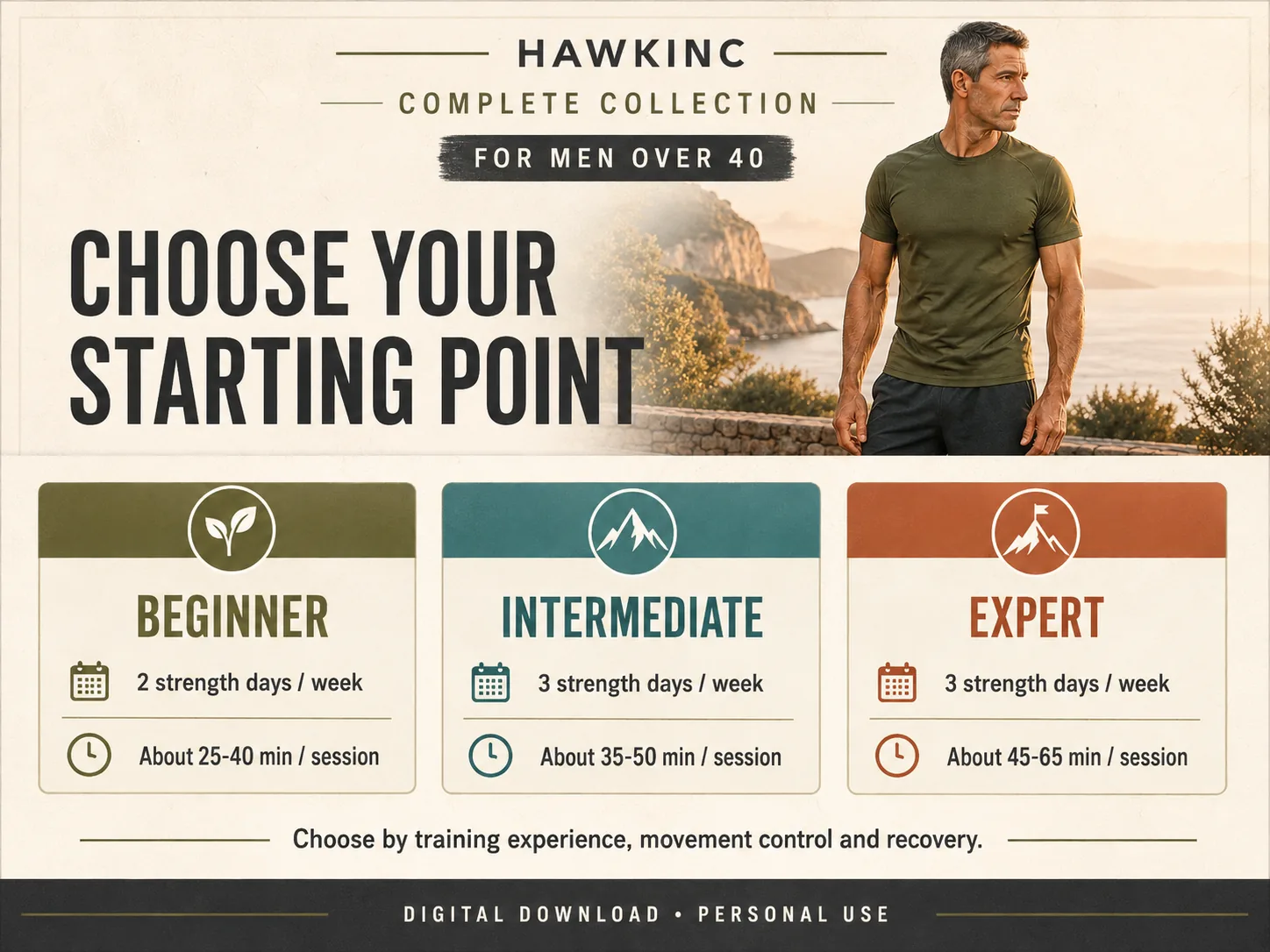
The biggest mistake men over 40 make is starting too hard, getting sore or hurt, and quitting in week two. The fix is to start at the right level. This collection is built around three of them, so you can begin where you are today and keep moving up as you get stronger.
| Level | Strength days per week | Session length | Best for |
|---|---|---|---|
| Beginner: build your foundation | 2 | About 25–40 min | Returning to training after a long break |
| Intermediate: develop strength and endurance | 3 | About 35–50 min | Training fairly consistently and controlling the basic movements |
| Advanced / Expert: build strength and work capacity | 3 | About 45–65 min | Experienced trainees with solid movement control and good recovery |
How the 8-week workout plan keeps you progressing
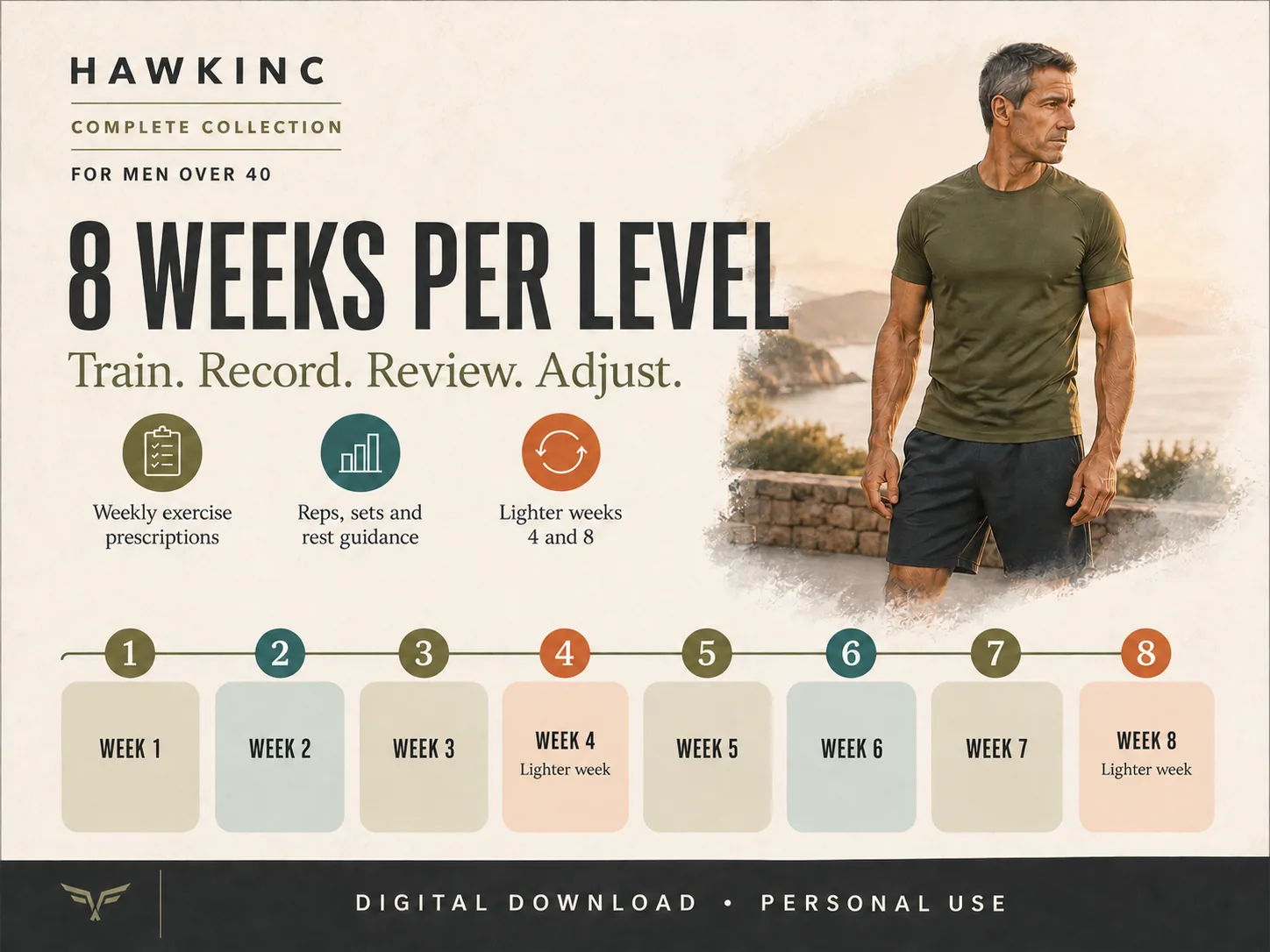
Each level runs for eight weeks and follows a simple, sustainable rhythm: train, record, review, adjust. You get weekly exercise prescriptions with reps, sets and rest guidance, so you always know exactly what to do.
Crucially, weeks 4 and 8 are lighter recovery weeks, the part almost every DIY plan forgets. Those lighter weeks let a 40-plus body absorb the work, reduce injury risk, and come back stronger instead of burning out.
Sample beginner week: what a session looks like
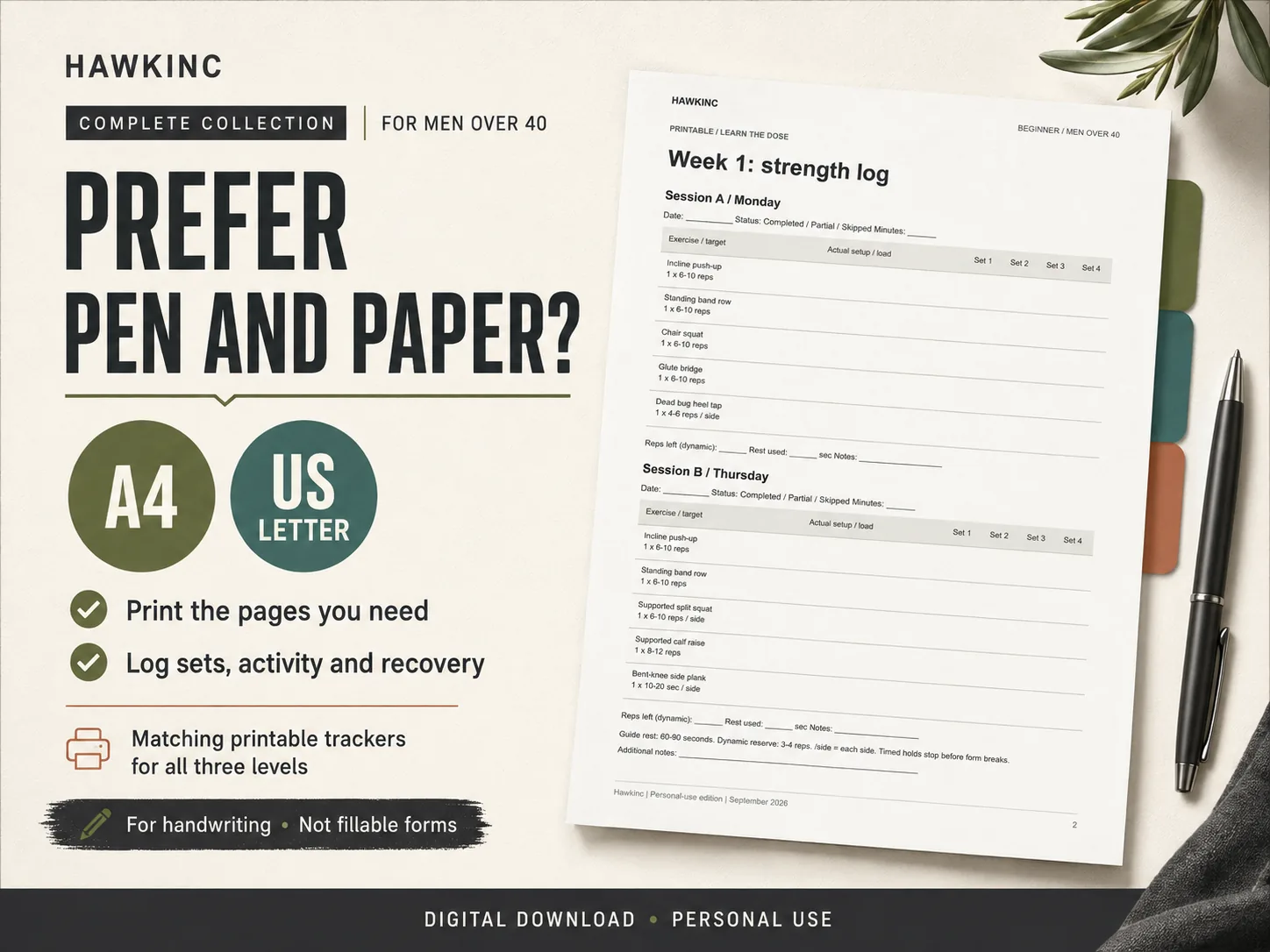
Here is how Week 1 of the Beginner level is laid out in the printable strength log. Rest about 60–90 seconds between sets and stop timed holds before your form breaks.
| Session A (Monday) | Target | Session B (Thursday) | Target |
|---|---|---|---|
| Incline push-up | 1 × 6–10 reps | Incline push-up | 1 × 6–10 reps |
| Standing band row | 1 × 6–10 reps | Standing band row | 1 × 6–10 reps |
| Chair squat | 1 × 6–10 reps | Supported split squat | 1 × 6–10 reps / side |
| Glute bridge | 1 × 6–10 reps | Supported calf raise | 1 × 8–12 reps |
| Dead bug heel tap | 1 × 4–6 reps / side | Bent-knee side plank | 1 × 10–20 sec / side |
It looks easy on purpose. Week 1 teaches the movements and sets your baseline; volume and difficulty build from there.
Track your work with a workout tracker and printable logs
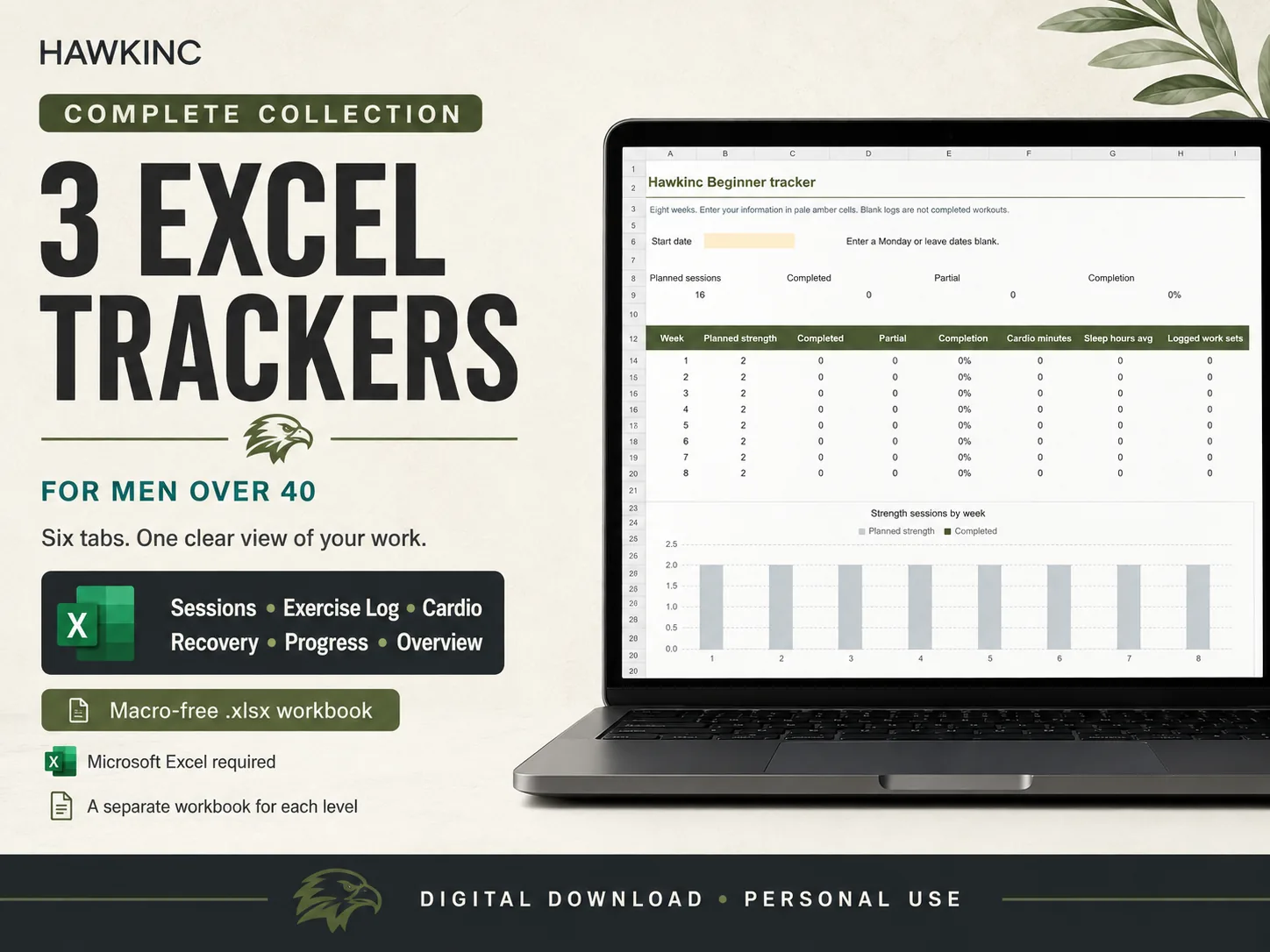
What gets measured gets improved. The collection includes three Excel workout trackers, one per level, each with six tabs: Sessions, Exercise Log, Cardio, Recovery, Progress and Overview. They are macro-free .xlsx files and need Microsoft Excel.
Prefer pen and paper? Matching printable workout logs come in A4 and US Letter for all three levels. Print the pages you need and log your sets, activity and recovery by hand. They are designed for handwriting, not as fillable forms.
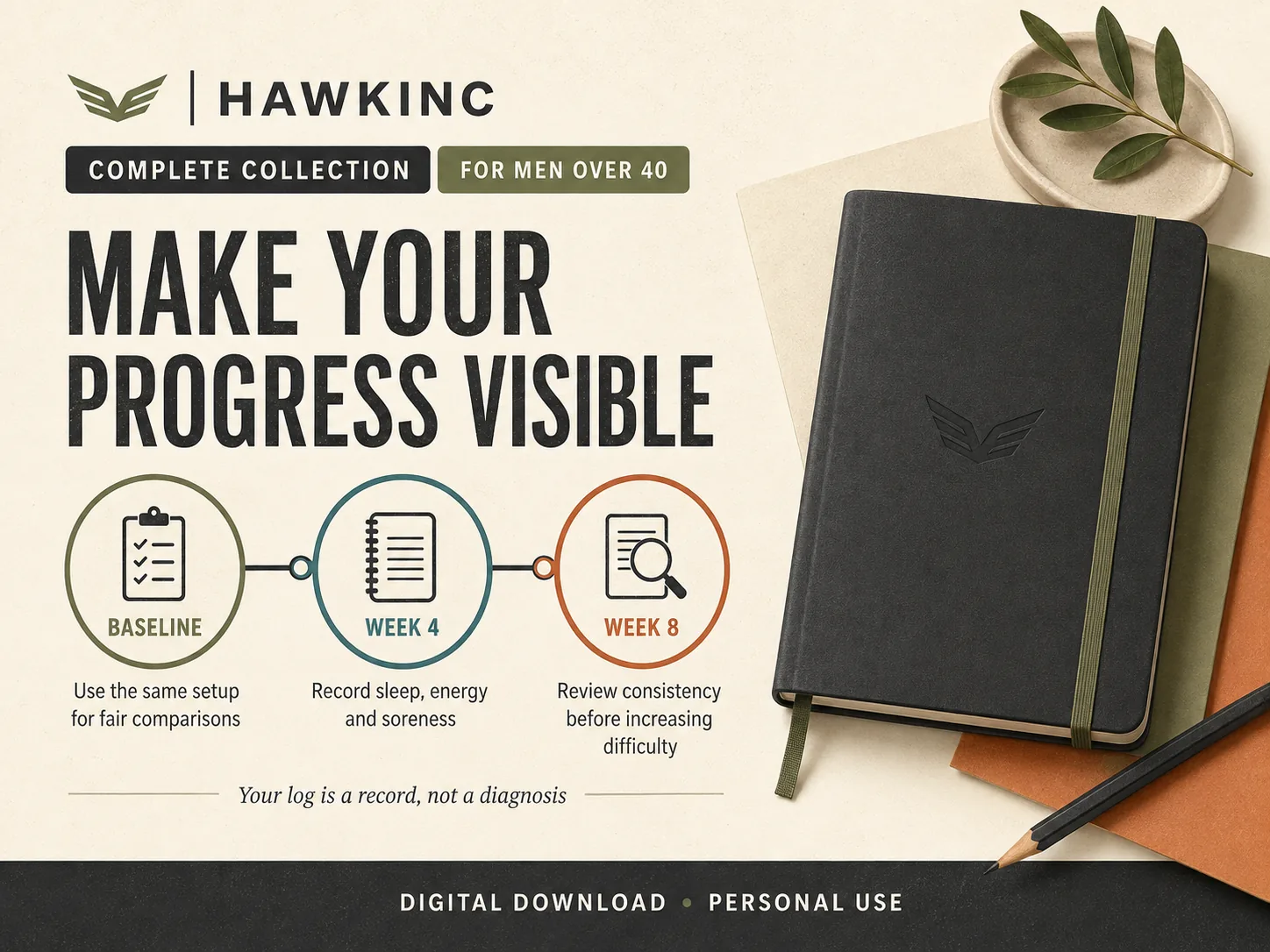
A good rule: use the same setup for fair comparisons, check in on sleep, energy and soreness around week 4, and review your consistency at week 8 before you increase difficulty. Your log is a record of your effort, not a diagnosis. Some weeks are lighter than others, and that is completely normal.
What you need for this no gym workout
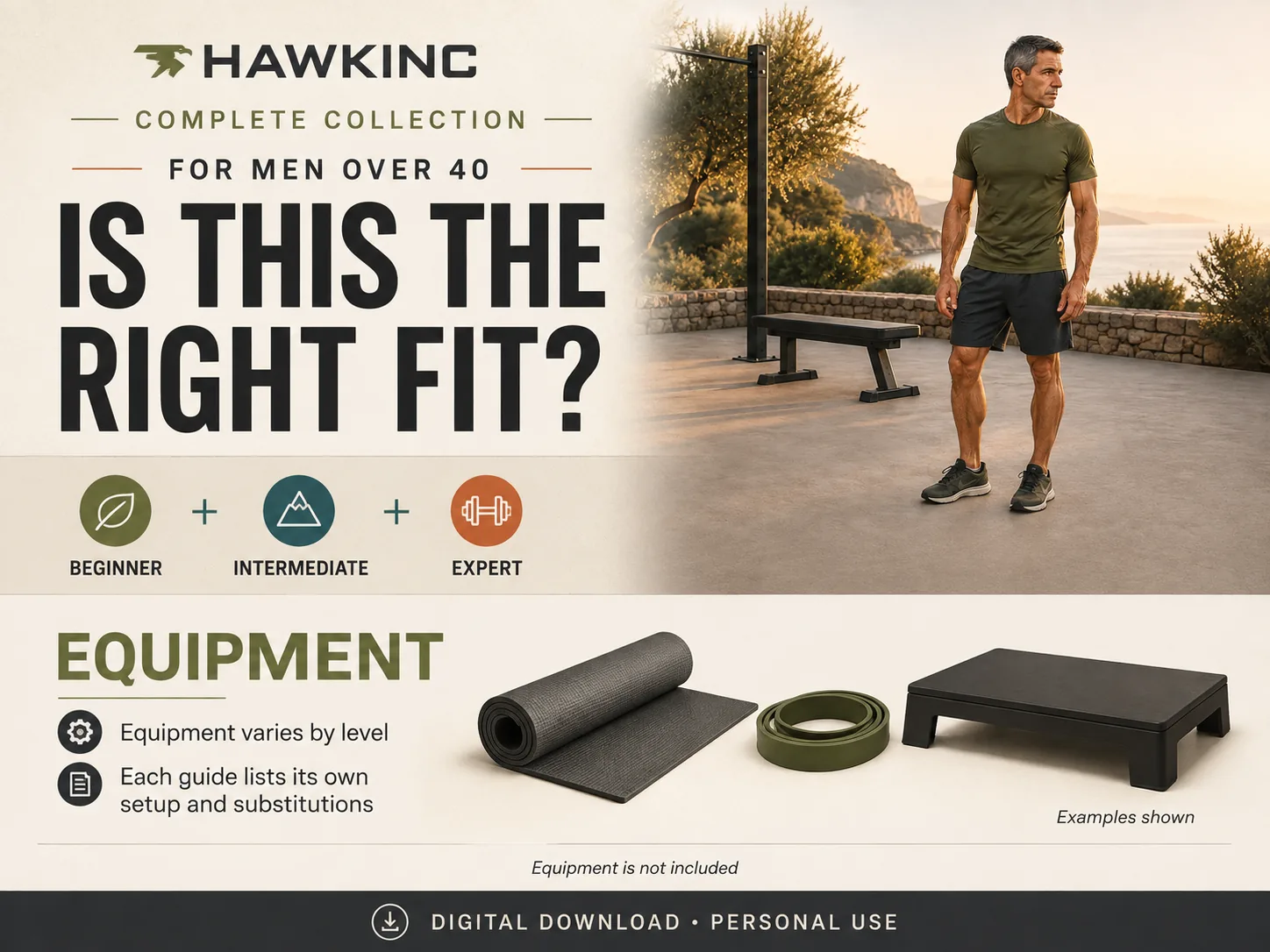
Most of the work is pure bodyweight. Depending on the level, a few simple items help: an exercise mat, a resistance band, and a sturdy step or low bench. Each guide lists its own setup and substitutions so you are never stuck. You do not need a full home gym to begin, and equipment is not included.
What’s included in the complete collection
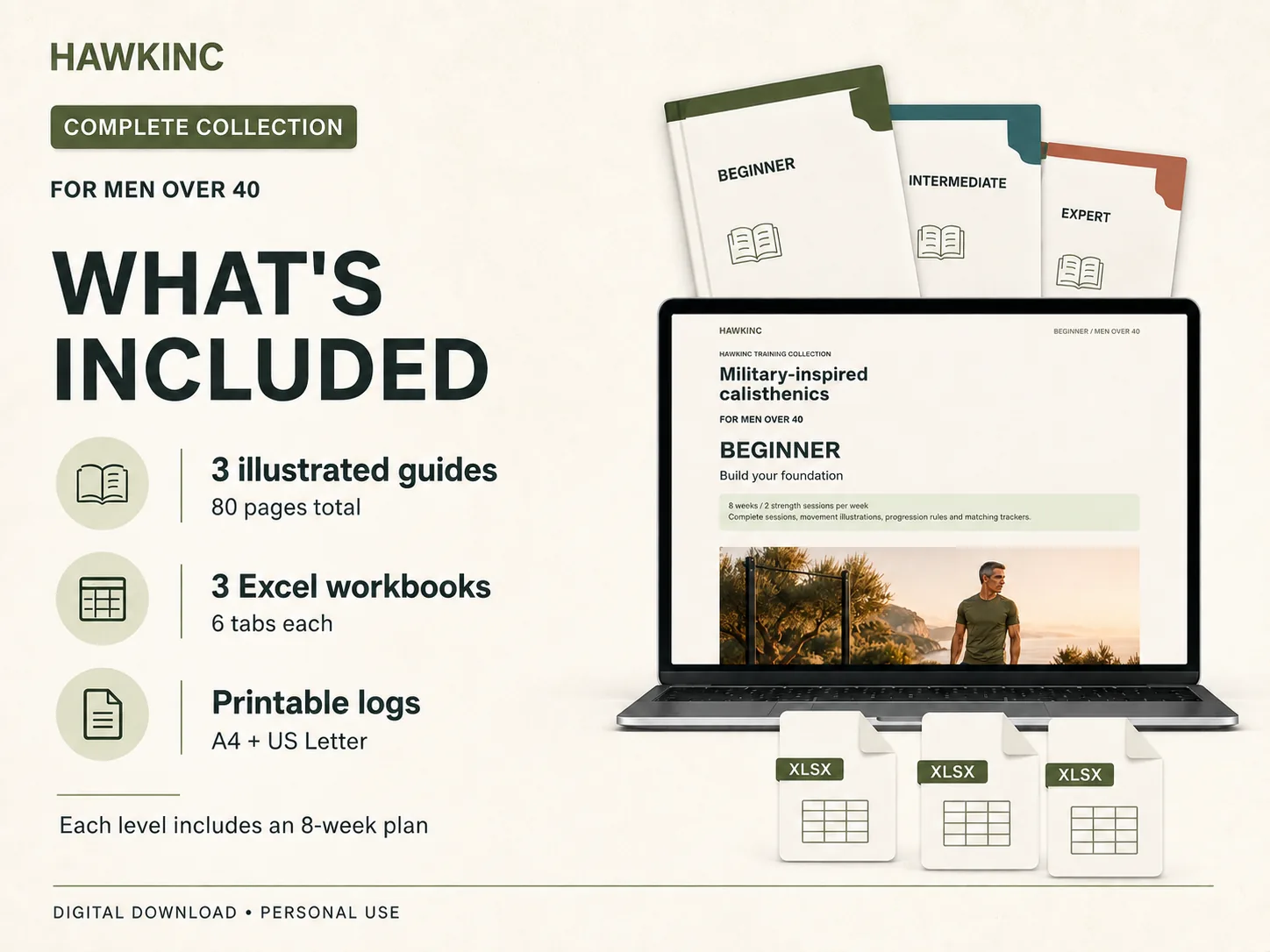
- 3 illustrated PDF guides, 80 pages in total: Beginner, Intermediate and Advanced / Expert
- 3 Excel workout trackers, one per level, six tabs each
- Printable workout logs in A4 and US Letter for every level
- An 8-week workout plan per level with weekly reps, sets and rest guidance
- 26 distinct exercise illustrations with setup instructions, form cues and easier or harder options
How to start in three steps
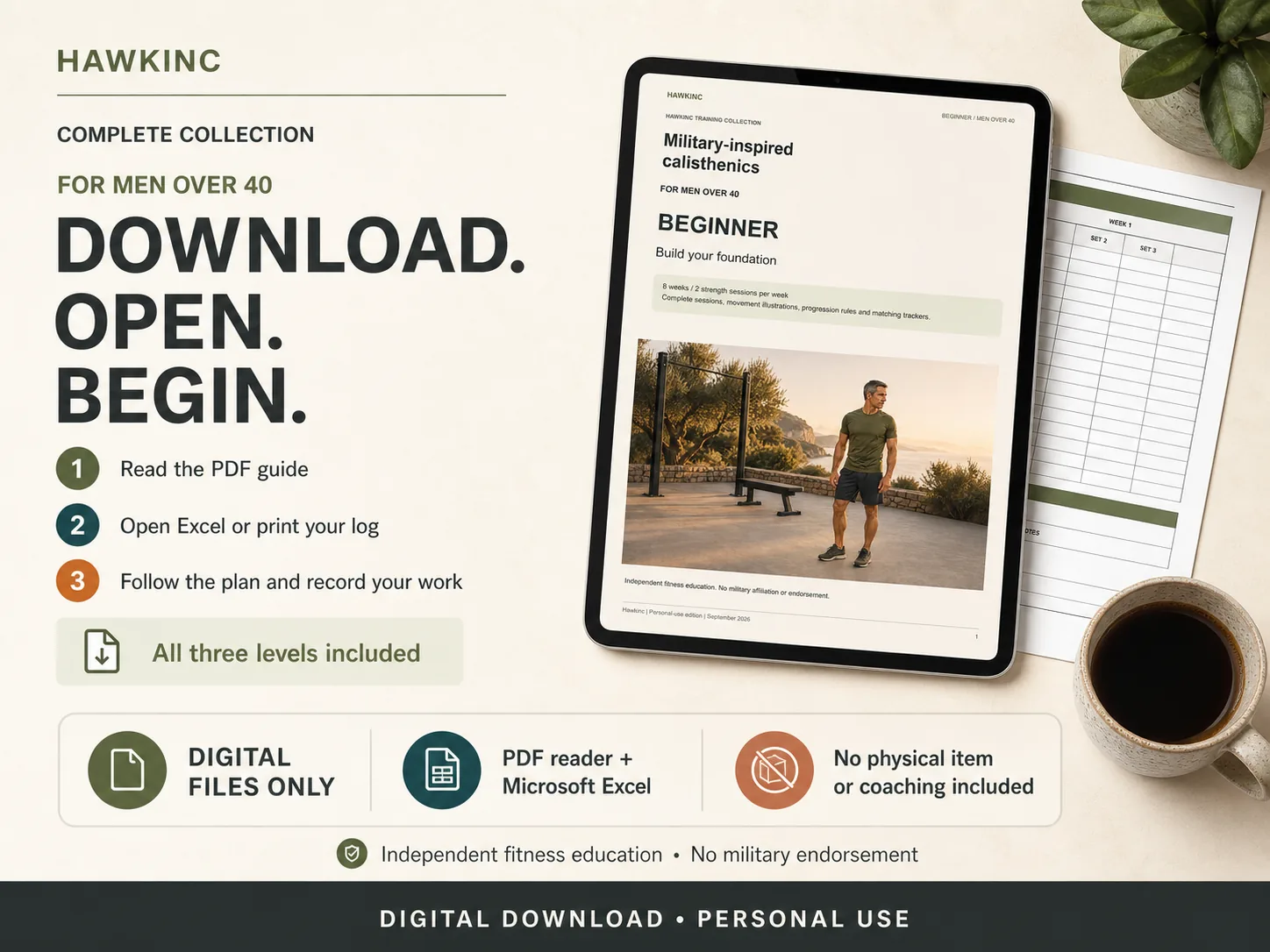
- Read the PDF guide for your level, including the warm-up, form cues and progression rules.
- Open the Excel tracker or print your log and record your baseline in week 1.
- Follow the plan and record your work each session, then review at weeks 4 and 8 before moving up.
How to progress calisthenics exercises safely
With bodyweight training you cannot just add a plate to the bar, so progress comes from changing the exercise itself. The safest way to do calisthenics for men over 40 is to move along a “ladder” of variations, and only climb to the next step when you can complete all prescribed reps with clean form for two sessions in a row.
| Movement | Easier | Standard | Harder |
|---|---|---|---|
| Push | Incline push-up on a bench or wall | Floor push-up | Slow-tempo or feet-elevated push-up |
| Pull | Standing band row | Inverted row under a sturdy table or bar | Slow-tempo inverted row or pull-up negatives |
| Squat | Chair squat | Bodyweight squat | Supported, then free split squat |
| Hinge | Glute bridge | Single-leg glute bridge | Slow-tempo single-leg bridge |
| Core | Dead bug heel tap | Front plank | Longer holds or side plank with top-leg lift |
Change only one thing at a time: first reps, then sets, then tempo, and only then the exercise variation. That keeps the stress on your joints and tendons predictable, which matters more after 40 than chasing a personal best.
Common calisthenics mistakes men over 40 make
- Starting at the wrong level. Beginning with advanced moves leads to soreness, niggles and missed sessions. Start one level lower if you are unsure.
- Skipping the warm-up. Five to ten minutes of easy movement prepares stiff hips, shoulders and ankles for the work ahead.
- Training to failure every set. Leaving two or three reps in reserve lets you train more often with better form.
- Ignoring recovery weeks. The lighter weeks 4 and 8 are part of the plan, not a sign you are slacking.
- Not tracking anything. Without a workout log it is hard to know whether you are progressing, stalling or overdoing it.
- Only training strength. Daily walking, some cardio and good sleep make every strength session more productive.
Calisthenics vs weights after 40
Both work. Weights make it easy to add small, precise amounts of load, while calisthenics needs little or no equipment, trains balance and body control, and is easy to fit into a busy week at home or on the road. Many men over 40 do well starting with a bodyweight workout plan to rebuild movement quality and consistency, then adding weights later if they want to. The best program is the one you can follow week after week without getting hurt.
Safety tips for calisthenics after 40
- Warm up for 5–10 minutes before every session; joints and tendons need more preparation after 40.
- Pick the easier option on days when you slept badly or feel stiff, and treat that as smart training, not failure.
- Leave a few reps in reserve rather than training to failure, especially in the first weeks.
- Progress one variable at a time: reps, sets, tempo or exercise difficulty.
- Stop any exercise that causes sharp pain, dizziness or chest discomfort, and speak to a doctor.
Frequently asked questions
What is the best calisthenics workout for men over 40?
The best calisthenics workout for men over 40 is a structured, scalable plan rather than a random list of exercises. Look for two or three full-body strength sessions a week, easier and harder versions of each movement, gradual progression, and planned lighter weeks for recovery. That is the approach this military-inspired collection follows.
Can men over 40 build strength and muscle with bodyweight exercises?
Yes. Bodyweight exercises can build strength and muscle at any age when you train consistently, use good form, and make the work gradually harder over time, for example by adding reps, sets, slower tempo or harder variations. Recovery, sleep and enough protein matter just as much after 40.
How many days a week should a man over 40 do calisthenics?
Two to three strength sessions a week is a sensible target for most men over 40. Beginners often do best with two, while intermediate and advanced trainees can handle three. Walking or light cardio on other days supports recovery.
What is military calisthenics?
Military calisthenics means bodyweight training built on the principles used in military physical training: consistency, progressive overload, movement quality and a balance of strength, endurance and mobility. In this plan it is scaled for a 40-plus body, not a boot-camp recruit.
Is this a no gym workout?
Yes. The plan is mostly bodyweight and can be done at home, in a park or while travelling. Depending on your level, a few simple items help, such as an exercise mat, a resistance band and a sturdy step or low bench. Each guide lists its own setup and substitutions. Equipment is not included.
Which level should I start with?
Choose by training experience, movement control and recovery. Start with Beginner if you are returning after a long break, Intermediate if you already train fairly consistently and control the basic movements, and Advanced or Expert if you have solid technique and recover well. If in doubt, start one level lower.
How long does each workout take?
Beginner sessions take about 25 to 40 minutes, Intermediate about 35 to 50 minutes, and Advanced or Expert about 45 to 65 minutes, depending on rest periods and warm-up.
What is included in the digital download?
The complete collection includes three illustrated PDF guides (80 pages in total), three Excel workout trackers with six tabs each, and matching printable workout logs in A4 and US Letter. Each level includes an eight-week plan, and there are 26 distinct exercise illustrations across the collection.
Do I need Microsoft Excel for the workout tracker?
Yes. The trackers are macro-free .xlsx workbooks designed for Microsoft Excel. If you prefer not to use a spreadsheet, the printable logs let you record the same workouts with pen and paper.
Are the printable workout logs fillable PDFs?
No. The printable logs are designed to be printed and filled in by hand. They are not fillable forms.
Does the plan include coaching or a physical product?
No. It is a digital download for personal use only. No physical item is shipped and no personal coaching is included.
Is this plan affiliated with the military?
No. It is independent fitness education that borrows principles from military-style physical training. It has no military affiliation or endorsement.
Should I see a doctor before starting calisthenics after 40?
If you have a health condition, joint problems, a history of heart issues, or have been inactive for a long time, check with your doctor before starting any new exercise program. Stop any exercise that causes sharp pain, dizziness or chest discomfort.
Key takeaways
- Calisthenics for men over 40 works best as a structured plan with two or three strength days a week.
- Start at the right level: Beginner, Intermediate or Advanced / Expert.
- Eight-week blocks with lighter weeks 4 and 8 help you progress without burning out.
- Tracking your sessions, sleep and soreness shows when you are ready to push harder.
- The Military-Inspired Calisthenics Complete Collection gives you all three levels, Excel trackers and printable logs in one digital download: get it on Etsy or see the full listing.
Related topics: calisthenics workout, bodyweight workout, no gym workout, strength training, workout tracker, digital download, home workout, workout chart, workout plan, military calisthenics, printable workout, advanced workout, calisthenics.
This article is independent fitness education for general information only and is not medical advice. The plan has no military affiliation or endorsement. If you have a health condition or have been inactive for a while, check with your doctor before starting a new exercise program.