
By Dr. Mueed Akhtar, PhD (Chemical Engineering), founder of HawkInc
Quick answer
A Halloween C2C crochet blanket is worked diagonally in small blocks of three double crochets, following a graph where each square is one block. Start at the bottom corner, read each diagonal row in the direction you are working, change colour when the squares change, and increase to full width before decreasing back to the opposite corner.
Key takeaways
- Every square on a C2C graph equals one block of three double crochets (US terms), worked on the diagonal.
- You read the graph one diagonal at a time, switching direction each row, starting from the bottom corner.
- A rectangle has width + height − 1 diagonal rows: 99 for a 40 × 60 block blanket, 249 for 100 × 150.
- Written block-by-block rows remove the need to count squares and make larger graphs much easier.
- Pick yarn weight to suit the size: worsted for small, DK for medium and sport for large in this set.
Table of Contents
What is a C2C crochet blanket?
A C2C (corner-to-corner) crochet blanket is built from small square tiles called blocks, worked diagonally from one corner to the opposite one. Each block is a short chain plus three double crochets. Because every block is one pixel of colour, C2C is ideal for picture blankets, often called graphgans, such as Halloween cats, ghosts and witches.
The trade-off is colour work: a detailed Halloween C2C crochet blanket uses several colours at once. US and UK patterns name the stitch differently (US double crochet equals UK treble), so check the Craft Yarn Council crochet abbreviations if a pattern looks unfamiliar.
How do you read a C2C crochet graph?
Read a C2C graph one diagonal row at a time. Start in the bottom-right square (bottom-left if you crochet left-handed), which is row 1 and a single block. Row 2 runs back across two squares, row 3 across three, and so on. Each row reverses direction, and every coloured square is one block in that colour.
- Find the starting corner marked on the chart and the colour key beside it.
- Mark row 1 (one square) and row 2 (two squares) with a highlighter so you can see the diagonal direction.
- Read each row along the diagonal, counting how many squares of each colour sit next to each other, for example ‘3 orange, 1 black, 2 orange’.
- Crochet that row in the same order, then turn your work and read the next diagonal in the opposite direction.
- Keep increasing (adding one block per row) until you reach the chart’s shorter edge, then follow the shaping described in the next section.
- Tick off each finished row on paper or in a PDF annotation app so you never lose your place.
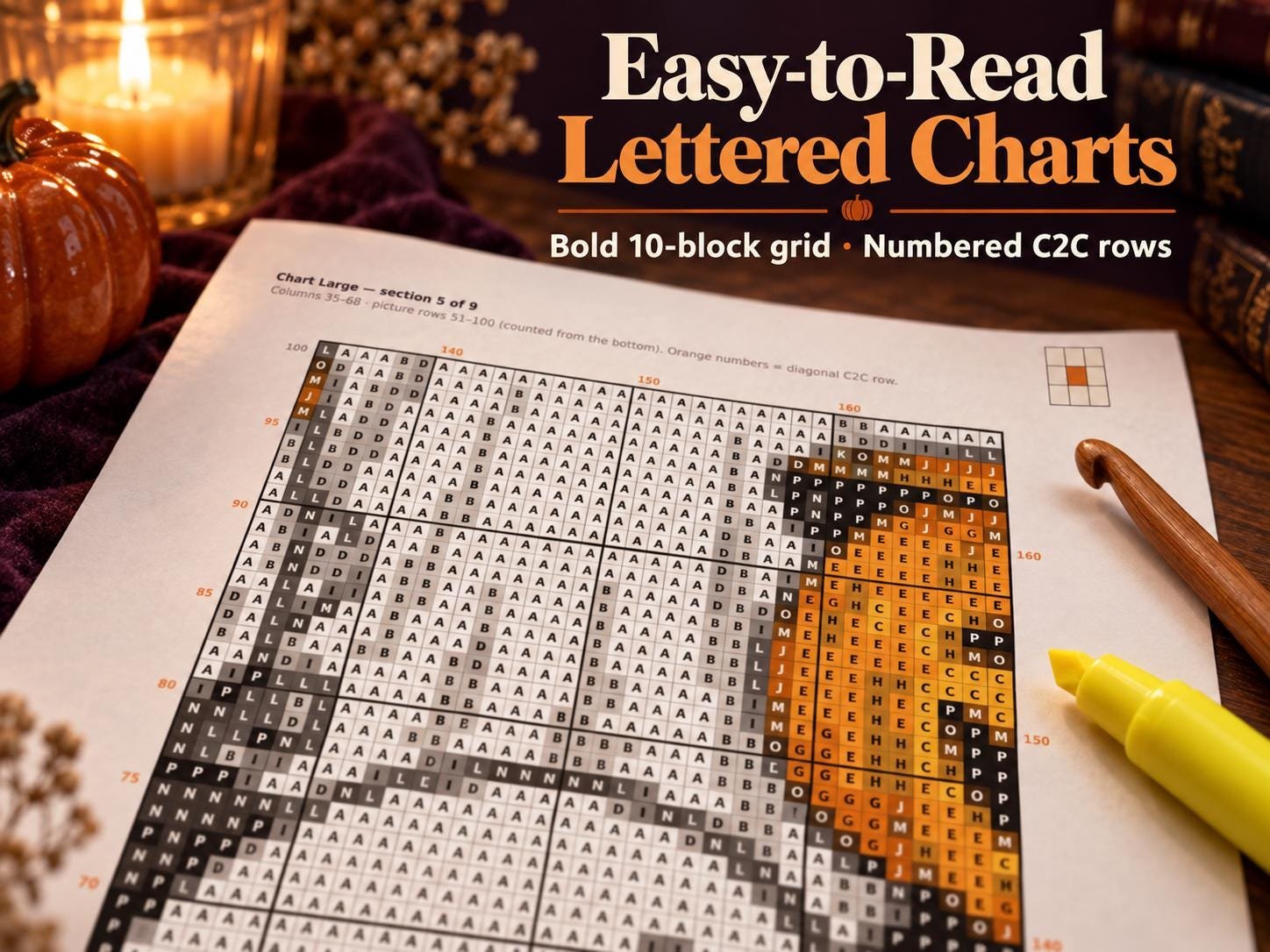
Lettered charts help here: when each square carries a letter (A for black, B for orange), similar dark shades are easy to tell apart.
The pattern used in this guide
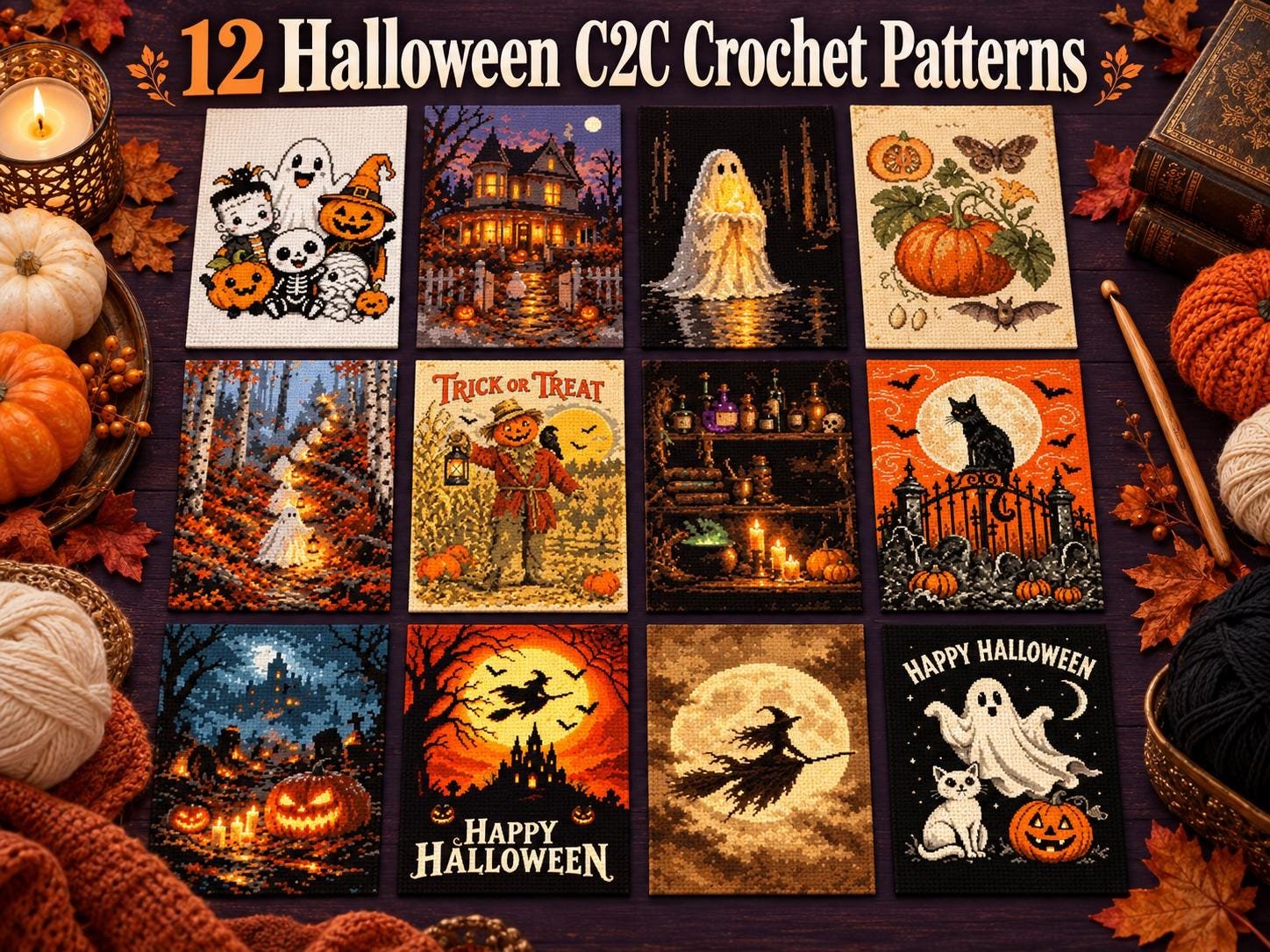
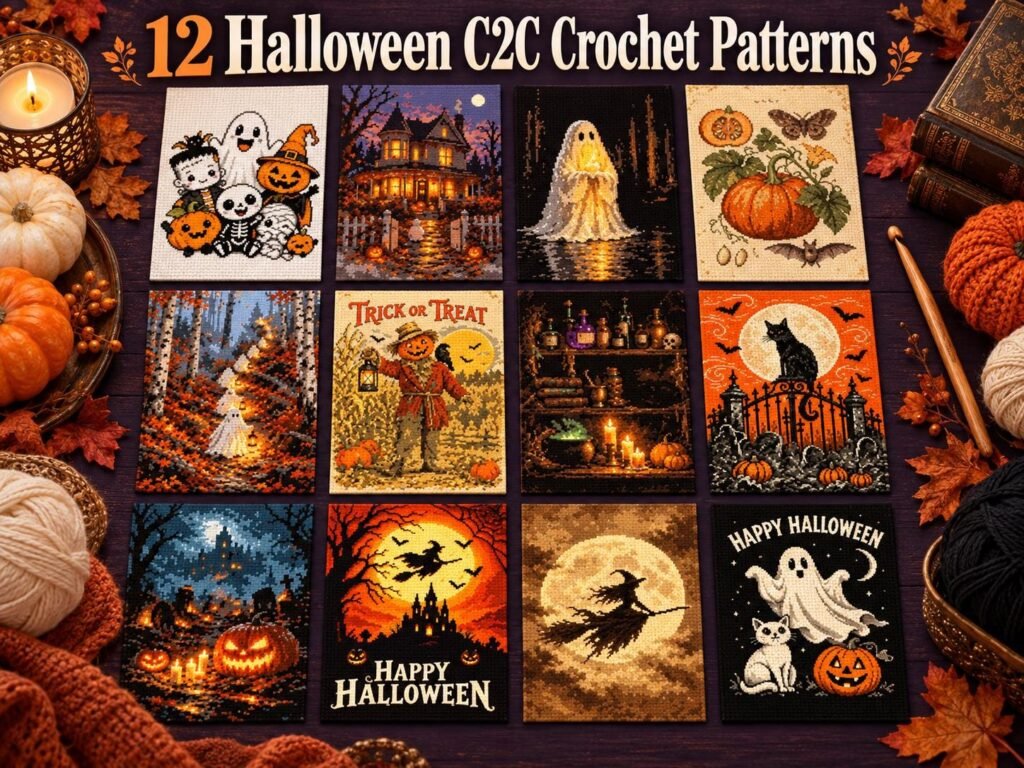
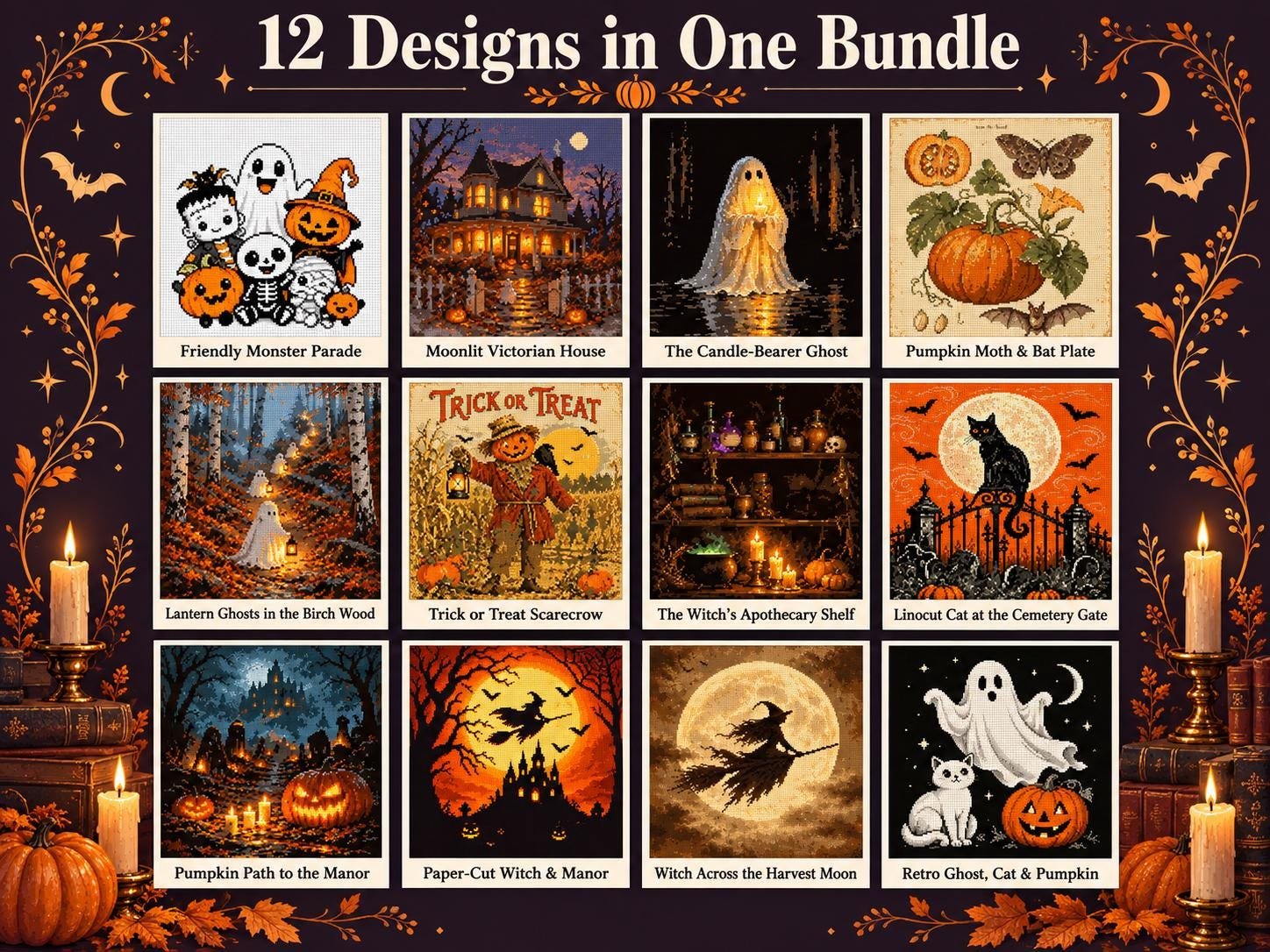
Halloween C2C Crochet Blanket Pattern: 12 spooky designs, each in 3 sizes, with colour graphs and written block-by-block rows, so you never have to count squares on screen. $11.99 USD on sale (regular $19.99), instant 377-page PDF.
See the full product page, sizes and FAQ
How many blocks and rows does each blanket size need?
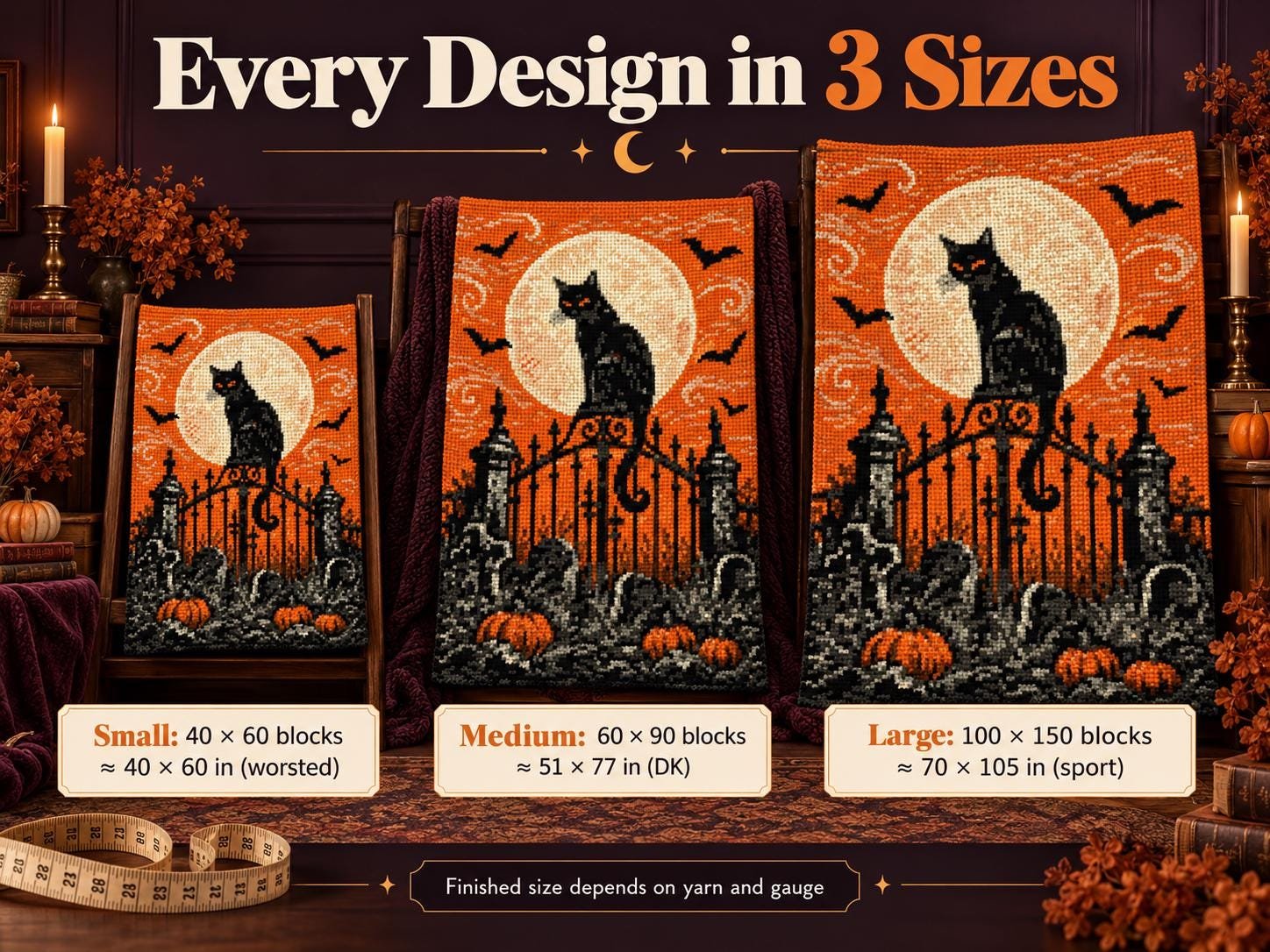
Multiply the width by the height to get the number of blocks, and add width and height minus one to get the number of diagonal rows. A small 40 × 60 block Halloween C2C crochet blanket has 2,400 blocks over 99 rows; a large 100 × 150 version has 15,000 blocks over 249 rows, which is a far bigger project.
| Size | Blocks (W × H) | Total blocks | Diagonal rows | Suggested yarn | Approx. finished size |
|---|---|---|---|---|---|
| Small | 40 × 60 | 2,400 | 99 | Worsted | 40 × 60 in |
| Medium | 60 × 90 | 5,400 | 149 | DK | 51 × 77 in |
| Large | 100 × 150 | 15,000 | 249 | Sport | 70 × 105 in |
Finished sizes depend on your yarn, hook and tension. The yarn names above follow the Craft Yarn Council’s standard yarn weight system (sport is category 2, DK is 3 and worsted is 4). To match a hook to each yarn weight, see the council’s hook and needle size chart. To estimate skeins for your own colour choices, try our free crochet yarn calculator.
How do you increase and decrease in a rectangular C2C blanket?
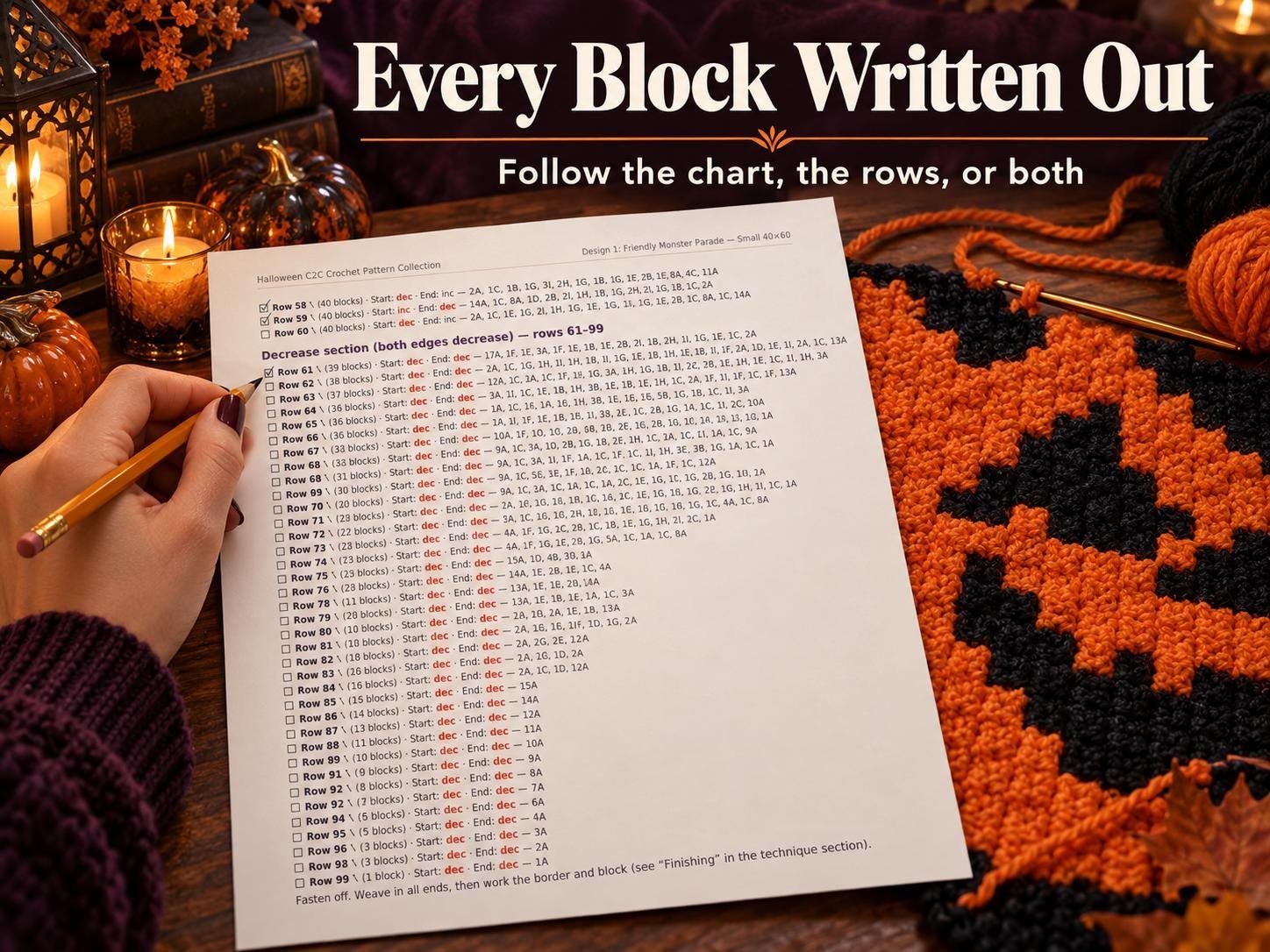
For a rectangle, increase at both edges until the diagonal reaches the chart’s shorter side, then increase along one edge while decreasing along the other until you reach the longer side, then decrease on both edges to finish in the opposite corner. The graph shows exactly where each change happens.
| Phase | Small blanket (40 × 60) | What happens at the edges |
|---|---|---|
| 1. Increase | Rows 1–40 | Add one block at the start and end of every row |
| 2. Shift | Rows 41–60 | Increase on the long side, decrease on the short side; the row length stays 40 blocks |
| 3. Decrease | Rows 61–99 | Decrease at both edges until one block remains |
To increase, chain six, then work three double crochets starting in the fourth chain from the hook to form a new block. To decrease, slip stitch across the last block’s three stitches and into its chain space, then carry on from there.
Worked example: the first five rows
Here is a worked example of the opening of a black cat design, using letters from a sample colour key (A = black, B = orange, C = cream). Treat it as a practice swatch: it shows how a diagonal on the chart turns into blocks on your hook.
| Row | Blocks | Read from chart | What you crochet |
|---|---|---|---|
| 1 | 1 | A | 1 black block |
| 2 | 2 | A, A | 2 black blocks |
| 3 | 3 | A, B, A | 1 black, 1 orange, 1 black |
| 4 | 4 | A, B, B, A | 1 black, 2 orange, 1 black |
| 5 | 5 | A, B, C, B, A | 1 black, 1 orange, 1 cream, 1 orange, 1 black |
After five rows you should have a small triangle whose colours match the bottom corner of your graph exactly, and your Halloween C2C crochet blanket is under way.
How do you change colours in C2C crochet?
Change colour on the last yarn-over of the block before the new colour starts: work the final double crochet until two loops remain, then pull the new colour through. Leave a tail of a few inches and either carry the old colour inside the next blocks or drop it and join a separate small ball. Neat colour changes are what make a Halloween C2C crochet blanket look crisp.
- Wind small ‘bobbins’ for colours used in short runs, such as pumpkin highlights or a witch’s hat.
- Carry a colour only across one or two blocks; longer carries can show through and pull the fabric.
- Weave in ends every 10 rows rather than at the end, so the final finishing is not overwhelming.
Which Halloween C2C crochet blanket design should you start with?
Start with a design that has large areas of one colour and few colour changes per row. The ghost and cat ‘Happy Halloween’ design or the black cat on the cemetery gate are friendlier first projects than the haunted castle or witch’s potion shelf, which pack many small details into each row.
| Design type | Example from the set | Best for |
|---|---|---|
| Bold silhouette | Black cat on the cemetery gate | First C2C graph; strong shapes, fewer colours |
| Cute characters | Ghost and skeleton friends | Kids’ rooms and gifts |
| Lettered scene | ‘Happy Halloween’ ghost and cat | Seasonal throws and wall hangings |
| Detailed scene | Haunted castle with jack-o’-lanterns | Experienced colour-work fans |
For more seasonal home ideas, browse our lifestyle and home collection.
Ready to start your Halloween blanket?
Halloween C2C Crochet Blanket Pattern: 12 spooky designs, each in 3 sizes, with colour graphs and written block-by-block rows, so you never have to count squares on screen. $11.99 USD on sale (regular $19.99), instant 377-page PDF.
See the full product page, sizes and FAQ
Frequently asked questions
Is C2C crochet good for beginners?
Yes, C2C suits confident beginners because it repeats one simple block made of a chain and three double crochets. The hardest parts are managing several colours and keeping track of rows, so a design with large single-colour areas and written row instructions is the easiest place to start your first picture blanket.
Can I follow written rows instead of a C2C graph?
Yes. Written block-by-block rows list each diagonal in order, for example ‘2 black, 3 orange, 1 black’, so you never count squares on the chart. The HawkInc Halloween pattern includes written rows for all 36 charts, and the graph stays useful as a picture to check your progress.
How much yarn do I need for a C2C Halloween blanket?
It depends on the size, yarn weight, hook and how many colours you use. A small throw needs far less than a large bed-sized blanket with 15,000 blocks. Use the yardage in your pattern’s colour key, and buy an extra skein of the main background colour so dye lots match.
What hook size should I use for C2C?
Use the hook recommended on your yarn label as a starting point, then make a test square of ten by ten blocks and measure it. If your square is larger than expected, go down a hook size; if smaller, go up. Consistent tension matters more than the exact hook number.
How long does a C2C blanket take to crochet?
It varies widely with your speed, yarn and the number of colour changes. Count blocks rather than hours: a 40 × 60 block blanket has 2,400 blocks, while a 100 × 150 block blanket has 15,000. If Halloween is close, choose the small size and a bold silhouette design.
Do C2C blankets need a border?
A border is optional but recommended. The stepped edges of C2C blocks look slightly jagged, and one or two rounds of single crochet or half double crochet in a dark Halloween shade straightens them, adds weight and frames the picture neatly. Work three stitches into each corner to keep it flat.
Can I sell blankets made from a C2C pattern?
That depends on each designer’s terms. For the HawkInc Halloween C2C pattern you may sell finished handmade items, with credit to the shop where possible. You may not share, copy or resell the PDF or its charts, so always check the licence in any pattern before selling.