
Looking for wabi sabi wall art ideas that feel calm rather than cluttered? You are in the right place. Wabi sabi is all about simple, imperfect beauty – and the right artwork can set that mood in any room. In this guide we look at eight ways to style gold Japandi art, the colours and frames that suit it, and the mistakes to avoid.
Quick answer: Wabi sabi wall art celebrates simplicity, imperfection and natural materials, so style it with restraint: one large piece per wall (or a matched pair), plenty of empty space, earthy colours, soft antique gold rather than shiny gold, and simple oak, walnut or black frames.
By Dr. Mueed Akhtar, PhD (Chemical Engineering), founder of HawkInc · Last updated 13 October 2026
Key takeaways
- Wabi sabi is a Japanese philosophy of imperfect beauty; Japandi is an interior style that blends Japanese minimalism with Scandinavian comfort.
- Fewer pieces is better: one large piece per wall, or a pair on a wide wall.
- Muted, antique gold suits the natural palette; avoid glossy metallics.
- Choose natural oak, walnut or simple black frames and skip ornate ones.
- It works above a low console, in a reading nook, with sage walls and a bonsai, or alone on a narrow wall.
On this page
What is wabi sabi wall art?
Wabi sabi is a Japanese worldview centred on accepting transience and imperfection. In interiors, it shows up as natural materials, muted colours, handmade objects and empty space. Wabi sabi art follows the same rules: one organic gesture, a restrained palette, and room to breathe.
Japandi wall art combines that with Scandinavian warmth and practicality – think soft neutrals, pale wood and cosy textiles. A flowing ribbon of antique gold on a warm neutral background fits both styles perfectly.
8 wabi sabi wall art ideas for your home
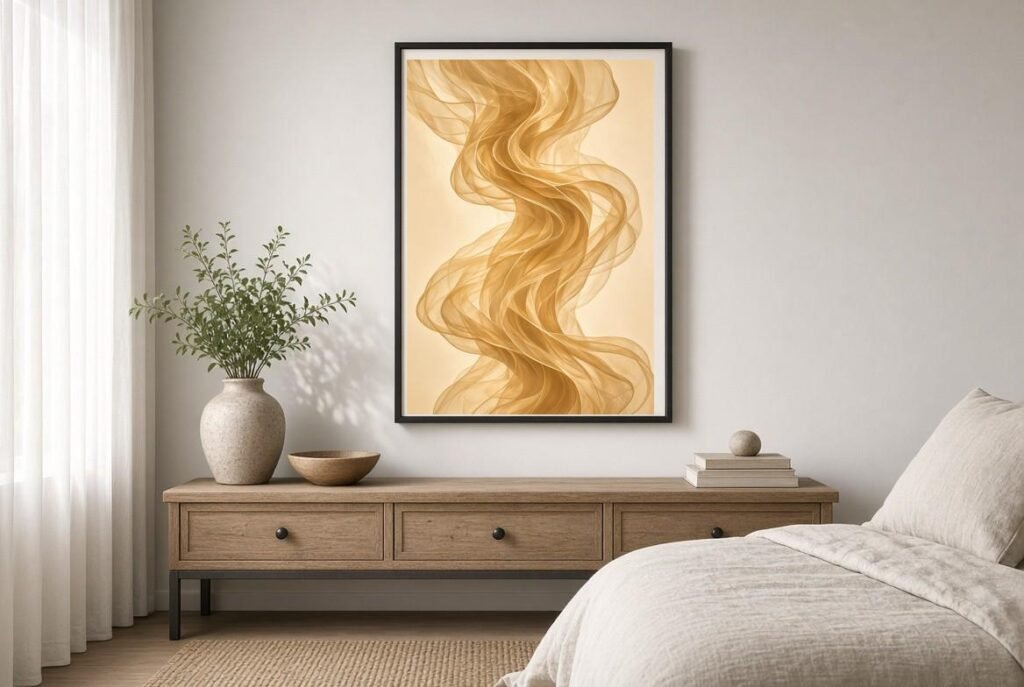
1. Above a low bedroom console
Hang a single print above a low wooden console with a ceramic vase and a small branch. Keep the rest of the wall bare. The emptiness is part of the design.
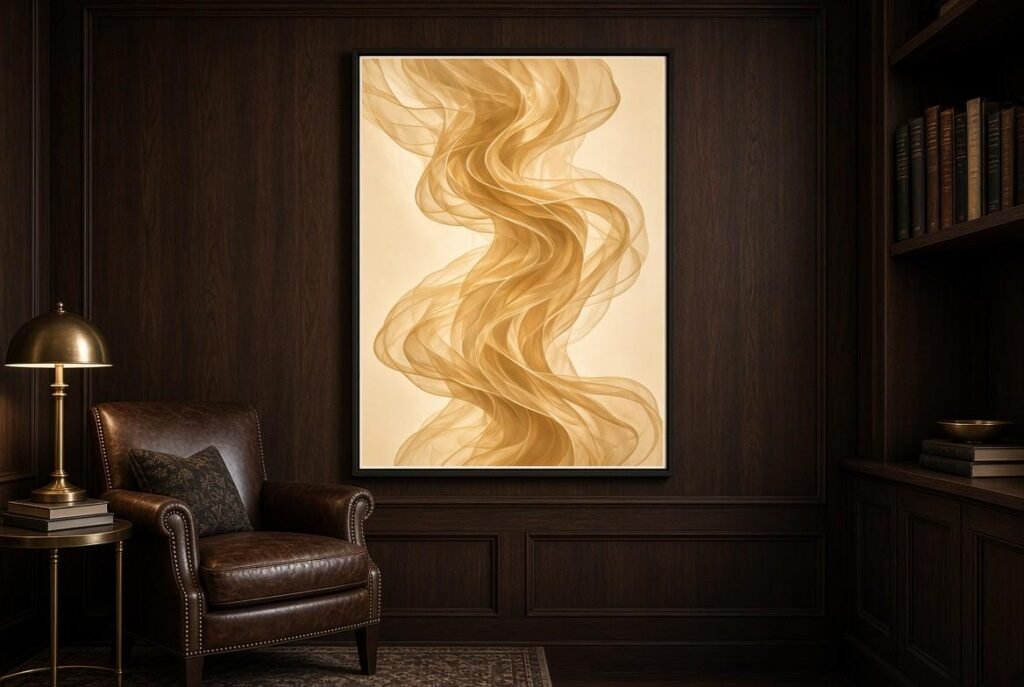
2. In a moody reading nook
Gold glows against dark wood panelling. Add a leather chair and a brass lamp, and the art becomes the warm focal point of the corner.
3. Above a grey sofa in a city apartment
In modern apartments with grey sofas and big windows, gold abstract wall art adds warmth that stops the room feeling cold.
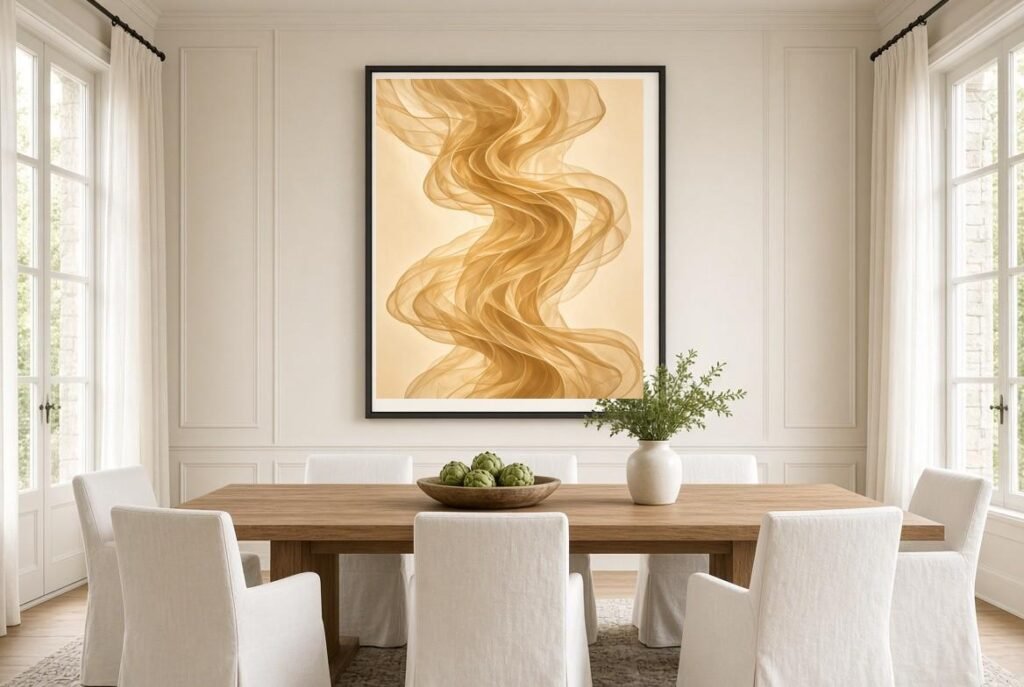
4. In a bright dining room
Place it at the head of the dining table so guests see it as they sit down. White chairs and a wooden table let the gold stand out.
5. With sage walls and a bonsai
Sage green and antique gold are a beautiful natural pair. Add a bonsai or olive tree and linen cushions for a true Japandi living room.
6. In a desert-modern room
Gold also suits warm, desert-inspired spaces with leather chairs, cacti and clay tones. The ribbon echoes the curves of the landscape.
7. As a pair on a wide wall
Two identical prints side by side with a 3-inch gap create symmetry without clutter – ideal above a king bed.
8. Alone on a narrow wall
Tall sizes like 12×36 or 16×32 inches suit narrow walls beside doors or windows. For a physical option, see our wabi sabi framed canvas.
Wabi sabi decor: colours and materials
| Element | Wabi sabi choices |
|---|---|
| Wall colours | Bone, warm white, greige, clay, sage, deep brown |
| Woods | Oak, ash, walnut, reclaimed timber |
| Textiles | Linen, cotton, wool, jute |
| Accents | Stoneware, clay, paper lanterns, dried stems |
| Metals | Aged brass, antique gold, blackened steel |
Simple rules for styling Japandi art
- Choose one strong piece per wall.
- Leave generous empty space around it.
- Use natural frames – oak, walnut or black.
- Repeat the art’s colour once elsewhere in the room.
- Prefer matte paper and finishes over gloss.
How to print and frame printable wall art
Printable art only looks as good as the print. These simple steps give you gallery-quality results at a fraction of the cost of original art.
Choose the right paper
Matte or lightly textured papers – such as heavyweight matte photo paper or cotton rag – give soft, rich colour with no glare. Glossy paper can look cheap under bright lights and shows reflections in photos.
Print at a print shop for large sizes
A home inkjet is fine for 8×10 or 11×14 inches. For anything larger, a local print shop or online print service will give you better colour accuracy and sharper detail. Upload the PDF that matches your frame size so nothing gets cropped.
Pick a frame that suits the room
- Black: crisp and modern; works almost anywhere.
- Natural oak or walnut: warm, Japandi and mid century friendly.
- White: light, coastal and Scandinavian.
- Brass or gold: elegant and slightly glamorous.
Hang it at the right height
Centre the artwork about 57–60 inches from the floor – roughly eye level. Above furniture, leave 8–10 inches between the top of the sofa, bed or console and the bottom of the frame. Art that is about two-thirds of the width of the furniture below looks balanced.
Refresh with the seasons
Because printable art is affordable, you can swap prints when the seasons change or when you redecorate. Keep your files safe and reprint whenever you need a new size.
Shop the wabi sabi gold Japandi wall art
The print shown throughout this guide is our wabi sabi gold Japandi wall art: a flowing antique gold ribbon on a soft neutral background. You get a high-resolution JPG plus print-ready files in 10 vertical sizes.
$5.99 · See full product details
For a softer green palette, read our sage green living room wall art guide, or browse all wall hangings.
Frequently asked questions
What is wabi sabi wall art?
Wabi sabi wall art celebrates simplicity, imperfection and natural materials. It usually features organic shapes, earthy colours, textured surfaces and plenty of empty space.
What is the difference between wabi sabi and Japandi?
Wabi sabi is a Japanese philosophy of imperfect beauty. Japandi is an interior style that blends Japanese minimalism with Scandinavian comfort. Japandi rooms often use wabi sabi art.
Does gold fit a wabi sabi interior?
Yes, when it is soft and antique rather than shiny. Warm, muted gold feels like aged brass or autumn leaves and suits the natural wabi sabi palette.
How many pieces of art should a Japandi room have?
Usually fewer than you think. One large piece per wall, or a pair, keeps the calm, uncluttered feeling that defines the style.
What frames suit wabi sabi art?
Natural oak, walnut or simple black frames. Avoid ornate or glossy frames.