
Quick answer: To organise a tutoring business, keep one roster of students, a weekly timetable, a lesson plan and session log for every lesson, and numbered invoices with a payment tracker. Spend 30 to 45 minutes each week updating them, write a progress report every term, and file income and expense records for tax.
By Dr. Mueed Akhtar, PhD (Chemical Engineering), founder of HawkInc
Key takeaways
- Use one system with five core records: roster, timetable, lesson plans, session log and invoices.
- Log every session the same day; it feeds your invoices, progress reports and tax records.
- Invoice on a fixed schedule (monthly or every four sessions) and track each payment.
- Write a short progress report every term using the same skill ratings each time.
- Self-employed tutors must keep income and expense records; HMRC asks for at least five years.
What does a tutoring business need to keep organised?
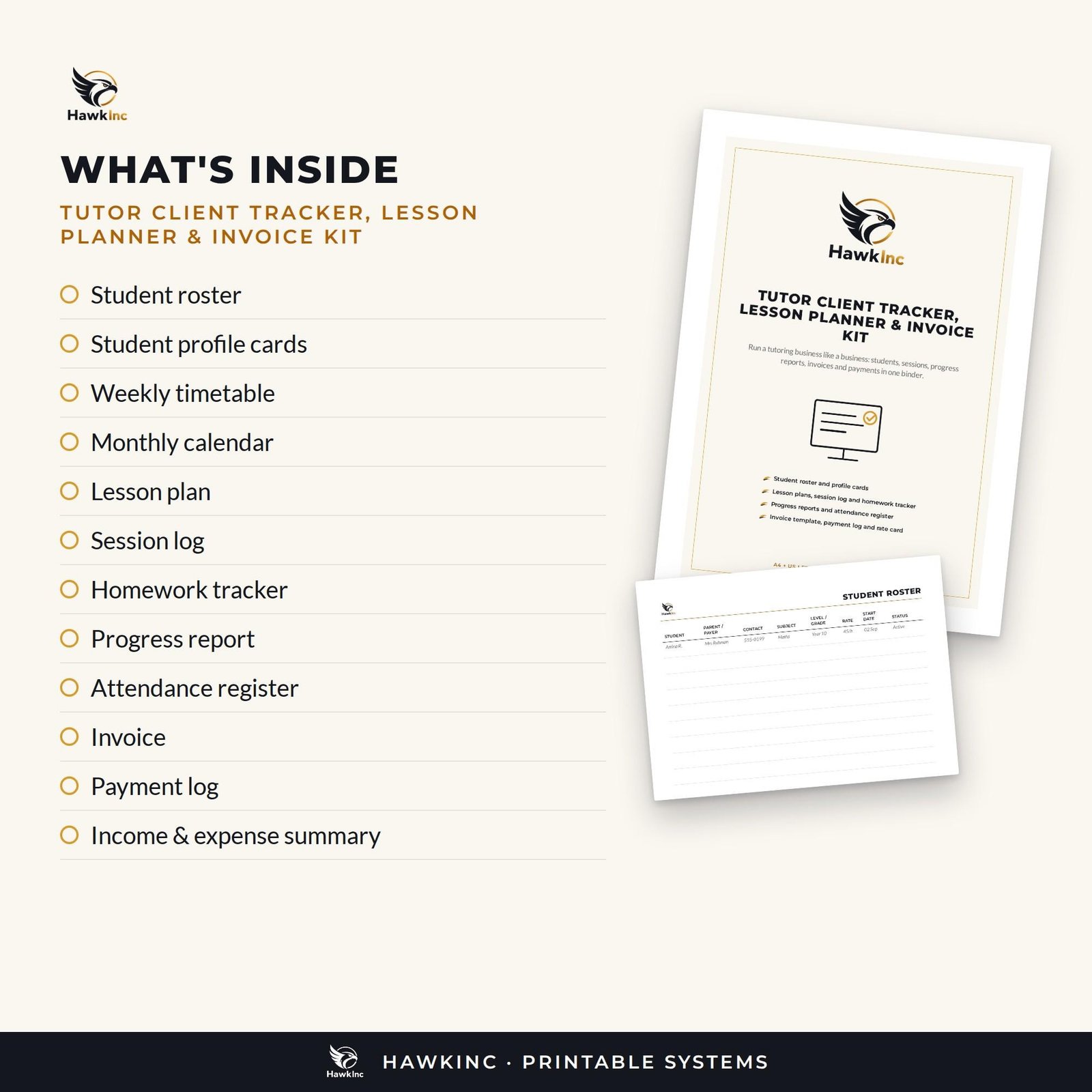
A tutoring business needs five core records: who you teach (roster and profile cards), when you teach (timetable and calendar), what you teach (lesson plans and session log), how students are doing (homework tracker and progress reports), and what you are owed (invoices and payments). Everything else builds on these five.
The table below is a checklist you can use whatever tools you prefer.
| Record | What it holds | When to update |
|---|---|---|
| Student roster | Name, parent contact, subject, level, rate, start date | When a student joins or leaves |
| Profile card | Goals, strengths, gaps, exam dates, notes from parents | After the first lesson, then each term |
| Timetable and calendar | Regular weekly slots, one-off sessions, holidays | Weekly |
| Lesson plan | Objective, activities, resources, homework | Before each lesson |
| Session log | Date, length, topics covered, attendance | Same day as the lesson |
| Homework tracker | Task set, due date, completed or not | Each lesson |
| Progress report | Skill ratings and comments | Every 6 to 8 sessions or termly |
| Invoices and payments | Invoice number, sessions billed, amount, date paid | Monthly or every 4 sessions |
How do tutors keep track of students?
Tutors keep track of students with a roster that lists every student on one page, plus a profile card for each one. The roster is your quick reference for contacts and rates; the profile card holds goals, exam dates and notes, so you can prepare in minutes rather than scrolling through old messages.
An attendance register completes the picture. Marking each session as attended, cancelled with notice, or late-cancelled gives you an honest record of how many lessons each student has had, which you need for both invoices and progress reports.
How should a tutor plan lessons and log sessions?
Plan each lesson around one clear objective linked to what the student is doing at school, then log what actually happened straight after. The Education Endowment Foundation notes that tuition is more likely to have an impact when it is explicitly linked with normal lessons, so a short plan tied to schoolwork pays off.
A simple routine for each lesson:
- Check the session log and homework tracker from last time.
- Write one objective (for example, “solve two-step linear equations”).
- Choose a warm-up, a main activity and a short check for understanding.
- Set homework and add it to the homework tracker.
- Straight after the lesson, log the date, length, topics covered and attendance.
The EEF Teaching and Learning Toolkit rates one to one tuition as having a moderate impact, about five months of additional progress on average, which is a useful reminder that the planning behind each session matters.
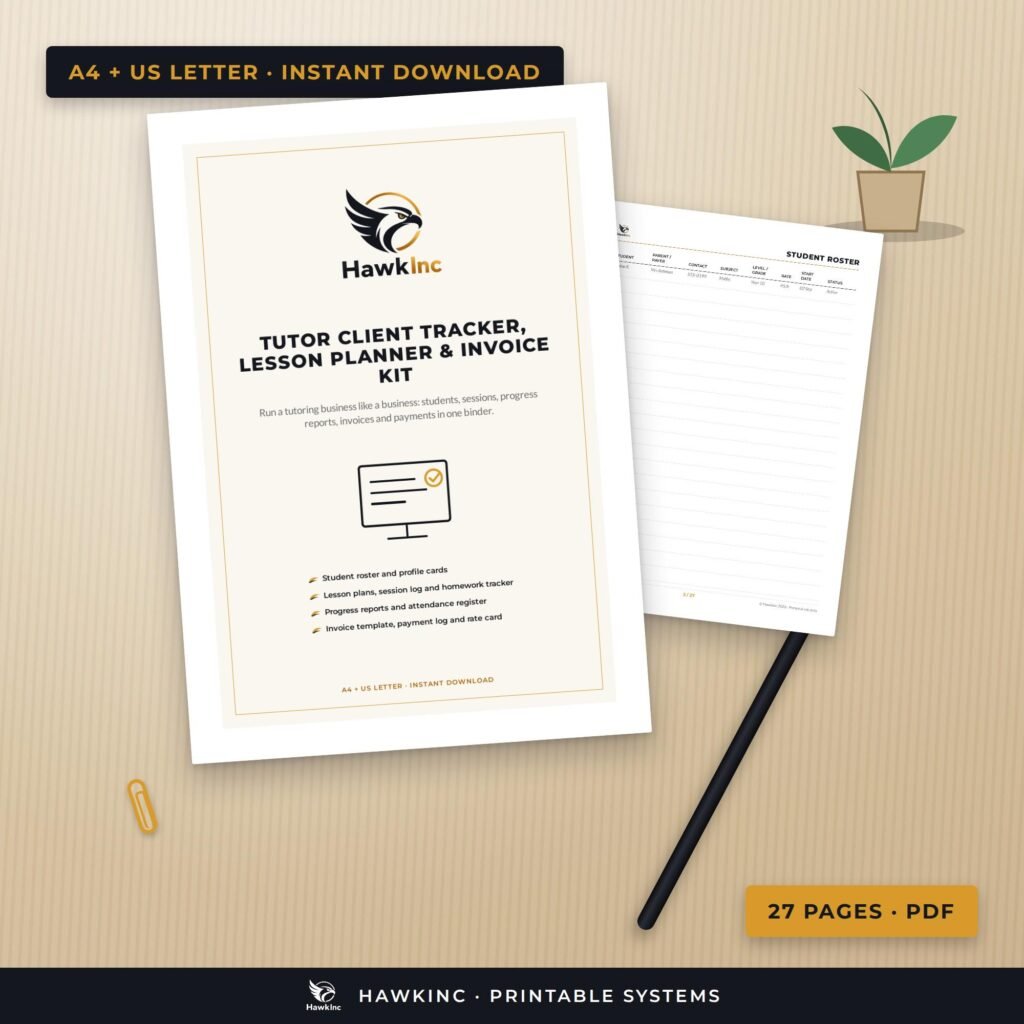
Tutor Business Planner – one 27-page printable for students, lessons, attendance, progress reports and invoices. USD 1.79 on Etsy (reg. USD 2.99), A4 + US Letter.
See what is inside the planner
How do tutors invoice and track payments?
Tutors invoice most smoothly by billing each family on a fixed schedule, monthly or every four sessions, using numbered invoices that list session dates, lengths, rate, total, payment method and due date. A payment tracker then shows who has paid, who is due and who needs a reminder.
Worked example: one month for one student
Here is an illustrative month for a student booked for weekly 60-minute maths lessons at USD 40 per hour, with a policy of 24 hours’ notice for cancellations.
| Date | Session | Attendance | Charge (USD) |
|---|---|---|---|
| 3 Nov | 60 min | Attended | 40 |
| 10 Nov | 60 min | Cancelled with 2 days’ notice | 0 |
| 17 Nov | 60 min | Attended | 40 |
| 24 Nov | 90 min (exam prep) | Attended | 60 |
| Total | 140 |
Invoice 2026-011 for USD 140, due 7 December, is entered in the payment tracker as “sent”. When the parent pays, you mark the date and method. Because every line comes straight from the session log and attendance register, there is nothing to reconstruct from memory.
What business records should a tutor keep for tax?
A self-employed tutor should keep records of all income, such as invoices and payments received, and all business expenses, such as books, printing, software and travel, with receipts. In the UK, HMRC requires sole traders to keep records for at least five years after the 31 January Self Assessment deadline for that tax year.
GOV.UK explains what to keep in its guide to business records if you’re self-employed. In the US, the IRS recordkeeping page covers which records support your income and deductions. Rules differ by country, so check with a tax adviser if you are unsure. For a quick estimate of UK tax on tutoring income, try our free UK side hustle tax calculator.
A sample weekly admin routine for tutors
Admin is easier when it has a fixed slot. This 40-minute routine keeps every record current without eating into teaching time.
| When | Task | Time |
|---|---|---|
| Every lesson | Log session and set homework | 3 min |
| Sunday | Review next week’s timetable and confirm slots | 10 min |
| Sunday | Write plans for the week’s lessons | 20 min |
| Last Sunday of the month | Send invoices and update the payment tracker | 10 min |
| End of term | Write progress reports and start a new attendance register | 30 min per 5 students |
A look inside the Tutor Business Planner
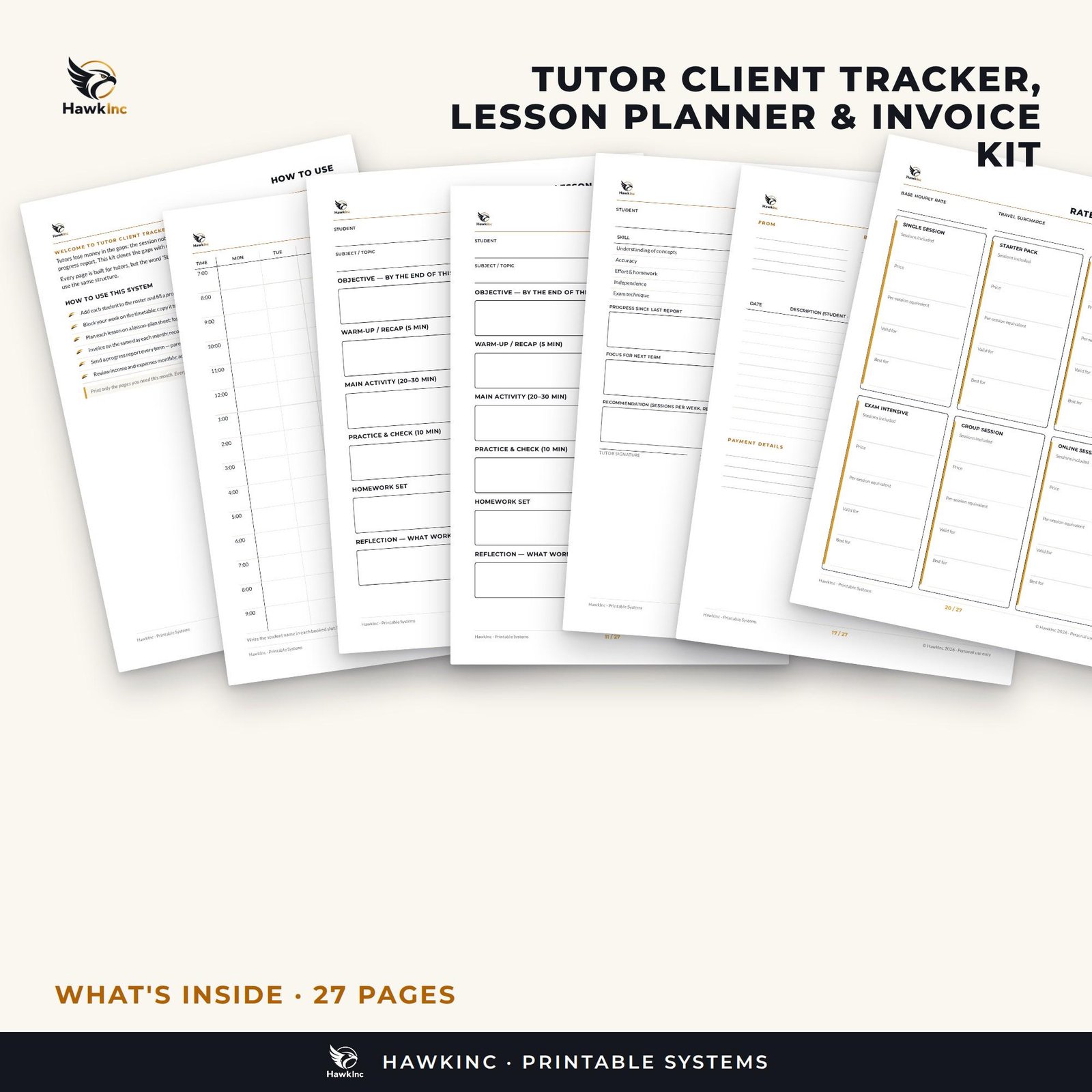
The Tutor Business Planner puts all of these records into one printable PDF. It has 27 pages in A4 and US Letter: a student roster and profile cards, weekly timetable and monthly calendars, four lesson plan layouts, a session log, a homework tracker, two progress report designs with five skill ratings, a 16-session attendance register, and invoice and payment pages.
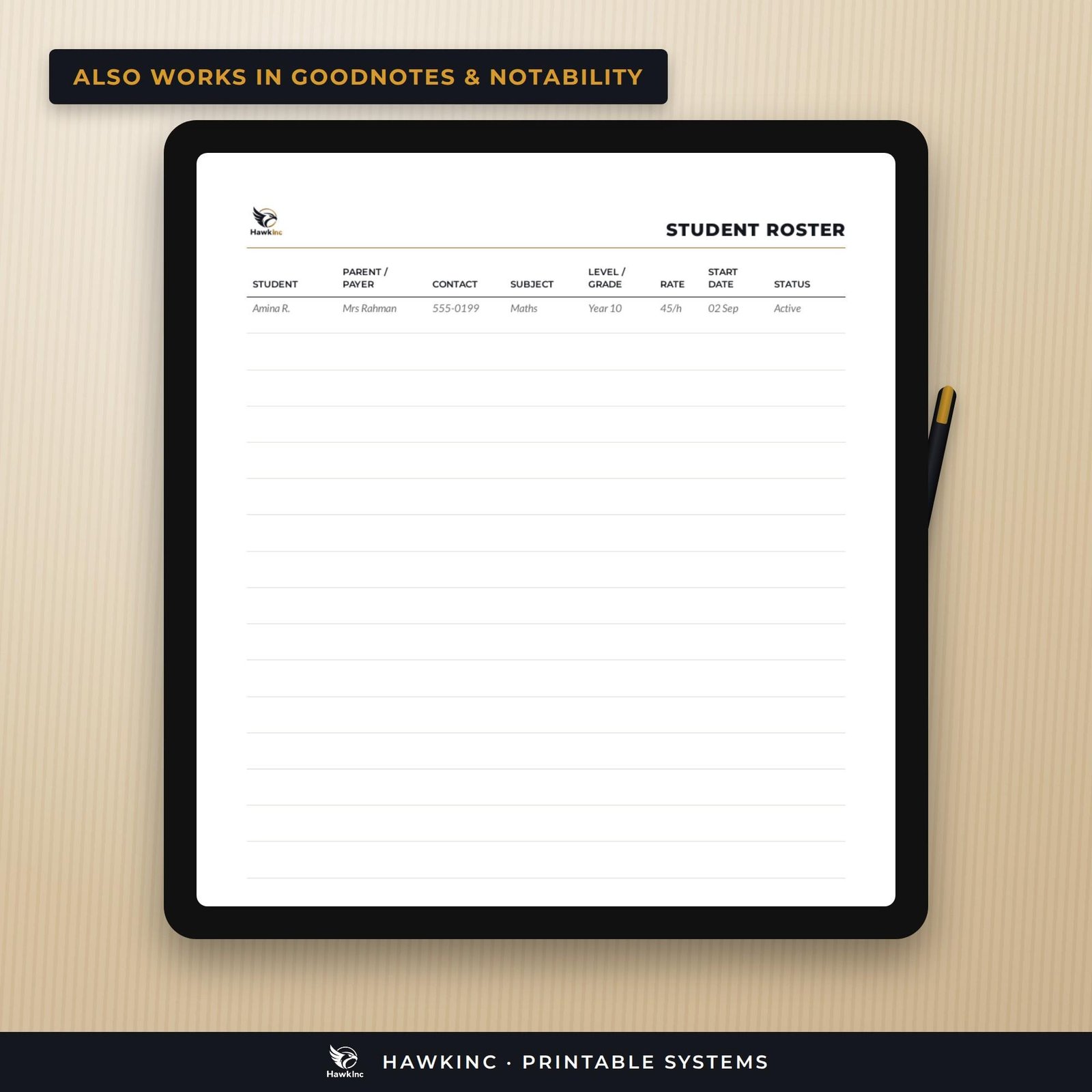
You can print it for a ring binder or open it in GoodNotes or Notability and write on a tablet. If you also want a digital overview of your week, the Notion-style daily planner dashboard pairs well with it, and our guide to building a habit tracker in Google Sheets shows how to track a weekly admin habit.
Frequently asked questions
What is the best way to organise a tutoring business?
Keep five things in one system: a student roster, a weekly timetable, lesson plans, a session log, and invoices with a payment tracker. Whether you use paper, a tablet or a spreadsheet matters less than having one place for each record and a short weekly routine to keep it current.
How do tutors keep track of their students?
Most tutors keep a roster with each student’s contact details, subject, level and goals, then add a profile card with notes on strengths and gaps. A session log records what was covered every lesson, and an attendance register shows missed or cancelled sessions so billing and progress reports stay accurate.
How should a private tutor invoice parents?
Send one invoice per family on a fixed schedule, usually monthly or every four sessions. List each session date, length and rate, the total, how to pay and the due date. Number your invoices in order and record every payment as it arrives so you can follow up on late ones politely.
What records does a self-employed tutor need to keep?
Keep records of all income (invoices and payments received) and allowable expenses such as resources, travel and software, with receipts. In the UK, HMRC says sole traders must keep records for at least five years after the 31 January Self Assessment deadline. In the US, see the IRS recordkeeping guidance.
How often should tutors write progress reports?
A common rhythm is a short written update every six to eight sessions or once a term, with a quick verbal summary at the end of most lessons. Rating a few key skills the same way each time makes it easy for parents to see change, and it gives you a clear record if goals need to be adjusted.
Should a tutor have a cancellation policy?
Yes. A written policy that says how much notice is needed and whether late cancellations are charged prevents awkward conversations. Share it before the first lesson, keep a copy with each family’s profile card, and mark cancellations in your attendance register so your invoices match what was agreed.
Get the planner
Tutor Business Planner – one 27-page printable for students, lessons, attendance, progress reports and invoices. USD 1.79 on Etsy (reg. USD 2.99), A4 + US Letter.
See what is inside the planner
More planners and templates for small businesses are in the Business hub.