

By Dr. Mueed Akhtar, PhD (Chemical Engineering), founder of HawkInc
Quick answer: A military calisthenics workout for beginners uses simple bodyweight moves, such as push-ups, squats, lunges, planks and burpees, done as timed circuits two or three days a week. Start with the easiest version of each move, keep rest periods fixed, log your reps and add a little more each week. No equipment is needed.
Key takeaways
- Military calisthenics is structured bodyweight training: a fixed warm-up, circuits with set reps and rest, and a cool-down.
- Beginners should train two or three non-consecutive days a week and start with incline push-ups, sit-to-stand squats and short planks.
- Progress by adding reps, slowing the movement or moving to a harder variation, never by sacrificing form.
- A simple log of sets and reps is the easiest way to know when you are ready to progress.
- Check with your doctor first if you have a health condition or have not exercised in a long time.
What is military calisthenics?
Military calisthenics is bodyweight strength and conditioning training organised the way armed forces run group fitness: a set warm-up, drills or circuits with clear rep targets and rest periods, then a cool-down. It needs no equipment, so it can be done anywhere, and it trains strength, endurance and coordination together.
The US Army, for example, structures its Physical Readiness Training around drills that start with a preparation drill and finish with a recovery drill. You do not need to copy any official programme to benefit. The useful lessons for home training are the structure, the consistency and the habit of measuring progress.
Can beginners do military calisthenics?
Yes. Every classic military exercise has an easier version, so beginners can follow the same routine as fitter people by choosing a lower level. The key is to start lower than you think you need to, keep your form clean on every rep, and move up one step at a time once the current level feels steady for all sets.
Here are the core movements, with an easier option for day one and a harder option for later:
| Exercise | Start here (beginner) | Progress to | Main muscles |
|---|---|---|---|
| Push-up | Wall or kitchen-counter push-up | Floor push-up, then decline push-up | Chest, shoulders, triceps |
| Squat | Sit-to-stand from a chair | Bodyweight squat, then jump squat | Thighs, hips |
| Lunge | Supported split squat holding a wall | Alternating reverse lunge | Thighs, hips, balance |
| Plank | Plank on knees, 15 to 20 seconds | Full plank, 45 to 60 seconds | Core, shoulders |
| Burpee | Step-back burpee without the jump | Full burpee with jump | Whole body, conditioning |
| Mountain climber | Slow step-ins on a counter edge | Fast floor mountain climbers | Core, conditioning |
| Glute bridge | Two-leg bridge | Single-leg bridge | Glutes, hamstrings |
How do you start a no-equipment military workout? (step by step)
Start with a short warm-up, then work through one circuit of five to six exercises for a set time or number of reps, rest for a fixed period, and repeat the circuit two or three times. Finish with gentle stretching. Write down what you did so the next session can be slightly harder.
- Warm up for 5 to 8 minutes: march on the spot, arm circles, hip circles, 10 slow bodyweight squats and 10 wall push-ups.
- Pick your level for each exercise from the table above. If you are unsure, choose the easier one.
- Do one circuit: push-ups, squats, reverse lunges, plank, glute bridges and step-back burpees, 30 seconds of work each with 30 seconds rest.
- Rest 2 minutes, then repeat the circuit. Beginners do 2 rounds; add a third round after two or three weeks.
- Cool down for 5 minutes: slow walking and gentle stretches for the chest, thighs and hips.
- Log the session: reps for each exercise, how hard it felt from 1 to 10, and any aches.
The HawkInc Military Calisthenics Workout Plan

An 8-week, three-day-a-week bodyweight programme with an illustrated 28-page PDF and a six-tab Excel tracker, for when you are ready for the next step. USD 3.59 on Etsy (regular USD 5.99).
How many days a week should a beginner do calisthenics?
Two or three non-consecutive days a week is enough for a beginner. The CDC adult activity guidelines recommend muscle-strengthening activity that works all major muscle groups on at least two days a week, plus 150 minutes of moderate aerobic activity such as brisk walking. Leave a rest day between full-body sessions.
Sample 4-week beginner schedule
This is an example schedule I would suggest to a friend starting from little or no training. Adjust the days to your own week.
| Week | Mon | Wed | Fri | Other days | Work / rest per exercise |
|---|---|---|---|---|---|
| 1 | Circuit, 2 rounds | Circuit, 2 rounds | Brisk walk 20 min | Walk or rest | 20 s / 40 s |
| 2 | Circuit, 2 rounds | Circuit, 2 rounds | Circuit, 2 rounds | Walk or rest | 30 s / 30 s |
| 3 | Circuit, 3 rounds | Circuit, 2 rounds | Circuit, 3 rounds | Walk or rest | 30 s / 30 s |
| 4 (lighter) | Circuit, 2 rounds | Brisk walk 30 min | Circuit, 2 rounds + rep test | Walk or rest | 30 s / 30 s |
Week 4 is deliberately lighter. Planned easier weeks give your joints and muscles time to catch up, and the rep test at the end of the week shows you how far you have come.
Can you build muscle with only bodyweight exercises?
Yes. Your muscles respond to hard, consistent work, not to whether the load is a barbell or your own body. The trick with bodyweight training is to keep making it harder: add reps, slow the lowering phase to three seconds, cut rest periods, or move to a harder variation. Enough protein and good sleep support the process.
If you are not sure how much protein you eat now, our free protein intake calculator gives a quick estimate based on your weight and activity level.
How do you track calisthenics progress?
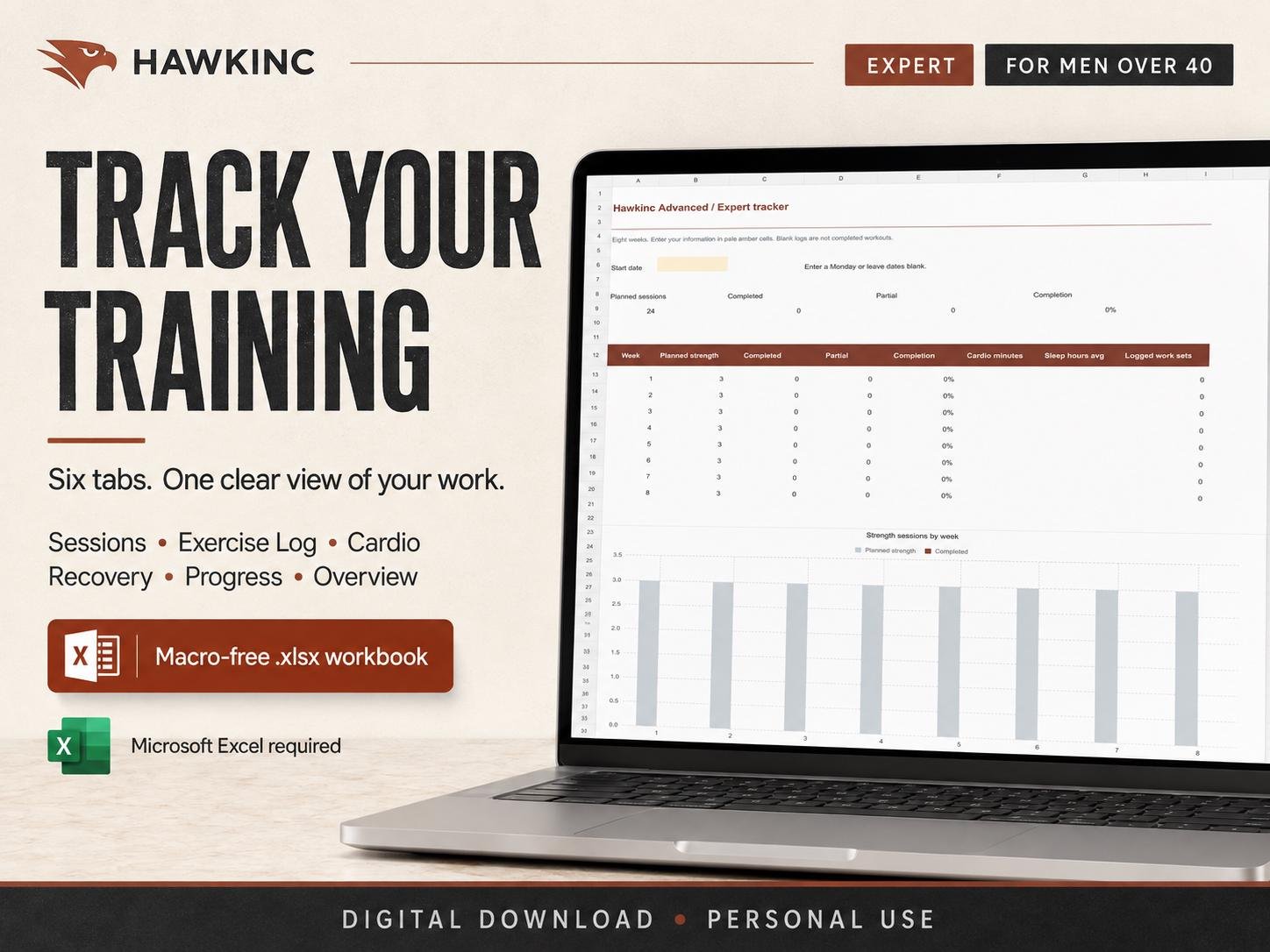
Write down the exercise, level, sets, reps and how hard it felt after every session. When you can complete all sets at the top of your rep target with good form for two sessions in a row, move up a level. A simple log turns vague effort into clear, visible progress.
Worked example
| Session | Exercise and level | Reps (round 1 / 2) | Effort 1 to 10 | Next step |
|---|---|---|---|---|
| Week 1, Mon | Incline push-up (counter) | 10 / 8 | 6 | Same level |
| Week 2, Wed | Incline push-up (counter) | 14 / 13 | 6 | Same level |
| Week 3, Fri | Incline push-up (counter) | 15 / 15 | 5 | Move to lower incline (sturdy chair) |
| Week 4, Fri | Incline push-up (chair) | 11 / 10 | 7 | Same level |
Notice that reps dropped when the level went up. That is normal and is a sign you progressed at the right time.
How long until you see results from calisthenics?
Most beginners feel a difference within two to four weeks: sessions feel smoother and rep counts go up, mainly because coordination improves. Visible changes in muscle tone usually take eight weeks or more of steady training, and depend on your food, sleep, age and consistency. Focus on your log rather than the mirror at first.
If you are over 40, recovery can take a little longer, so a lighter week every three or four weeks is worth keeping. The National Institute on Aging has practical guidance on staying active safely as you get older, and our guide to calisthenics for men over 40 covers the age-specific details.
Safety checklist before you start
| Check | Why it matters |
|---|---|
| Doctor cleared you if you have a health condition or have been inactive | Some heart, blood pressure and joint conditions need a tailored plan |
| Warm up every time | Raises body temperature and prepares joints for load |
| Clear floor space and non-slip surface | Prevents slips during lunges and burpees |
| Stop if you feel sharp pain, dizziness or chest discomfort | These are warning signs, not something to push through |
| Progress one variable at a time | Makes it clear what is working and lowers injury risk |
The HawkInc Military Calisthenics Workout Plan
Ready for structured progress? The HawkInc plan gives you 8 weeks of scheduled sessions, illustrated form cues and printable logs. USD 3.59 on Etsy (regular USD 5.99).
Frequently asked questions
Is military calisthenics good for beginners?
Yes, if you start with the easiest version of each movement. Wall or incline push-ups, sit-to-stand squats and short planks give you the same movement patterns soldiers train with, at a load you can control. Add reps or harder variations only when every set feels steady and your form stays clean.
How many days a week should a beginner do calisthenics?
Two or three non-consecutive days a week is a sensible start. The CDC recommends muscle-strengthening activity on at least two days a week for adults, alongside regular aerobic activity such as brisk walking. Rest days let your muscles recover, so avoid training the same full-body routine two days in a row.
Can you build muscle with only bodyweight exercises?
Yes. Muscles respond to challenging work, not to the type of equipment. You keep bodyweight training challenging by adding reps, slowing the lowering phase, shortening rest or moving to a harder variation, such as going from incline to floor push-ups. Eating enough protein and sleeping well also matter.
How long does a military calisthenics workout take?
A beginner session takes about 25 to 35 minutes: 5 to 8 minutes of warm-up, 15 to 20 minutes of circuits and a few minutes of cool-down stretching. More advanced programmes run longer. Consistency matters more than length, so a shorter session you finish every time beats a long one you skip.
How soon will I see results?
Most beginners notice that sessions feel easier and that they can do more reps within two to four weeks, largely because their coordination improves. Visible changes in muscle and body shape usually take longer, often eight weeks or more, and depend on diet, sleep, age and how consistently you train.
Is military calisthenics safe if I am over 40?
For most healthy adults it is, provided you warm up, start with easier variations and progress gradually. If you have a heart condition, high blood pressure, joint pain or a recent injury, or have not exercised in years, talk to your doctor first and stop any exercise that causes sharp pain, dizziness or chest discomfort.
What is the difference between military calisthenics and regular calisthenics?
The exercises overlap almost completely. Military-style calisthenics puts more weight on simple movements done in structured drills or circuits, set rep targets, fixed rest periods and regular testing, much like a unit fitness session. Regular calisthenics often focuses more on skills such as handstands or muscle-ups.
More from HawkInc
- Military Calisthenics Workout Plan: No-Equipment 8-Week Programme
- Military Calisthenics for Men Over 40: 3-Level Collection
- Health and Wellness hub
- Heart rate zone calculator
- Calisthenics for Men Over 40
This guide is for general information and is not medical advice; talk to your doctor before starting a new exercise or health routine.