

Quick answer: A bodyweight workout for men over 40 builds real strength when you progress one step at a time: start with easier versions such as incline push-ups, box squats and glute bridges, add reps until you reach a target range, then move to a harder variation. Train two to three non-consecutive days a week and take a lighter week every fourth week.
Key takeaways
- Progress by changing leverage, range, tempo or by moving to one limb, not by jumping straight to the hardest move.
- Two strength days a week is enough to start; three suits most intermediate and advanced trainees.
- Move up a rung only after you hit the top of the rep range with clean form in two sessions in a row.
- Plan a lighter week every fourth week so joints and tendons can catch up with your muscles.
- Log every session so your progress is a record, not a guess.
Can men over 40 build muscle with bodyweight exercises?
Yes. Muscles respond to effort and a steadily increasing challenge, not to whether the load is a barbell or your own body. Bodyweight work builds muscle when you pick variations that bring you close to fatigue in roughly 6 to 15 reps, and keep making them harder as you adapt. That is what a progression does.
The CDC physical activity guidelines for adults recommend muscle-strengthening activities that work all major muscle groups on at least two days a week, alongside 150 minutes of moderate aerobic activity. The NHS guide to strength exercises lists bodyweight moves such as squats, lunges and push-ups as valid ways to meet that target. After 40, the main differences are practical: recovery can take longer, old injuries speak up, and warming up matters more. A gradual ladder of exercises handles all three.

How do bodyweight progressions work?
A progression is a ladder of variations of the same movement pattern, ordered from easiest to hardest. You make an exercise harder by changing leverage (hands higher or lower), range of motion, tempo, adding a pause, or shifting to one arm or one leg. Each rung should feel only a little harder than the one before it.
Here is a simple ladder for the five patterns that cover the whole body:
| Pattern | Beginner | Intermediate | Advanced |
|---|---|---|---|
| Push | Wall push-up; incline push-up on a bench or counter | Floor push-up; 3-second lowering push-up | Feet-elevated push-up; archer push-up |
| Squat | Box squat to a chair | Bodyweight squat with a pause; reverse lunge | Rear-foot-elevated split squat; assisted shrimp squat |
| Hinge | Glute bridge | Single-leg glute bridge | Single-leg hip thrust (shoulders on a bench); single-leg Romanian deadlift |
| Pull | Prone Y-T-W raises on the floor | Bent-knee inverted row (sturdy bar or rings) | Straight-leg or feet-elevated inverted row |
| Core | Dead bug | Forearm plank and side plank | Long-lever plank; hollow body hold |
How to move up a rung
- Pick the variation where you can do at least 8 clean reps but not more than 12.
- Work in a fixed range, for example 3 sets of 8 to 12 reps, with 60 to 90 seconds of rest.
- Add a rep or two when your form holds and you finish with one or two reps in reserve.
- When you hit 3 sets of 12 in two sessions in a row, move to the next variation and drop back to 8 reps.
- If a joint complains with sharp pain (not muscle effort), go back a rung and slow the lowering phase to three seconds.
How many days a week should a man over 40 do bodyweight training?
Two to three non-consecutive days of strength work a week suits most men over 40. Beginners do well on two full-body sessions of 25 to 40 minutes. Intermediate and advanced trainees usually progress best on three sessions, with walking, mobility or easy cardio on the days between to help recovery.
A sample week that fits around work:
| Day | Beginner (2 days) | Intermediate / Advanced (3 days) |
|---|---|---|
| Mon | Strength session A (25–40 min) | Strength session A (35–65 min) |
| Tue | Brisk walk 30 min | Brisk walk or easy cycle 30 min |
| Wed | Mobility 10–15 min | Strength session B |
| Thu | Strength session B | Mobility 10–15 min |
| Fri | Rest or walk | Strength session A |
| Sat | Longer walk or bike ride | Longer walk, hike or bike ride |
| Sun | Rest | Rest |
Not sure how hard your cardio days should be? Our free heart rate zone calculator helps you keep easy days easy.
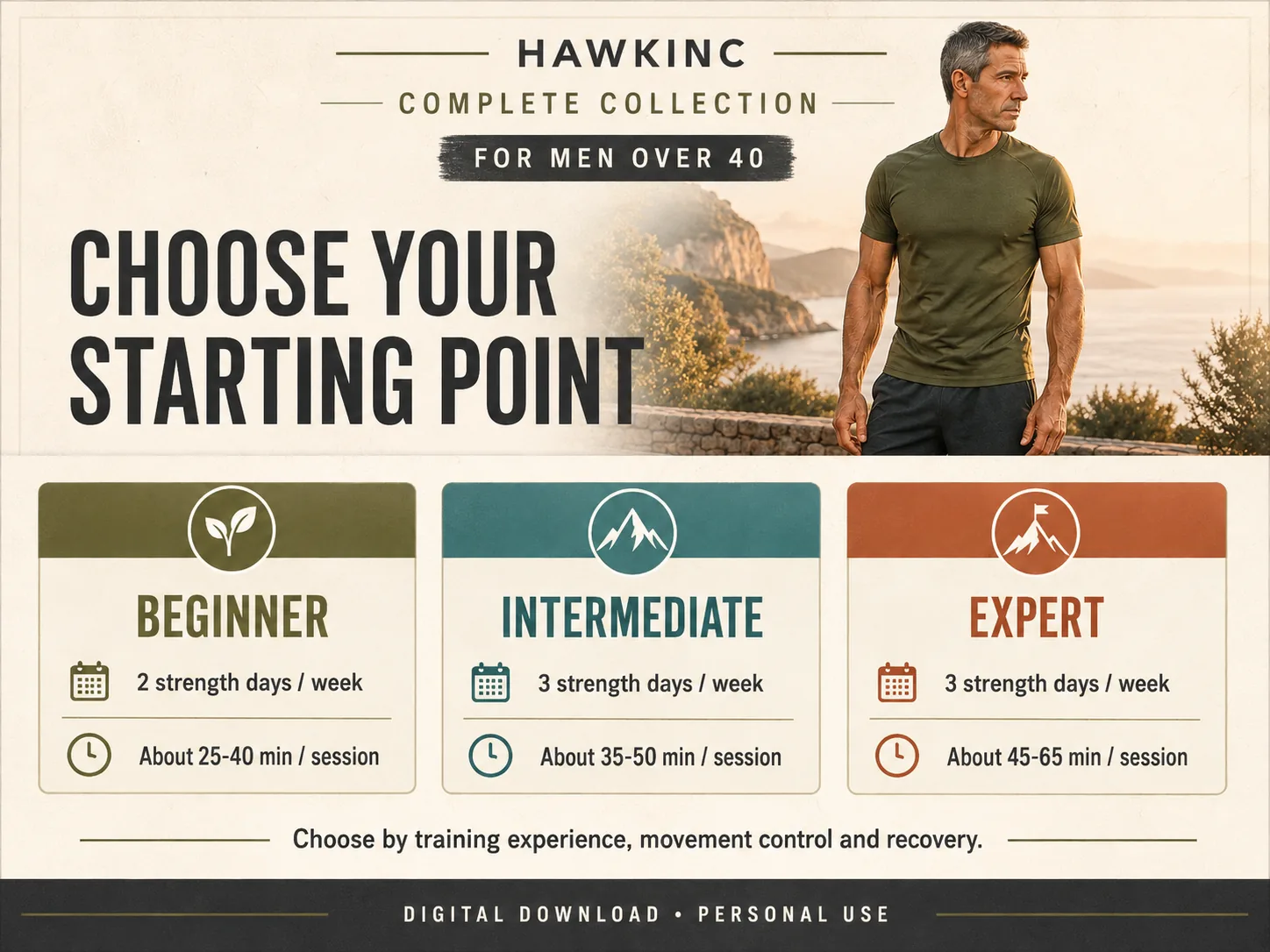
Military Calisthenics for Men Over 40 (Beginner to Advanced): three 8-week bodyweight programs, Excel trackers and printable logs, so you always know which rung comes next. $3.59 on Etsy (sale at the time of writing; regular $5.99). Instant digital download.
See the full product page and what is inside →
Worked example: an 8-week bodyweight workout for men over 40
Here is how the rules above play out for a hypothetical 47-year-old who has not trained for years. At his first session he can do 6 floor push-ups with a sagging lower back, 15 easy squats, and holds a plank for 20 seconds.
| Weeks | Focus | Example push progression | Example squat progression |
|---|---|---|---|
| 1–3 | Learn the moves, 2 sessions, 2 sets each | Incline push-up on kitchen counter, 2 × 10 | Box squat to chair, 2 × 12 |
| 4 | Lighter week: one set less, same rungs | Counter push-up, 1 × 10 | Box squat, 1 × 12 |
| 5–7 | 3 sets, add reps, climb a rung when ready | Lower bench, 3 × 8 → 3 × 12 | Free squat with pause, 3 × 8 → 3 × 12 |
| 8 | Lighter week, then retest | Retest floor push-ups | Retest reverse lunges |
By week 8, he is not chasing a number from the internet. He has a log showing that he moved two rungs on push-ups and one on squats with no joint flare-ups, and he knows exactly which variation to start with in the next block.
How long does it take to see results from calisthenics after 40?
Most people notice they can do more reps or a harder variation within the first few weeks, largely because coordination improves. Visible changes in muscle usually take longer, think months rather than weeks, and depend on consistent training, sleep and enough protein. Track reps and variations, not just the mirror.
For the protein side, our free protein intake calculator gives a personal starting estimate.
What should men over 40 watch out for when starting?
The main risks are doing too much too soon and ignoring warning signs. Warm up for five to ten minutes, start one rung easier than you think you need, and stop any exercise that causes sharp, joint-line or lingering pain. If you have chest pain, dizziness, a heart condition or high blood pressure, see your doctor first.
The National Institute on Aging recommends combining strength, endurance, balance and flexibility work, and building up gradually. That fits the ladder approach: small, regular steps, with lighter weeks built in.
| Before each session | Yes / No |
|---|---|
| 5–10 minute warm-up done (march, arm circles, easy squats) | |
| Slept reasonably well; no new aches since last session | |
| Starting rung chosen from last session’s log | |
| Water nearby, space clear of furniture | |
| Plan to stop any move that causes sharp pain |
Is military-style calisthenics good for men over 40?
It can be, if you take the structure and leave the shouting. Military-style training is built on simple bodyweight drills done with good form, progressed in planned stages and done consistently. The US Army’s Physical Readiness Training moved toward exactly this kind of controlled, progressive approach to reduce injuries.
If you want a ready-made version, the HawkInc Military Calisthenics for Men Over 40 collection gives you three 8-week levels with illustrated exercises, form cues and easier and harder options for each move. You can read more about the approach in our earlier guide to calisthenics for men over 40.
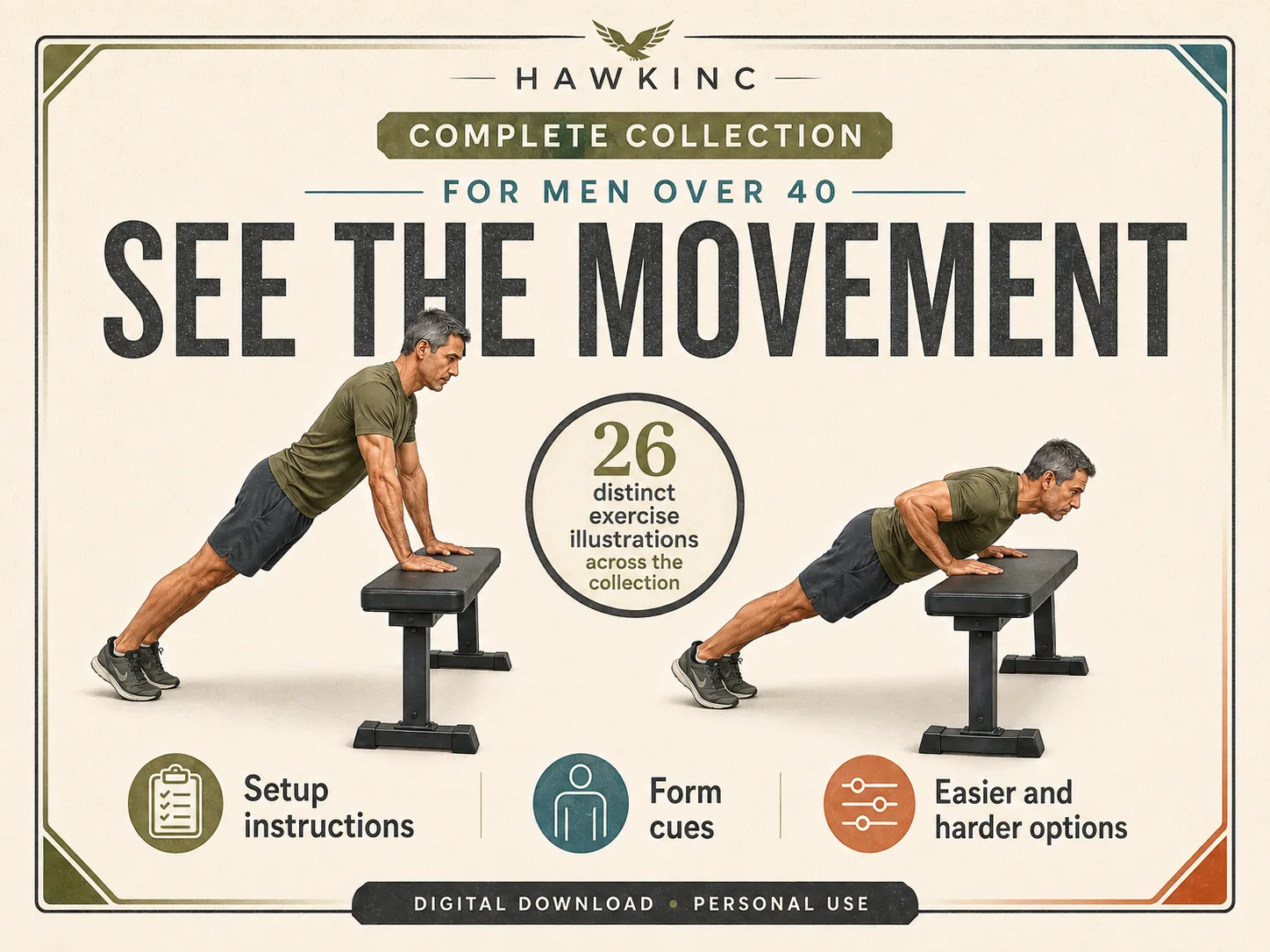
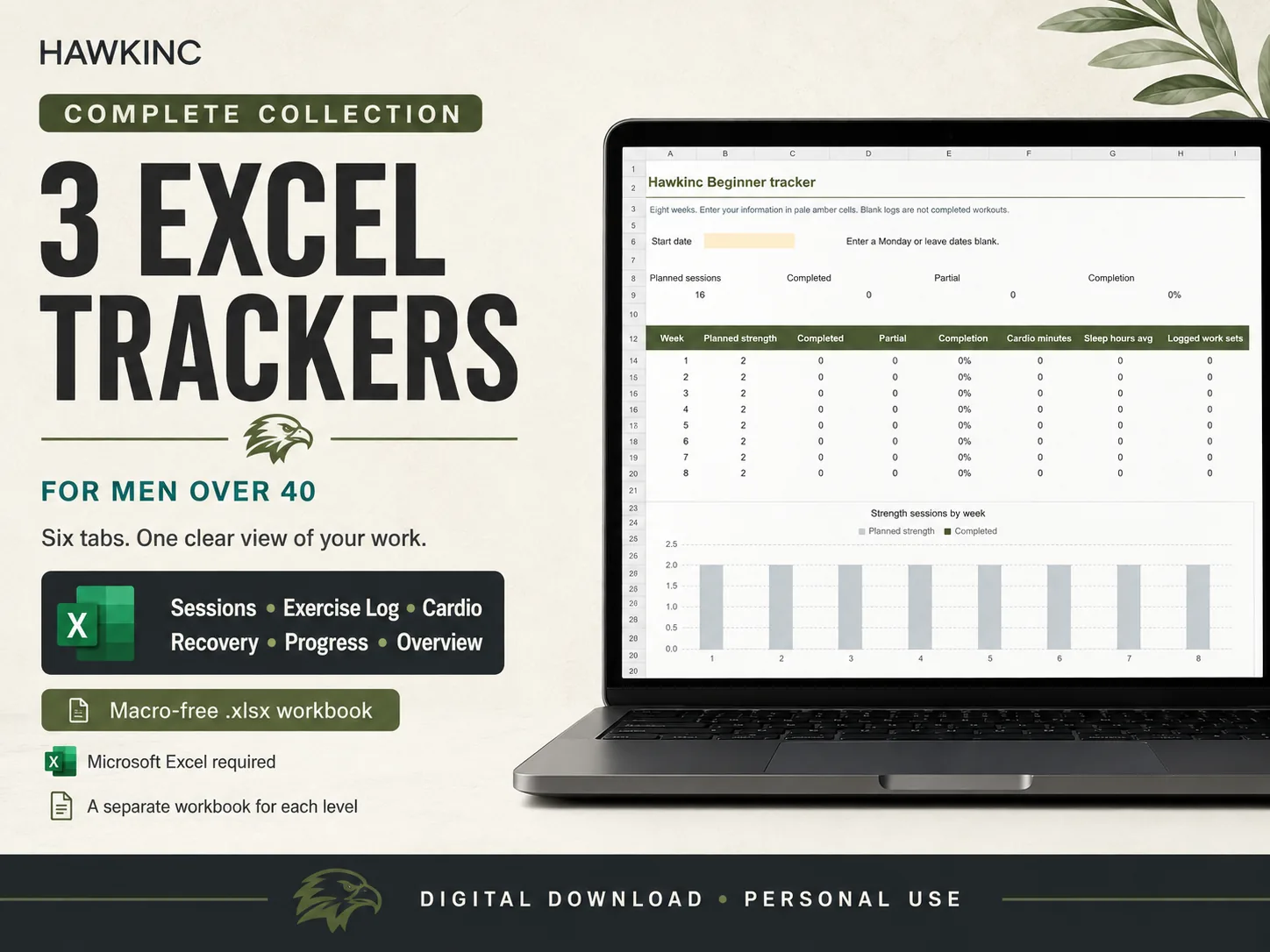
Military Calisthenics for Men Over 40 (Beginner to Advanced): three 8-week bodyweight programs, Excel trackers and printable logs, so you always know which rung comes next. $3.59 on Etsy (sale at the time of writing; regular $5.99). Instant digital download.
See the full product page and what is inside →
Frequently asked questions
Is it too late to start calisthenics at 40 or 50?
No. Many men start bodyweight training in their 40s, 50s or later. The key is to begin at a rung you can control, such as wall or incline push-ups and box squats, and progress slowly. If you have a heart condition, joint problems or have been inactive for a long time, check with your doctor first.
Can I do bodyweight training every day?
You can move every day, but hard strength sessions for the same muscles work better with a rest day in between. A simple rhythm is strength on two or three non-consecutive days, with walking, easy cycling or mobility on the other days. Persistent soreness or poor sleep is a sign to back off.
Do I need a pull-up bar for bodyweight progressions?
Not to start. Pushing, squatting, hinging and core work need nothing but floor space. Pulling is harder without kit, so beginners can use prone Y-T-W raises on the floor. Later, a sturdy bar, rings or a low bar for inverted rows makes back training far easier to progress.
How many reps should I do to build muscle?
A practical range is about 6 to 15 reps per set, finishing each set with one to three good reps left in reserve. If you can do more than 15 clean reps, the variation is too easy for building strength, so move to the next rung. If you cannot reach 6, step back a rung.
What if push-ups hurt my wrists or shoulders?
Raise your hands onto a bench or counter to reduce the load, try fists or push-up handles to keep wrists neutral, and keep elbows about 45 degrees from your body. Sharp or lingering pain is different from muscle effort; stop that exercise and get it checked by a doctor or physiotherapist.
How much protein do I need for bodyweight training?
Needs vary with body size, age and activity, so there is no single number for everyone. Spreading protein across meals and including a source at each one is a sensible start. Our free protein intake calculator gives a personal estimate; if you have kidney disease or another condition, ask your doctor or a dietitian.
More guides and printables: Health & Wellness hub · Strength and mobility exercises for women, decade by decade
This guide is for general information and is not medical advice; talk to your doctor before starting a new exercise or health routine.
Written by Dr. Mueed Akhtar, PhD (Chemical Engineering), founder of HawkInc.