

By Dr. Mueed Akhtar, PhD (Chemical Engineering), founder of HawkInc
Quick answer: The best exercises for women over 50 (and at every age from 30 to 70) cover the same three things: strength training for all major muscles twice a week, about 150 minutes of moderate activity, and balance and mobility work. What changes by decade is the emphasis: building a base in your 30s, protecting muscle and bone in your 40s and 50s, and prioritising balance after 60.
Key takeaways
- The CDC recommends at least 2 days of muscle-strengthening activity and 150 minutes of moderate activity every week for adults, including older adults.
- Bone loss speeds up around menopause, so strength and weight-bearing exercise matter more from your mid-40s onwards.
- Balance work becomes a priority after 60 because it helps reduce the risk of falls.
- You can start at any age with a chair, a wall and a step; progression matters more than equipment.
This guide is for general information and is not medical advice; talk to your doctor before starting a new exercise or health routine.
What exercises should women do in each decade from 30 to 70?
The core menu is the same at every age: a squat or sit-to-stand, a push, a pull, a hinge, a carry, core work, balance and mobility. What changes is the focus. In your 30s you build a base, in your 40s and 50s you protect muscle and bone, and in your 60s and 70s balance and getting up and down easily come first.
| Decade | Main focus | Example exercises | Weekly target |
|---|---|---|---|
| 30s | Build the habit and a strength base | Squats, push-ups (incline if needed), band rows, glute bridges, planks | 2 to 3 strength days, 150+ min activity |
| 40s | Keep muscle, start bone loading, look after posture | Split squats, step-ups, rows, farmer carries, dead bugs, hip and upper-back mobility | 2 to 3 strength days, 150 min activity |
| 50s | Protect bone and muscle through menopause; keep joints moving | Sit-to-stand with load, step-ups, wall or bench push-ups, bag carries, calf raises | 2 strength days minimum, daily walking |
| 60s | Strength for daily tasks; add regular balance | Chair sit-to-stands, supported lunges, wall push-ups, band rows, heel-to-toe walking | 2 strength days, short daily balance practice |
| 70s | Independence: getting up, carrying, not falling | Sit-to-stand, step-ups on a low step, standing on one leg with support, light carries, ankle mobility | 2 gentle strength days, daily balance and walking as able |
The weekly targets come from the CDC physical activity guidelines for adults; the balance emphasis for later decades follows the CDC guidelines for adults 65 and older.
How often should a woman over 50 strength train?
Aim for at least two strength sessions a week that work all the major muscle groups, ideally on non-consecutive days. Add around 150 minutes of moderate activity, such as brisk walking, spread across the week. Short sessions count: two 25-minute workouts are enough to cover the strength target if they are done consistently.
The NHS strength exercises page shows simple home moves such as sit-to-stands and calf raises that can be done with a sturdy chair, which makes a sensible starting point if you have not trained before.
Why does strength training matter more after menopause?
Around menopause, falling oestrogen speeds up bone loss, and muscle is lost gradually with age unless it is used. Strength and weight-bearing exercise are among the most practical ways to work on both. Stronger legs and better balance also reduce the risk of the falls that lead to fractures, which matters more with each decade.
According to the National Institute on Aging, about one in five women over 50 develops osteoporosis, and women may lose bone mass quickly for several years around menopause. The NIA lists strength training, walking, hiking, dancing and stair climbing as weight-bearing activities that can help strengthen bones. If you already have osteoporosis or a past fracture, ask your doctor which movements are right for you.
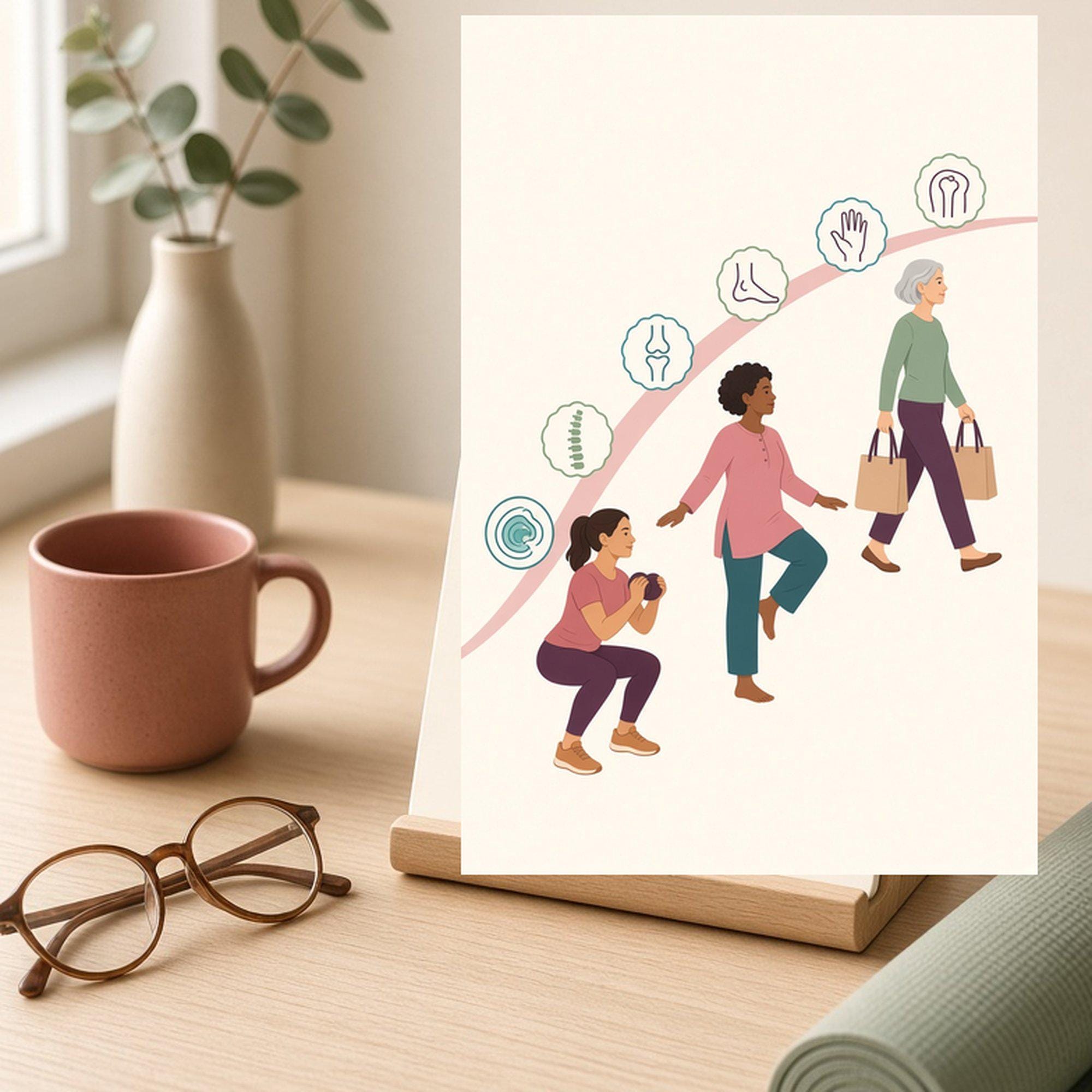
Women’s Health Exercise Guide (PDF)
A 143-page illustrated guide with 28 exercise plates, a 10-minute daily routine and weekly plans for ages 30–45, 45–60 and 60–70.
$4.19 on Etsy $6.99
What are the best exercises for women over 50?
The best exercises for women over 50 are simple, repeatable movements that train the legs, hips, back, chest, shoulders and core, plus a balance drill. You do not need a gym. The eight below cover every major muscle group and can be done with a chair, a wall, a step and two shopping bags.
- Sit-to-stand: stand up from a chair and sit back down slowly, without using your hands if you can.
- Wall or counter push-up: hands on a wall or worktop, lower your chest towards it and press back.
- Band or towel row: pull a band, or a towel looped around a sturdy post, towards your ribs, squeezing your shoulder blades.
- Step-up: step onto a low, stable step, stand tall, then step down with control.
- Glute bridge: lying on your back with knees bent, lift your hips and lower slowly.
- Suitcase carry: walk for 20 to 30 seconds holding a loaded shopping bag in one hand, then switch.
- Calf raise: holding a support, rise onto your toes and lower slowly.
- Supported single-leg stand: stand on one leg next to a counter, holding on lightly, for up to 30 seconds each side.
How to do a sit-to-stand with good form
- Sit near the front of a sturdy chair with feet hip-width apart and flat on the floor.
- Lean forward slightly from the hips, keeping your chest up.
- Push through your whole foot to stand up fully, squeezing your glutes at the top.
- Lower yourself slowly, taking about three seconds to sit back down.
- Do 8 to 12 repetitions. When that feels easy, hold a loaded bag or use a lower chair.
Sample week: a beginner plan for women in their 50s
Here is a worked example of how the guidelines translate into a realistic week for a woman in her 50s who is starting out. Each strength session takes about 25 minutes, and the daily routine takes about ten.
| Day | Main session | Extra |
|---|---|---|
| Monday | Strength A: sit-to-stand, wall push-up, band row, glute bridge, suitcase carry (2 rounds) | 10-minute daily routine |
| Tuesday | Brisk walk, 30 minutes | Balance: single-leg stand |
| Wednesday | Rest or gentle mobility | 10-minute daily routine |
| Thursday | Strength B: step-up, counter push-up, towel row, calf raise, dead bug (2 rounds) | Balance: heel-to-toe walk |
| Friday | Brisk walk, 30 minutes | 10-minute daily routine |
| Saturday | Active hobby: dancing, hiking, gardening or swimming, 30 to 45 minutes | Stretch hips and upper back |
| Sunday | Rest | Repeat the self-test every 4th week |
This covers two strength days and about 150 minutes of moderate activity. After three or four weeks, add a third round or a little more load.
A look inside the Women’s Health Exercise Guide
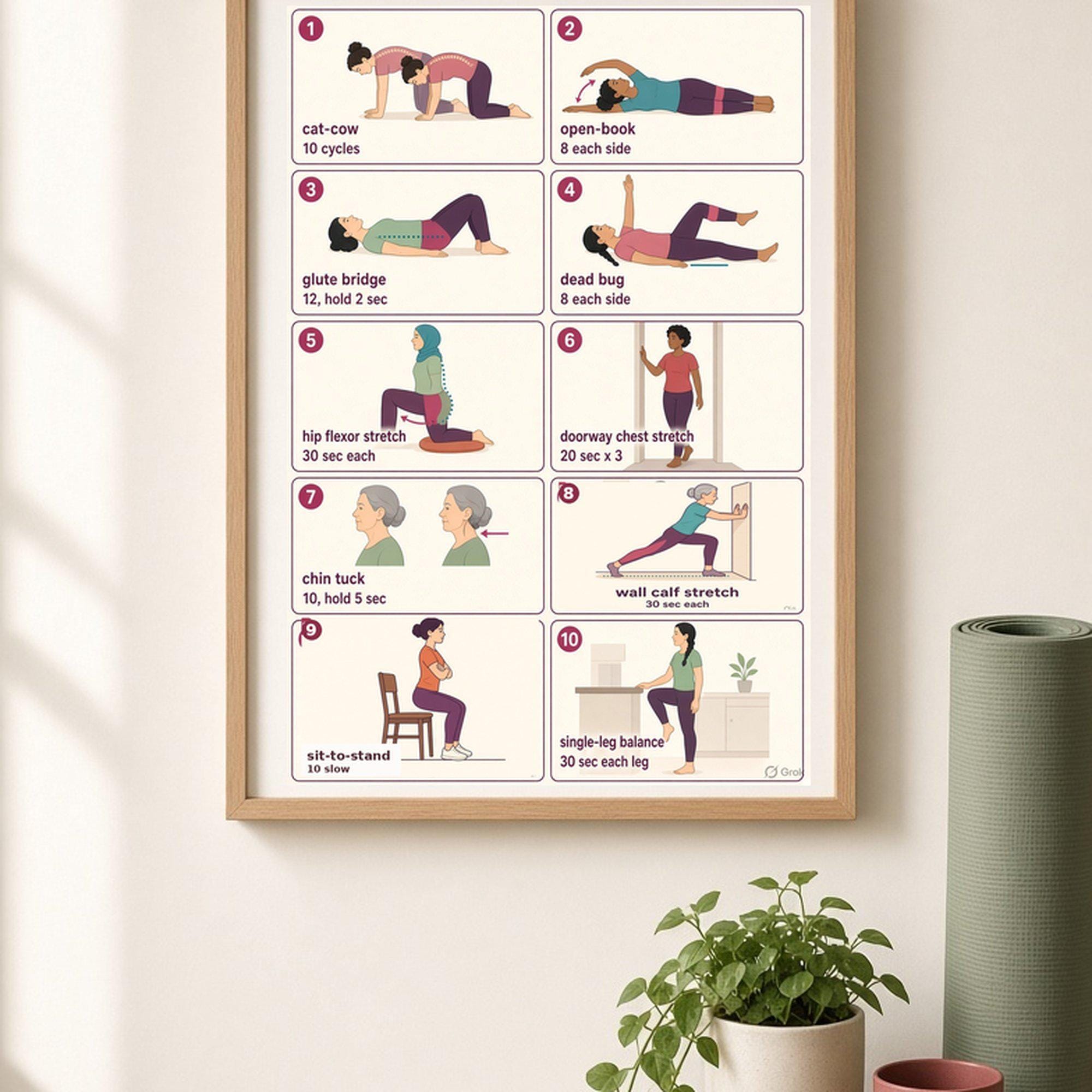
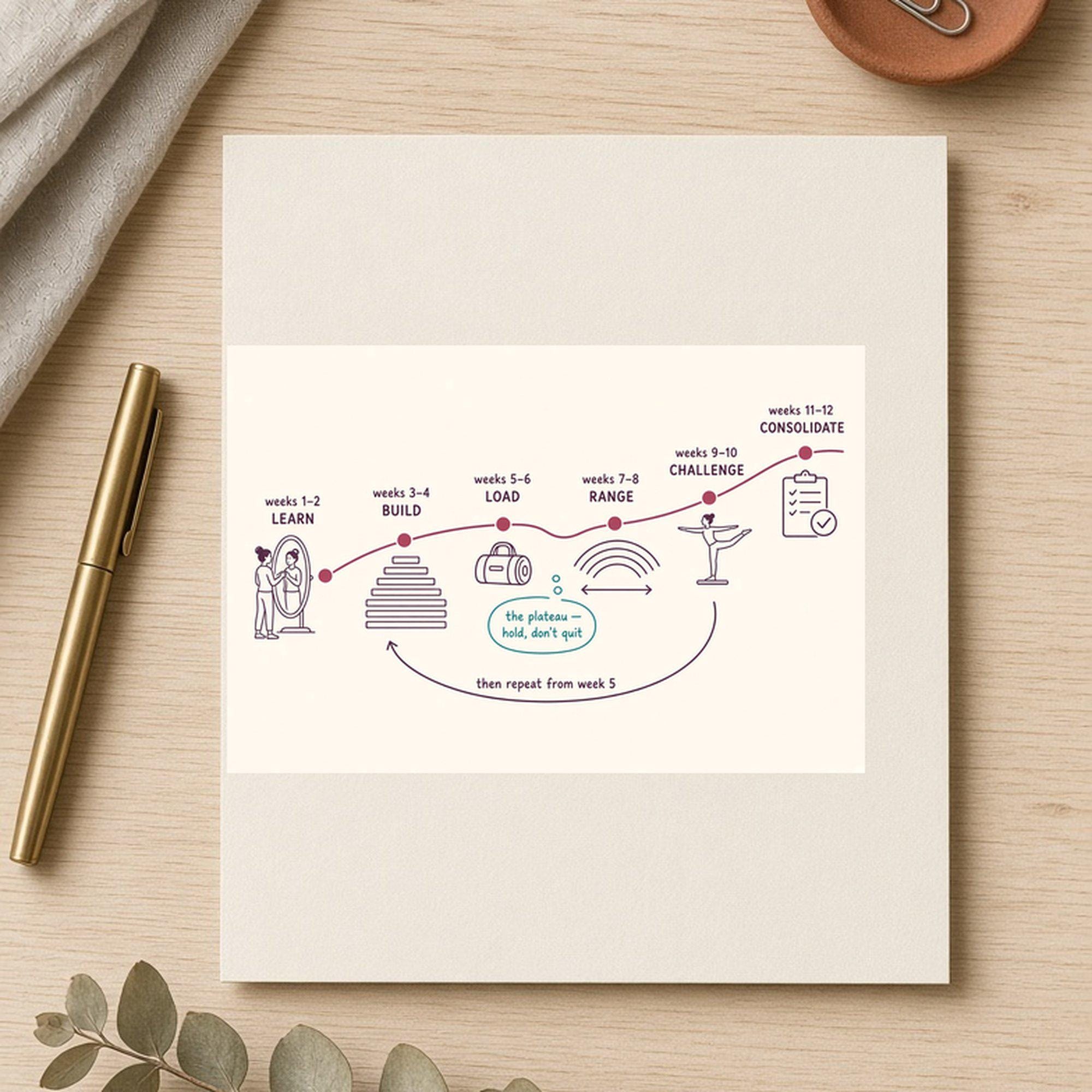
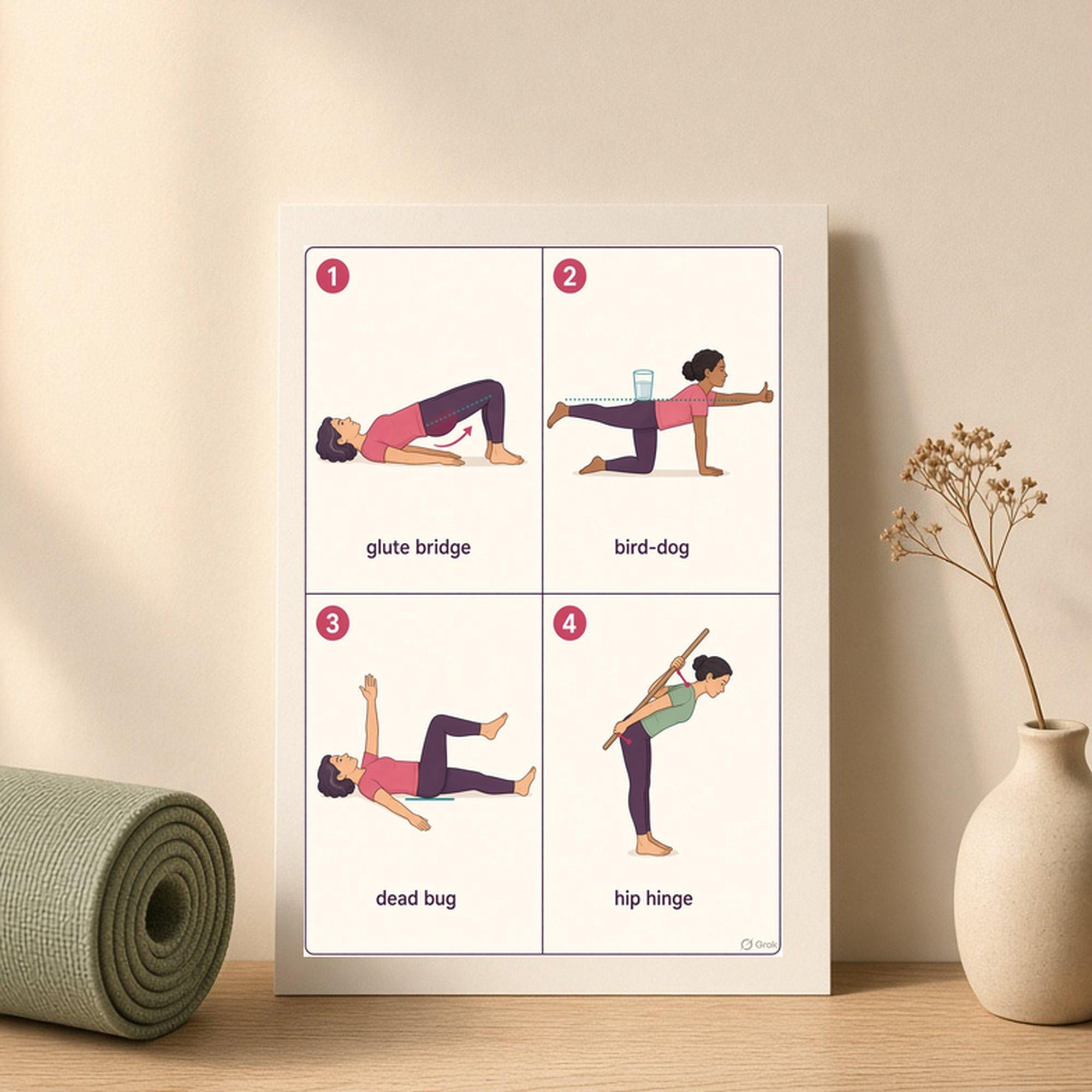
If you would rather follow a plan already laid out by age, the Women’s Health Exercise Guide includes three weekly plans (30–45, 45–60 and 60–70), a 12-week progression schedule with four repeatable self-tests, a habit tracker and a pain log. These are a few of its pages:
How can you start exercising safely at any age?
Start low and go slow: choose the easiest version of each exercise, do one or two rounds, and increase only one thing at a time, such as reps, rounds or load. Check with your doctor first if you have a heart condition, a recent injury or surgery, osteoporosis, or you are pregnant or recently gave birth.
- Talk to your doctor if you have any health condition or have been inactive for a long time.
- Take a baseline test, such as how many sit-to-stands you can do in 30 seconds.
- Begin with two short strength sessions a week and a daily walk.
- Use a chair or counter for support during balance work until you feel steady.
- Progress every two to four weeks, and stop any movement that causes sharp or spreading pain.
- Repeat your baseline test every four weeks and write the result down.
If you also want to check your nutrition alongside training, our free protein intake calculator gives a quick daily estimate. For more structure, see our 12-week menopause workout plan for women over 40 and, for gentle balance work, 10-minute tai chi routines for seniors.
Frequently asked questions
What is the best exercise for a woman over 50?
There is no single best exercise. The strongest routine combines strength work for all major muscle groups, regular moderate aerobic activity such as brisk walking, and short daily balance and mobility practice. Sit-to-stands, wall push-ups, rows with a band and step-ups cover a lot of ground with little equipment.
How many days a week should a woman over 50 strength train?
The CDC recommends muscle-strengthening activity on at least two days a week, working the legs, hips, back, abdomen, chest, shoulders and arms. Most women do well with two or three short sessions on non-consecutive days, plus daily walking and a few minutes of balance and mobility work.
Is walking enough exercise after 50?
Walking is excellent for heart health and counts towards the 150 weekly minutes of moderate activity, but on its own it does little to maintain muscle strength. Adding two strength sessions a week, and some balance practice, covers what walking leaves out, especially for bones and fall prevention.
Can you build muscle in your 60s and 70s?
Yes. Muscle responds to training at any age, although progress may be slower. Start with bodyweight or very light resistance, increase the challenge gradually, and keep sessions regular. Balance work becomes more important in this decade, and the CDC specifically recommends balance activities for adults aged 65 and over.
What exercises help bone density in women?
The NIA lists weight-bearing activities such as strength training, walking, hiking, dancing and stair climbing as ways to help build and strengthen bones. Exercise that improves strength and balance also lowers the risk of falls. If you have osteoporosis, ask your doctor which movements suit you.
Should I exercise if I have joint pain?
Many people with joint aches find gentle, regular movement helps, but it depends on the cause. Choose low-impact options, reduce range or load if a movement hurts, and stop if pain is sharp or spreading. For ongoing or worsening pain, get assessed by a doctor or physiotherapist before you continue.
Women’s Health Exercise Guide (PDF)
Everything in this article, laid out as 20 body-area chapters, 28 illustrated plates and printable trackers you can follow at home.
$4.19 on Etsy $6.99
More guides and printables: Health & Wellness hub.
This guide is for general information and is not medical advice; talk to your doctor before starting a new exercise or health routine.