
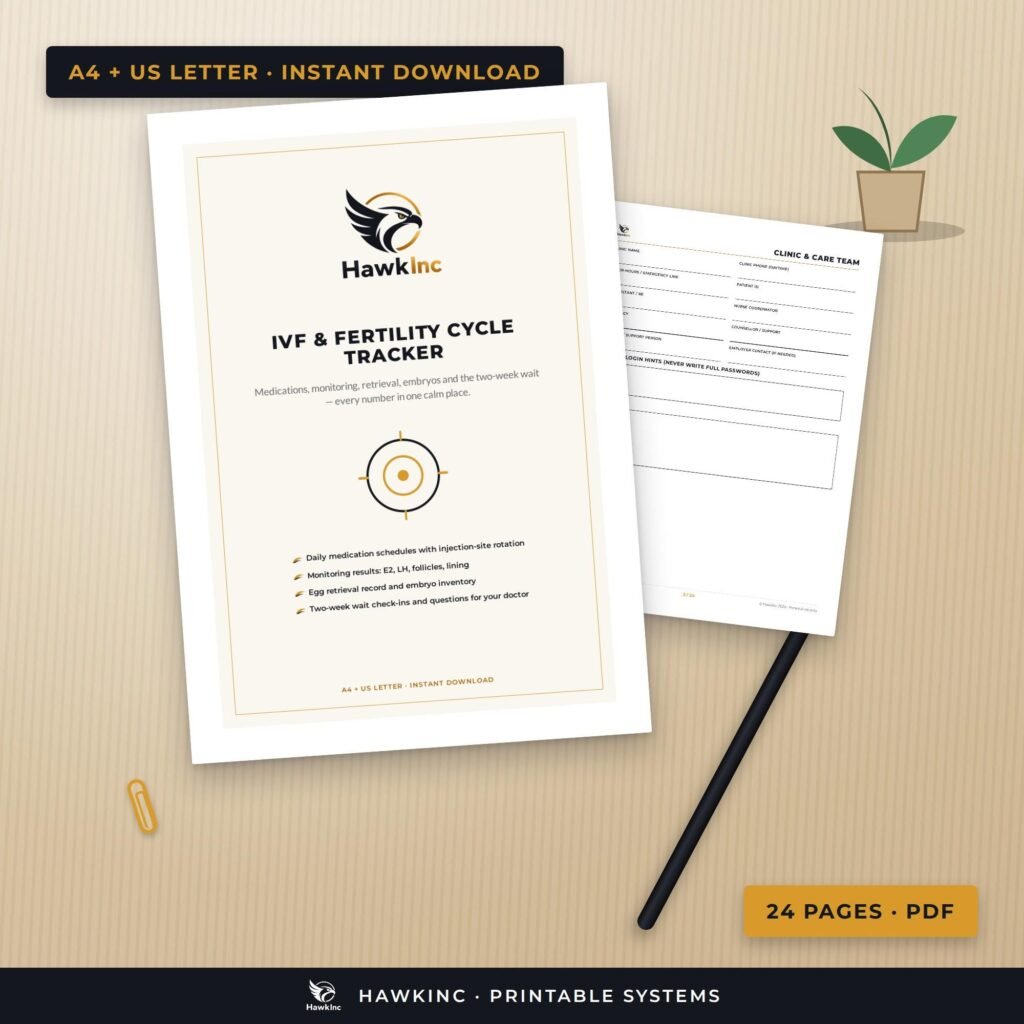
Quick answer: To organise an IVF cycle, copy your clinic’s full medication plan into one daily IVF medication schedule, tick each dose with the time and injection site, log every scan and blood result, keep supplies and contacts together, and write questions down as they arise. One written record makes it easier to follow changes your clinic makes mid-cycle.
By Dr. Mueed Akhtar, PhD (Chemical Engineering), founder of HawkInc · Last updated: October 13, 2026
Key takeaways
- Your fertility clinic sets every medicine, dose and time. Your job is to record the plan clearly and follow it.
- One daily schedule beats several apps, sticky notes and texts. Put doses, times and injection sites on the same page.
- Log monitoring results (E2, LH, follicles, lining) so you can follow the conversation at each scan.
- Plan the big days early: trigger shot timing, egg retrieval, transfer and test date.
- Phone the clinic about a missed or late dose. Do not guess or double up.
Table of contents
IVF asks you to manage a short, intense project while also coping with hope, worry and appointments at short notice. According to Mayo Clinic, one full IVF cycle takes about three weeks, and sometimes longer when steps are split up. That is a lot of dates and doses to hold in your head. This guide shows a simple system you can set up in an evening.
What does an IVF medication schedule look like?
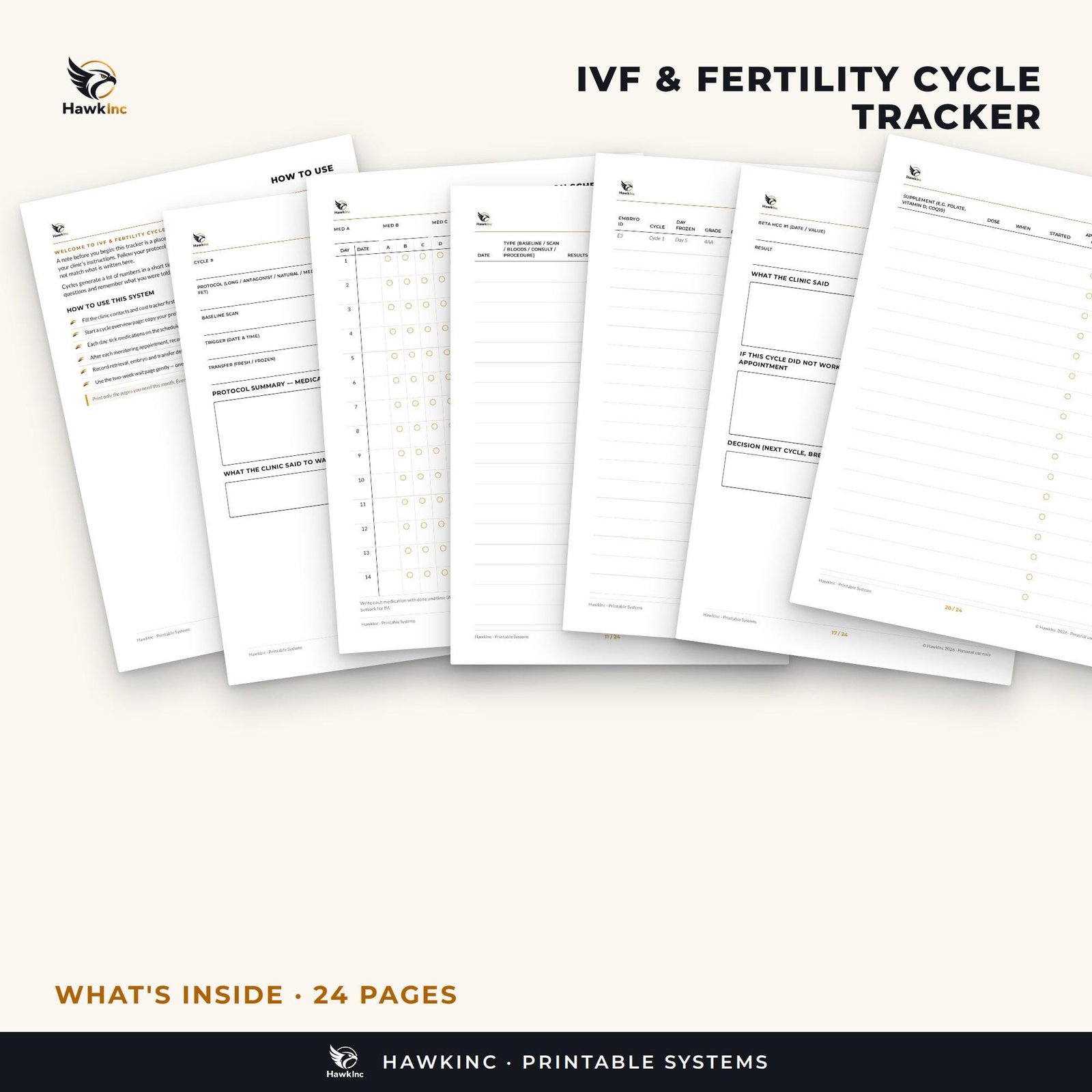
An IVF medication schedule is a day-by-day list of every medicine your clinic prescribes, with the dose, the time to take it and a box to tick once it is done. Most schedules also have space for the injection site, any change the clinic makes after a scan, and the date and time of the trigger shot.
The medicines themselves vary by protocol. The Guy’s and St Thomas’ NHS fertility team explains that the first stage of IVF uses medicines to stimulate the ovaries to produce several eggs, and the HFEA describes the later steps of collection, fertilisation and transfer. Your clinic will tell you exactly what applies to you.
A useful schedule page has these columns:
| Column | Why it helps |
|---|---|
| Date and cycle day | Keeps you aligned with the clinic’s day numbering (for example “stim day 4”) |
| Medicine and dose | Copied exactly from the clinic’s written plan |
| Planned time | Many injections are given at a similar time each day |
| Time given and by whom | Useful if a partner helps or doses change |
| Injection site | Helps you rotate sites as your nurse advised |
| Notes | Side effects, questions, or a change the clinic phoned through |
How long are you on IVF injections?
Most people inject stimulation medicines for one to two weeks before the eggs are ready, according to Mayo Clinic, although your protocol may differ. Some protocols add medicines before stimulation starts, and many people continue other medicines such as progesterone after egg retrieval or before a frozen transfer, often for several weeks.
Here is a general outline of the phases you may want to plan around. Exact timings come from your clinic.
| Phase | What usually happens | What to log |
|---|---|---|
| Before stimulation | Baseline scan or bloods; some protocols start preparation medicines | Start date, any pre-treatment medicines, clinic contacts |
| Stimulation | Daily injections and regular monitoring scans | Every dose, time, site; scan and blood results |
| Trigger | A final injection timed to mature the eggs | The exact time given, to the minute |
| Egg retrieval | Collection under sedation | Number of eggs collected and fertilised; aftercare notes |
| Embryo transfer | Fresh or frozen transfer | Transfer date, number of embryos, support medicines |
| Two-week wait | Support medicines continue; test date set by clinic | Doses, symptoms, questions, test date |
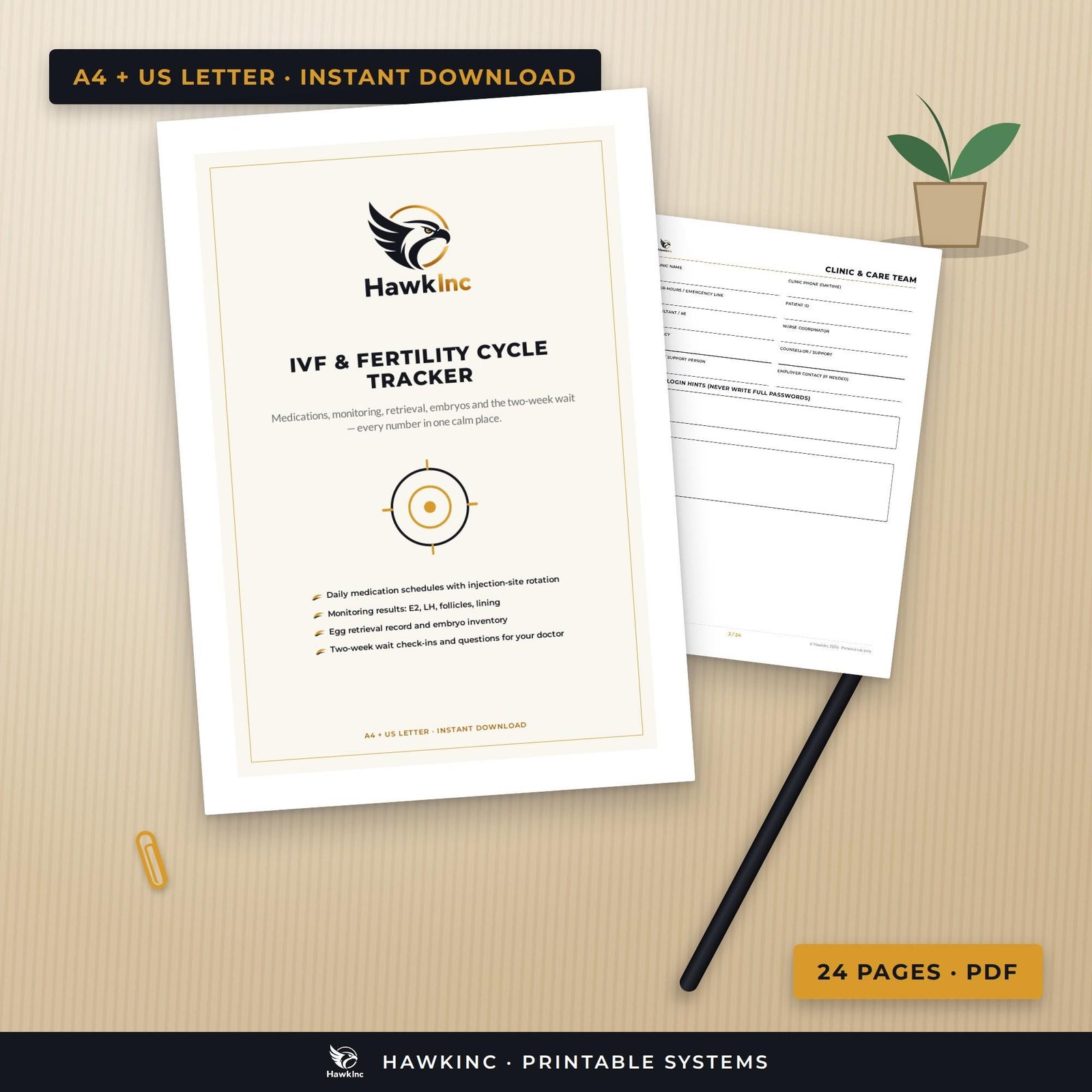
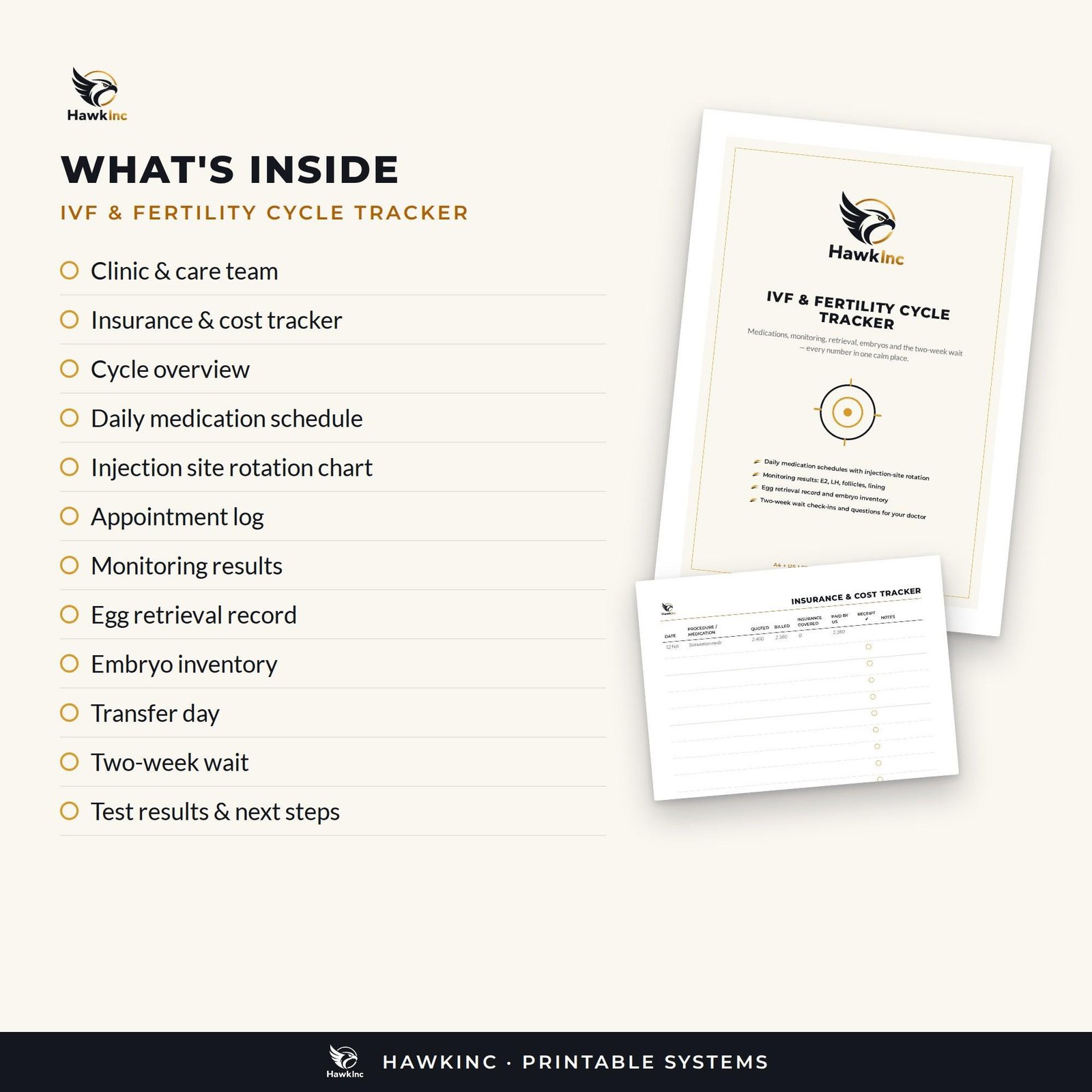
IVF Cycle Tracker Printable: 24 pages of medication schedules, an injection site chart, a monitoring log and an embryo inventory, so every dose and scan sits in one place. USD 1.79 (regular USD 2.99), A4 and US Letter PDF.
See what’s inside the IVF tracker →
How do you keep track of IVF medications?
The simplest way to keep track of IVF medications is to set up one written schedule before day one, keep all supplies together, and tick every dose in the same place each time. Pair it with phone alarms for reminders, and update the page the moment the clinic changes a dose.
- Get the plan in writing. Ask the clinic for a printed or emailed protocol and check the start date.
- Check deliveries against the plan. Count pens, vials and needles, and note what must be kept in the fridge.
- Copy each medicine into your schedule with dose and planned time. Use the clinic’s exact names.
- Set two alarms per dose: one to prepare and one to take it.
- Tick, time and site. After each dose write the time given and the injection site.
- Write changes in a different colour so you can see what the clinic adjusted after each scan.
- Keep the clinic’s nurse line and out-of-hours number on the same page.
What should you track at IVF monitoring appointments?
At each monitoring appointment, write down the date, the cycle day, your blood results if shared (often estradiol, called E2, and LH), the number and size of follicles, your lining thickness, any dose change, and the date of your next visit. Having these in one log helps you ask clear questions.
You do not need to interpret the numbers yourself; that is the clinic’s role. MedlinePlus explains that ultrasound and blood tests are used to watch how the follicles develop. Recording them simply helps you notice changes and remember what was said.
| Visit checklist | Done |
|---|---|
| Cycle day and date written | ☐ |
| Blood results noted (if shared) | ☐ |
| Follicle count and sizes noted | ☐ |
| Lining thickness noted | ☐ |
| Dose change confirmed and written in colour | ☐ |
| Next appointment date and time | ☐ |
| Questions asked and answered | ☐ |
What happens if you miss or are late with an IVF injection?
If you miss an IVF injection or take one late, phone your clinic’s nurse line or out-of-hours number as soon as you notice. Do not double the next dose or skip ahead unless they tell you to. Write down what happened and what they advised, so the record stays accurate.
The trigger shot needs special care, because egg retrieval is timed from it. Mayo Clinic notes that retrieval is usually done 34 to 36 hours after the final injection. Write the exact time on your schedule and set more than one alarm.
A worked example: one week of the tracker
Here is how a filled-in stimulation week might look on paper. The medicine names are placeholders; yours come from your clinic.
| Cycle day | Medicine A | Medicine B | Site | Notes |
|---|---|---|---|---|
| Stim 1 | ✔ 19:00 | — | Left abdomen | Started; mild bruise |
| Stim 2 | ✔ 19:05 | — | Right abdomen | |
| Stim 3 | ✔ 19:00 | — | Left abdomen | Scan booked stim 5 |
| Stim 4 | ✔ 19:10 | — | Right abdomen | |
| Stim 5 | ✔ 19:00 (dose changed) | — | Left abdomen | Scan: follicles noted; clinic adjusted dose |
| Stim 6 | ✔ 19:00 | ✔ 08:00 (new) | Right abdomen | Medicine B added by clinic |
| Stim 7 | ✔ 19:00 | ✔ 08:00 | Left abdomen | Scan stim 8; ask about trigger timing |
Notice how the change on stim 5 and the new medicine on stim 6 are easy to spot. That is the main benefit of one record: when a nurse phones with an update, you write it in once and everyone in the home can see it.
How to prepare for retrieval, transfer and the two-week wait
Before retrieval, transfer and the two-week wait, confirm dates and arrival times in writing, arrange transport and time off, note fasting or medicine instructions, and write your test date on the cycle overview. Afterwards, record the egg and embryo numbers the clinic gives you and keep logging any support medicines.
- Ask who will drive you home after retrieval, if sedation is used.
- Write the embryo numbers on an embryo inventory page so you have them for future cycles.
- Keep logging support medicines through the two-week wait; it is easy to lose track when you feel anxious.
- Plan small, calming routines. Our gentle yoga for anxiety guide has short breathing practices, and you can check your daily fluids with the water intake calculator. Ask your clinic before starting any new exercise during treatment.
You can find more printables in our health and wellness hub.
Frequently asked questions
What is the best way to organise IVF medications at home?
Keep every box, pen and vial in one labelled container, store anything that needs the fridge on one shelf, and write the plan your clinic gives you into a single daily schedule. Tick each dose as you take it, note the time and injection site, and keep the clinic’s phone number on the same page.
How many appointments are there in an IVF cycle?
It varies by clinic and protocol. Most cycles include a baseline visit, several monitoring scans and blood tests during stimulation, an egg retrieval, an embryo transfer and a pregnancy test. Some people need more scans if the clinic adjusts doses. Log every visit so you can see the pattern and plan time off work.
Should I use an app or a paper IVF tracker?
Both work, and many people use both. Phone alarms are good for reminders, while a printed schedule on the fridge lets a partner see what has been done at a glance. A paper or PDF tracker also gives you one record to bring to appointments if your clinic changes the plan mid-cycle.
What should I bring to IVF monitoring appointments?
Bring your medication schedule with doses ticked off, any questions you wrote down since the last visit, your clinic ID or paperwork, and something to write on. Ask the nurse to confirm the next doses and the date of your next scan before you leave, and write both down straight away.
Can my partner give my IVF injections?
Often yes, after the clinic has shown you both how. Many clinics offer injection teaching sessions or videos. If a partner helps, agree who is giving which dose, log it on the same schedule and record the site, so nothing is missed or doubled when routines get busy.
When do you take a pregnancy test after IVF?
Your clinic will give you a date. Mayo Clinic notes that a blood test is usually done about 12 days to 2 weeks after egg retrieval. Testing at home earlier can give confusing results, especially if you had a trigger shot, so many clinics ask you to wait for their test.
Get the IVF Cycle Tracker
IVF Cycle Tracker Printable: 24 pages of medication schedules, an injection site chart, a monitoring log and an embryo inventory, so every dose and scan sits in one place. USD 1.79 (regular USD 2.99), A4 and US Letter PDF.
See what’s inside the IVF tracker →
This guide is for general information and is not medical advice; talk to your doctor before starting a new exercise or health routine. Always follow your fertility clinic’s instructions about medicines, doses and timings.
Written by Dr. Mueed Akhtar, PhD (Chemical Engineering), founder of HawkInc.