
Quick answer: To track calisthenics progress, log every session with the exercise, its exact variation, sets, target reps, actual reps, rest time and a short note on form and effort. Review the log once a week. When you hit the top of your rep range on every set with clean form twice in a row, move to a harder variation.
By Dr. Mueed Akhtar, PhD (Chemical Engineering), founder of HawkInc · Last updated 12 October 2026
Key takeaways
- In bodyweight training there are no plates to add, so the variation, reps, tempo and rest time are your “weight”. Log all four.
- Write your target before the session and your actual reps after it. The gap between the two tells you what to do next time.
- Use a fixed rep range for each exercise and a clear rule for when to move up.
- Review the log once a week rather than judging single sessions.
- Paper, spreadsheet or app all work. The best tracker is the one you fill in every time.
What should you track in a calisthenics workout log?
Track the exercise and its exact variation, the number of sets, target reps, actual reps, rest time and a short note on form and effort. Those fields show whether you are getting stronger, because in calisthenics you rarely add weight. Instead you make the movement harder, add reps, slow the tempo or cut rest.
Here is what each field looks like in practice:
| Field | Example entry | Why it matters |
|---|---|---|
| Date and session | Mon 12 Oct, Session A | Shows how consistent you are and how much rest you had between sessions |
| Exercise and variation | Push-up, 3-second lowering | The variation is your load; “push-up” alone hides real progress |
| Sets × target reps | 3 × 8–12 | This is the plan you are measuring yourself against |
| Actual reps | 12, 11, 9 | What really happened, set by set |
| Rest between sets | 90 seconds | Same reps with shorter rest means better work capacity |
| Effort (1–10) | 8 | Helps you decide whether to push on or repeat the week |
| Notes | Left shoulder tight on set 3 | Spots aches and patterns before they become problems |
The effort score is a simple self-rating: 1 is very easy and 10 is the hardest you could possibly go. You do not need to be precise. What matters is that you rate the same way every week so the numbers can be compared.
How do you know if you are progressing in calisthenics?
You are progressing if, over two to four weeks, you complete more total reps at the same variation, move to a harder variation, hold positions for longer, or finish the same work with less rest or a lower effort score. One flat or weak session means very little. Look at the trend across weeks in your log.
Signs of real progress you can read straight from your log:
- Total reps rise at the same variation, for example from 30 to 34 push-ups across three sets.
- The variation changes, for example from incline push-ups to full push-ups.
- Holds get longer, such as a plank moving from 40 to 55 seconds.
- Rest gets shorter while reps stay the same.
- Effort drops for the same work, for example the same session rated 8 last week and 6 this week.
Once a week, sit down with the log for five minutes:
- Add up the total reps for each exercise this week and compare them with last week.
- Mark every exercise where you hit the top of your rep range on all sets.
- Check the notes column for any ache that appears more than once.
- Decide the next step for each exercise: move up, repeat, or ease off.
- Write next week’s targets in the log now, so you start each session knowing what to aim for.
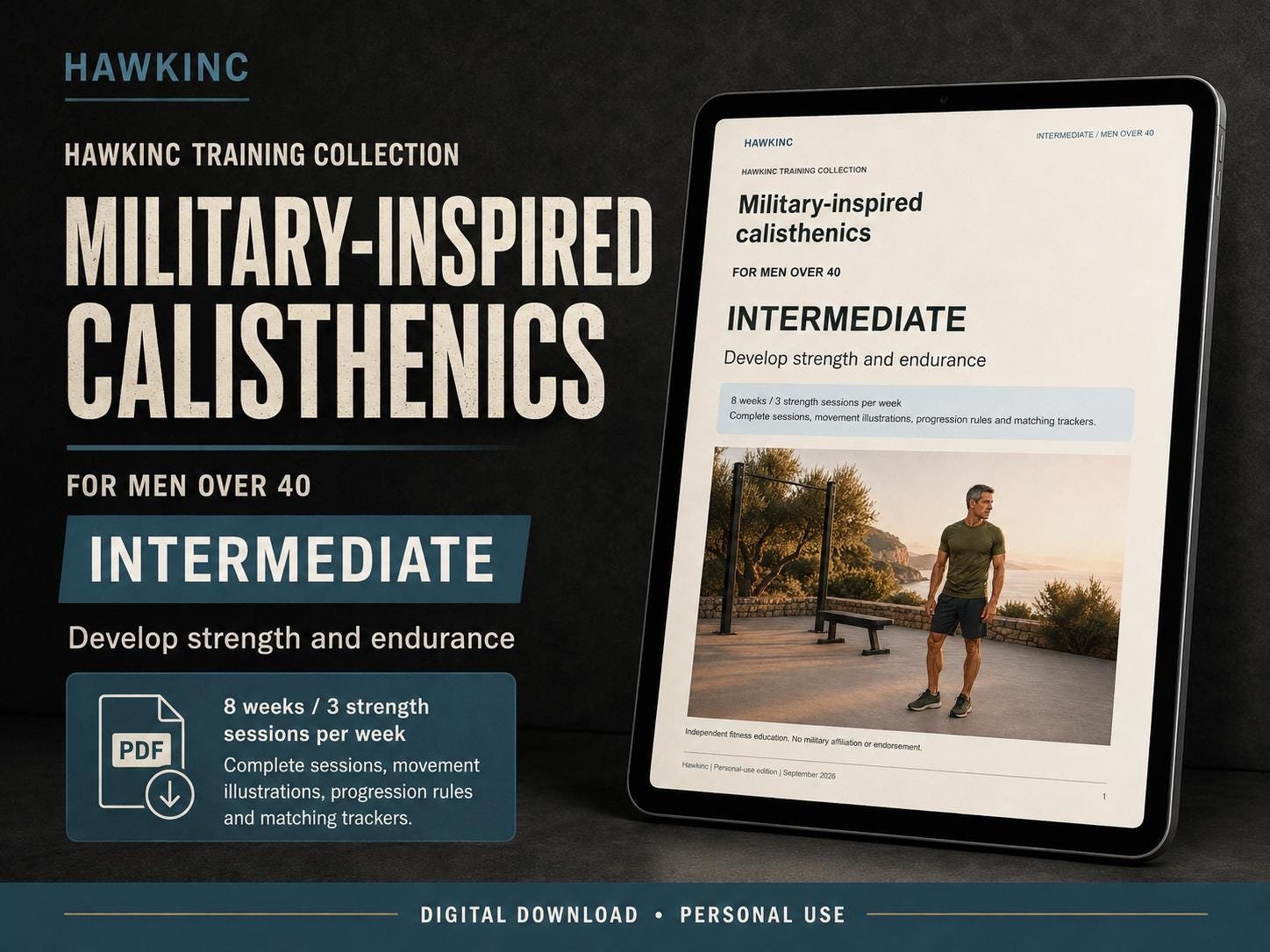
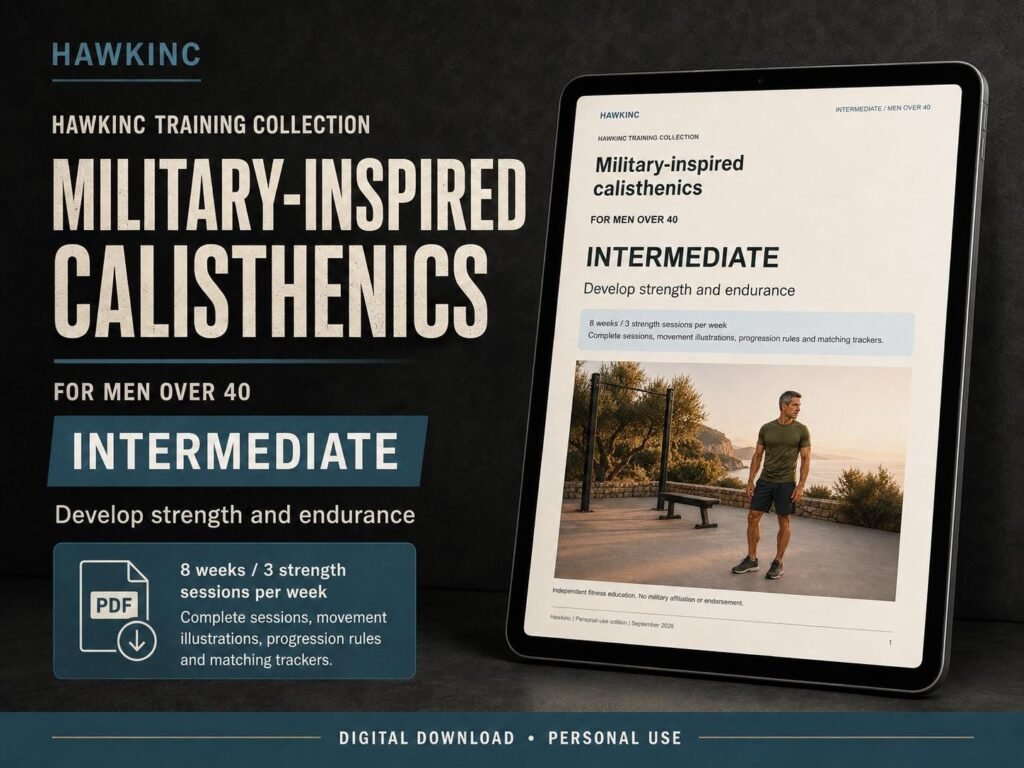
Military Calisthenics Workout Tracker – an 8-week intermediate bodyweight plan for men over 40 with a 27-page illustrated guide, a six-tab Excel log and printable A4 and US Letter sheets. USD 2.99 on Etsy (sale; regular USD 4.99).
Want the full beginner-to-advanced programme? See the Military Calisthenics Workout Plan for Men Over 40 (3-level collection) →
How often should you increase reps or move to a harder variation?
Use double progression. Pick a rep range, such as 8 to 12, and add reps session by session at the same variation. When you reach the top of the range on every set with clean form, usually twice in a row, switch to the next harder variation and start again at the bottom of the range.
- Choose a rep range for each exercise and write it in the target column.
- Start with a variation you can do for the bottom of the range with good form.
- Each session, try to add one rep to at least one set.
- When every set reaches the top of the range in two sessions in a row, move to the next variation.
- Start the new variation at the bottom of the range again. A drop in reps here is expected, not a step backwards.
Here are sample no-equipment progression ladders. Move one rung at a time:
| Pattern | Easier | Middle | Harder |
|---|---|---|---|
| Push | Incline push-up (hands on a table) | Full push-up | Slow-lowering or archer push-up |
| Legs | Bodyweight squat | Reverse lunge | Split squat with slow lowering |
| Core | Front plank | Long-lever plank (hands further forward) | Hollow body hold |
| Hips | Glute bridge | Single-leg glute bridge | Single-leg bridge with a pause at the top |
Not sure whether you are recovering well enough to move up? Check your sleep, energy and any aches in the notes column before you change a variation. If anything feels sharp rather than simply hard, stay where you are and speak to a health professional. The NHS guide to strength exercises is a good reference for safe form.
How to track calisthenics progress: free log template and worked example
Copy the template below into a notebook or a spreadsheet. Each row is one exercise; use one table per session.
Free log template (copy this)
| Exercise and variation | Sets × target | Set 1 | Set 2 | Set 3 | Rest | Effort (1–10) | Notes |
|---|---|---|---|---|---|---|---|
| Warm-up (what and how long) | – | – | – | – | – | – | |
| Cool-down | – | – | – | – | – | – |
Worked example: one intermediate week, logged
This is an illustrative week for someone training three days a week, alternating Session A and Session B:
| Day | Session | Exercise and variation | Target | Actual | Effort | Next step |
|---|---|---|---|---|---|---|
| Mon | A | Full push-up | 3 × 8–12 | 12, 12, 12 | 7 | Hit top of range once; repeat |
| Mon | A | Reverse lunge (each leg) | 3 × 8–12 | 10, 10, 9 | 7 | Add a rep next time |
| Wed | B | Hollow body hold | 3 × 20–40 s | 30, 25, 25 s | 8 | Repeat |
| Wed | B | Single-leg glute bridge | 3 × 8–12 | 12, 12, 11 | 6 | Add a rep to set 3 |
| Fri | A | Full push-up | 3 × 8–12 | 12, 12, 12 | 7 | Second time at the top: move to slow-lowering push-up |
| Fri | A | Reverse lunge (each leg) | 3 × 8–12 | 11, 10, 10 | 7 | Keep adding reps |
Reading the log takes seconds: push-ups hit 12, 12, 12 in two sessions in a row, so next week starts with slow-lowering push-ups at 8 reps. Everything else stays at the same variation and aims for one more rep.
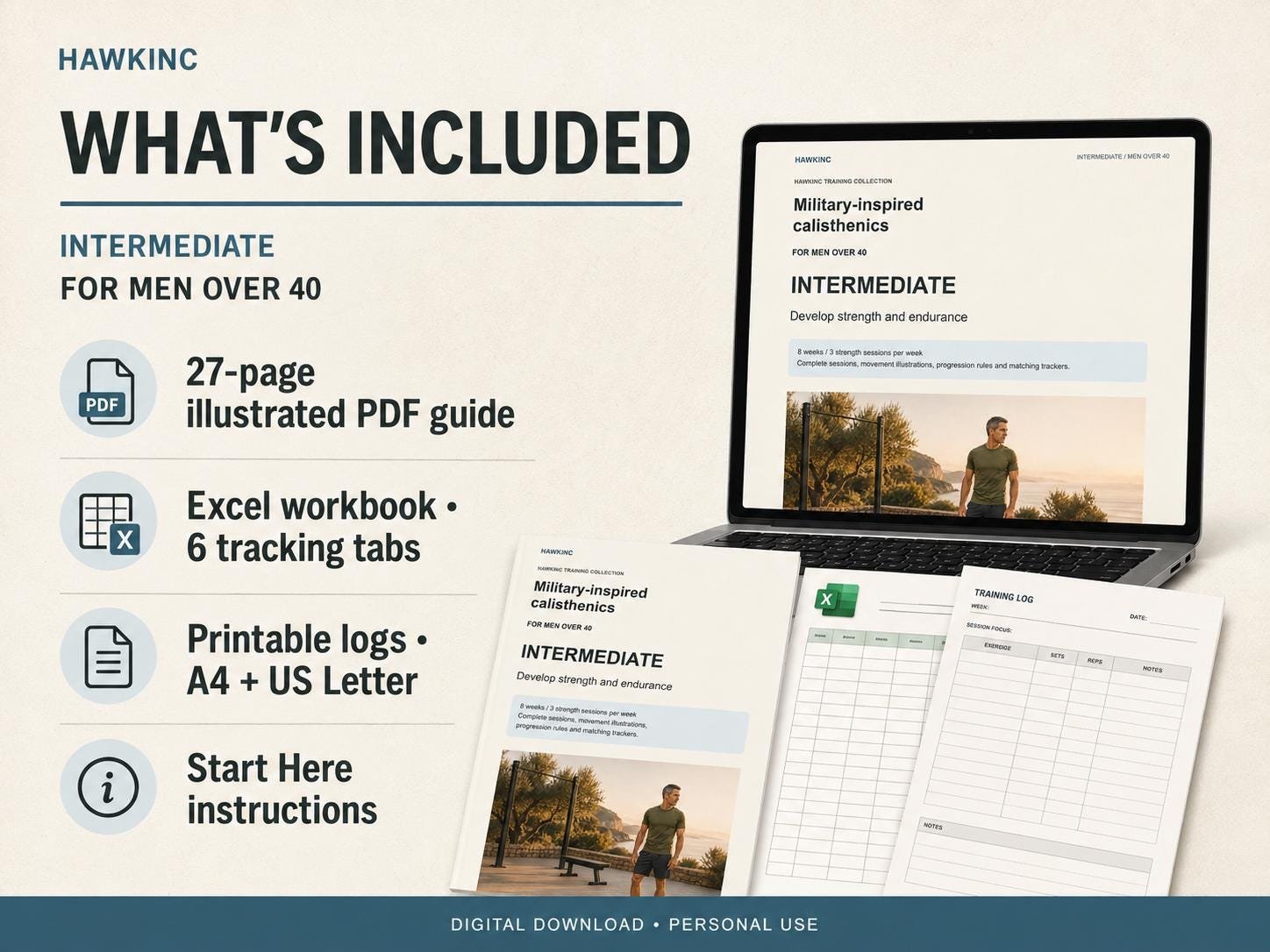
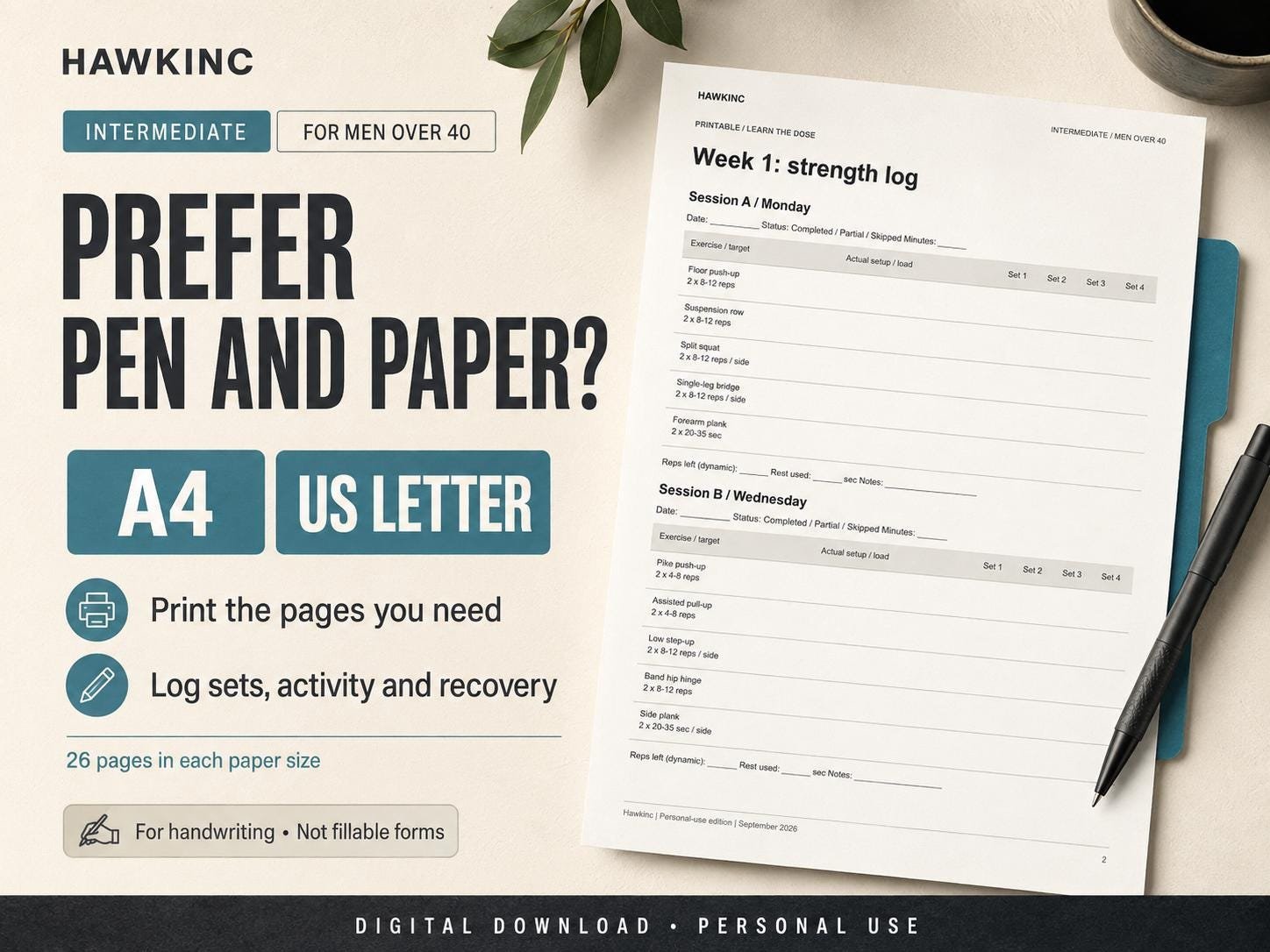
If you would rather not build the log yourself, the HawkInc tracker sets this up for you, with Session A and Session B pages, a printable weekly strength log and a six-tab Excel workbook:
Should you track workouts on paper, in a spreadsheet or in an app?
Choose the format you will actually fill in after every session. Paper is quick and distraction-free, a spreadsheet adds automatic totals and charts, and an app adds reminders and timers. Many people use paper during the workout and copy the totals into a spreadsheet once a week for the bigger picture.
| Paper log | Spreadsheet | App | |
|---|---|---|---|
| Speed during a session | Fastest | Medium | Medium |
| Totals and charts | By hand | Automatic | Automatic |
| Distractions | None | Few | Notifications and messages |
| Works offline | Yes | Yes (desktop file) | Depends on the app |
| Cost | Pen and paper | Free or one-off template | Often a subscription |
| Best for | Logging during training | Weekly reviews | Reminders and timers |
Whatever you use, keep strength work alongside regular activity. The CDC physical activity guidelines for adults recommend at least 150 minutes of moderate aerobic activity a week plus muscle-strengthening activity on two or more days. For age-specific guidance, see the National Institute on Aging advice on exercise. To estimate the energy used in a session, try the HawkInc calories burned calculator.
New to military-style bodyweight training? Read calisthenics for men over 40 first, and browse more printables in the health and wellness hub. Complete beginners can start with the no-equipment military calisthenics workout plan.
Frequently asked questions
How many days a week should I do calisthenics?
The CDC and NHS both advise muscle-strengthening activity on at least two days a week, working all the major muscle groups. Many intermediate bodyweight plans use three non-consecutive days, such as Monday, Wednesday and Friday, which leaves a rest day between sessions for recovery and keeps your log easy to compare week to week.
Is it better to track calisthenics on paper or in an app?
Neither is better for everyone. Paper is fast, visible and has no distractions, while a spreadsheet adds totals and charts and an app gives reminders. The best choice is the one you will fill in after every single session, because an incomplete log cannot show you a reliable trend.
What rep range should I use for calisthenics?
There is no single correct range. A common approach is a lower range, such as 5 to 8, for hard variations and a higher range, such as 8 to 15, for easier ones. Pick one range per exercise, write it in your log, and keep it fixed until you move up a variation.
What if my reps drop from one session to the next?
One weaker session is normal and usually reflects sleep, stress, food or timing rather than lost strength. Repeat the same targets next time. If your numbers fall for two weeks in a row, or joints ache, take an easier week with fewer sets, then rebuild from there.
Should I log my warm-up?
A single line is enough: what you did and how long it took, for example five minutes of marching, arm circles and bodyweight squats. Logging it builds the habit of warming up properly and helps you spot whether a rushed warm-up lines up with sessions where your reps or joints felt worse.
Can men over 40 still build strength with bodyweight training?
Yes. The NHS and the US National Institute on Aging both recommend regular strength exercise for adults of all ages, and bodyweight movements count. Progress gradually, allow rest days, use your log to avoid jumping ahead too quickly, and check with your doctor first if you have a heart, joint or other health condition.
How long does it take to see progress in calisthenics?
It varies from person to person. Many people see small rep gains within the first few weeks as their technique and coordination improve, while visible changes in muscle take longer. That is why a written log matters: it shows steady progress on paper well before you can see it in the mirror.
Where can I get a printable calisthenics workout tracker?
HawkInc’s Military Calisthenics Workout Tracker on Etsy is a printable and fillable calisthenics log: a six-tab Excel workbook, A4 and US Letter weekly strength logs and a 27-page guide to an 8-week intermediate bodyweight plan. It is an instant digital download, so you can print it or track on desktop, tablet or phone. If you prefer to build your own, the free template above covers the same fields.
Get the Military Calisthenics Workout Tracker on Etsy
Military Calisthenics Workout Tracker – an 8-week intermediate bodyweight plan for men over 40 with a 27-page illustrated guide, a six-tab Excel log and printable A4 and US Letter sheets. USD 2.99 on Etsy (sale; regular USD 4.99).
Want the full beginner-to-advanced programme? See the Military Calisthenics Workout Plan for Men Over 40 (3-level collection) →
This guide is for general information and is not medical advice; talk to your doctor before starting a new exercise or health routine.