
Quick answer: To do a lymphatic drainage massage at home, start with five slow belly breaths, then gently clear the collarbones, neck and armpits before working on the arms, belly and legs. Use light, skin-stretching strokes toward the nearest lymph node area, no oil, and stop if anything hurts. A full routine takes 15 to 20 minutes.
By Dr. Mueed Akhtar, PhD (Chemical Engineering), founder of HawkInc
Key takeaways
- Clear first, then drain: always start near the collarbones, neck and armpits, then move out to the limbs.
- Pressure is very light. You are stretching the skin, not kneading muscle; redness means you are pressing too hard.
- Manual lymphatic drainage is mainly a medical therapy for lymphoedema. For healthy people it is a calm self-care habit, not a detox or weight-loss method.
- Check with a doctor first if you have swelling, an infection, a blood clot, heart or kidney problems, cancer, or recent surgery.
What is lymphatic drainage massage?
Lymphatic drainage massage is a slow, very light massage that moves fluid in the skin toward working lymph nodes. Therapists use it mainly to manage lymphoedema, the swelling that can follow cancer treatment, according to Cleveland Clinic. A simplified version you do on yourself is called simple or self lymphatic drainage.
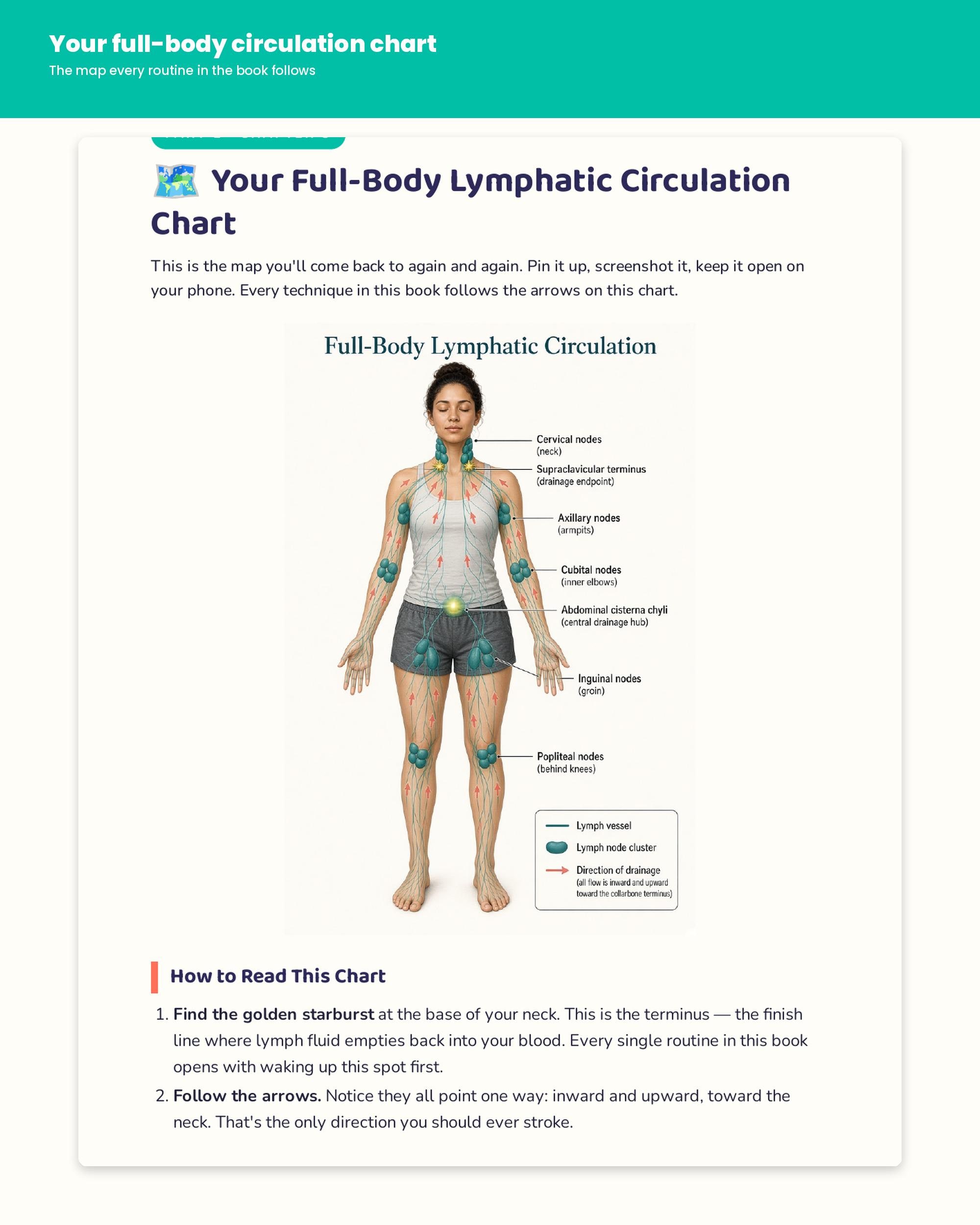
Your lymphatic system is a network of vessels and nodes that carries a clear fluid called lymph and helps keep body fluids in balance and fight infection, as MedlinePlus (US National Library of Medicine) explains. Most lymph vessels sit just under the skin, which is why the strokes are so gentle. Heavy pressure squeezes these small vessels flat instead of helping them.
Can you do lymphatic drainage massage on yourself?
Yes, most healthy adults can do a gentle self lymphatic drainage routine at home, but people with a medical reason for swelling should learn it from a specialist first. Macmillan Cancer Support advises that people with lymphoedema learn simple lymphatic drainage from their lymphoedema team, who will show them which areas to massage and how much pressure to use.
If you are healthy and simply want a relaxing evening routine, a self-guided routine is reasonable. Be honest about what to expect: the evidence for lymphatic drainage is strongest in lymphoedema care, and Cleveland Clinic notes that people without lymphoedema may not notice a meaningful benefit. Many people still enjoy it as a quiet, screen-free wind-down.
Who should not do lymphatic drainage massage at home?
Do not start lymphatic drainage at home without medical advice if you have an infection, fever, a blood clot, heart failure or another heart condition, kidney problems, active cancer, or a recent operation. Cleveland Clinic lists these among the conditions where the massage may be unsafe. Use this checklist before your first session.
| Check | If yes, then |
|---|---|
| Fever, feeling unwell, or red, hot, painful skin (possible infection or cellulitis) | Skip the massage and see a doctor |
| A known or suspected blood clot (DVT): one calf swollen, warm and sore | Seek medical help the same day; do not massage |
| Heart failure, other heart disease or kidney disease | Ask your doctor before starting |
| Cancer, or skin treated with radiotherapy | Only with your oncology or lymphoedema team’s approval |
| Surgery in the last few weeks | Follow your surgeon’s instructions first |
| Pregnancy | Check with your midwife or doctor |
| None of the above | A gentle routine like the one below is generally fine |
What order should you do lymphatic drainage in? A step-by-step full body routine
Work from the centre of the body outwards, clearing the main node areas first, then stroke the limbs back toward them. This is the same logic used in the NHS and hospice leaflets for simple lymphatic drainage. Do the routine on clean, dry skin, sitting or lying comfortably, and repeat each movement slowly, about 10 times.
- Breathe (1 minute). Place both hands on your belly. Breathe in slowly through your nose so your belly rises, then sigh the air out. Repeat five times and pause before you move on, in case you feel light-headed.
- Collarbones (1 minute). Rest your fingertips in the hollows just above your collarbones. Gently stretch the skin down and inward toward the centre, then release. Repeat 10 times.
- Side of the neck (1 minute). Lay your flat hands just below your ears and slowly stroke the skin down toward the collarbones. Repeat 10 times.
- Face, optional (2 minutes). With flat fingers, stroke from the centre of the forehead, under the eyes and along the jaw out toward the ears, then down the neck.
- Armpits (1 minute per side). Cup one hand into the opposite armpit and make slow, gentle upward scoops. Repeat 10 times on each side.
- Arms (2 minutes per side). Start at the upper arm and stroke the skin up toward the armpit. Move to the inner elbow, then the forearm toward the elbow, then the back of the hand toward the wrist. Finish with long sweeps from hand to shoulder.
- Belly (2 minutes). With both hands flat, make slow, gentle circles around the belly button, combined with three or four deep breaths.
- Groin (1 minute per side). Place a flat hand on the crease at the top of the thigh and keep a light pressure there while you lift the knee and lower it 10 times, as in the NHS simple lymphatic drainage leaflet for legs.
- Legs (3 minutes per side). Begin at the top of the thigh and stroke upward toward the groin. Gently press behind the knee while you bend and straighten it 10 times. Stroke the lower leg up toward the knee, then the ankle and foot. Finish with long sweeps from foot to hip.
- Finish (1 minute). Repeat the groin, armpit and collarbone steps once more, then take five slow breaths. Sit for a moment before standing up.
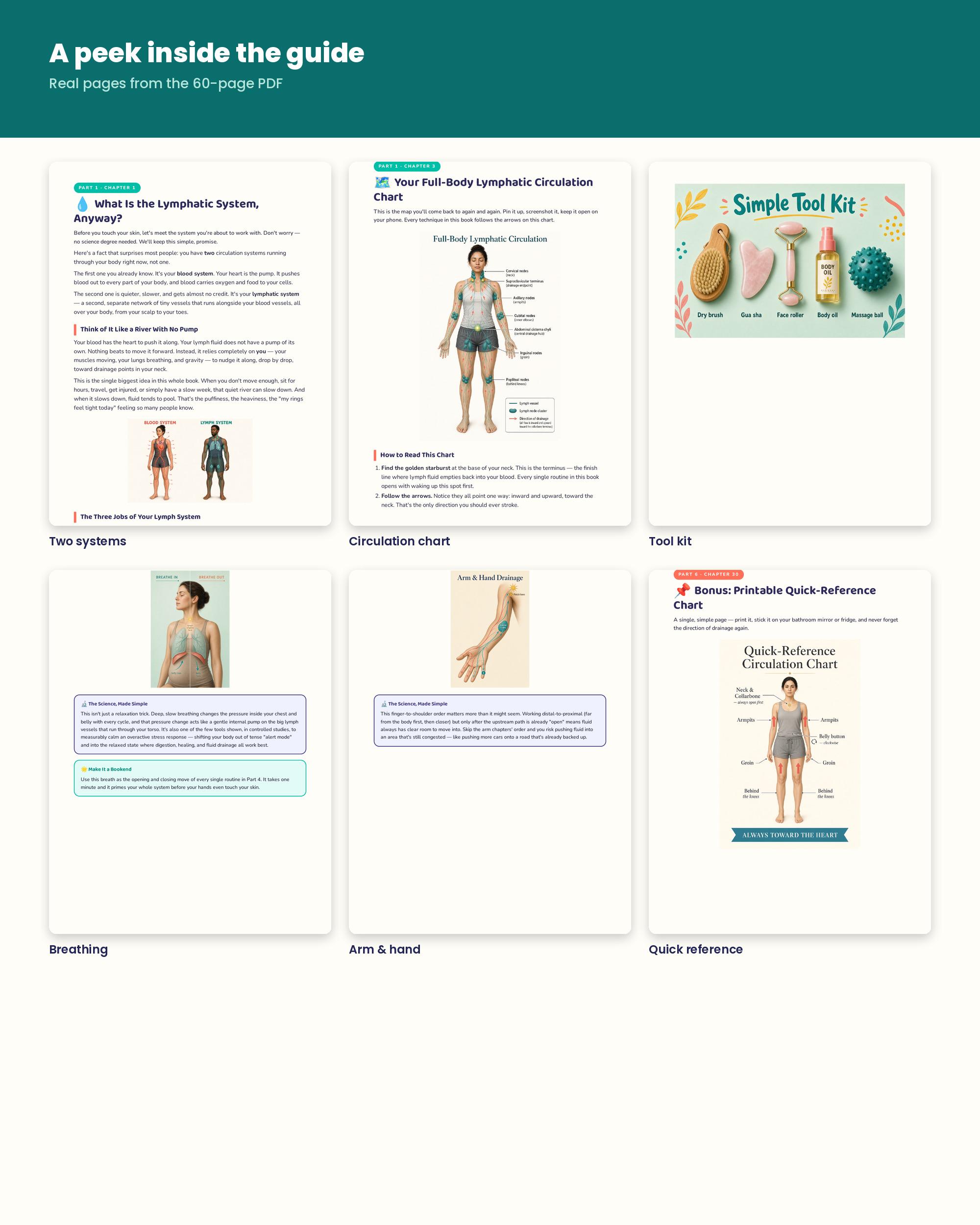
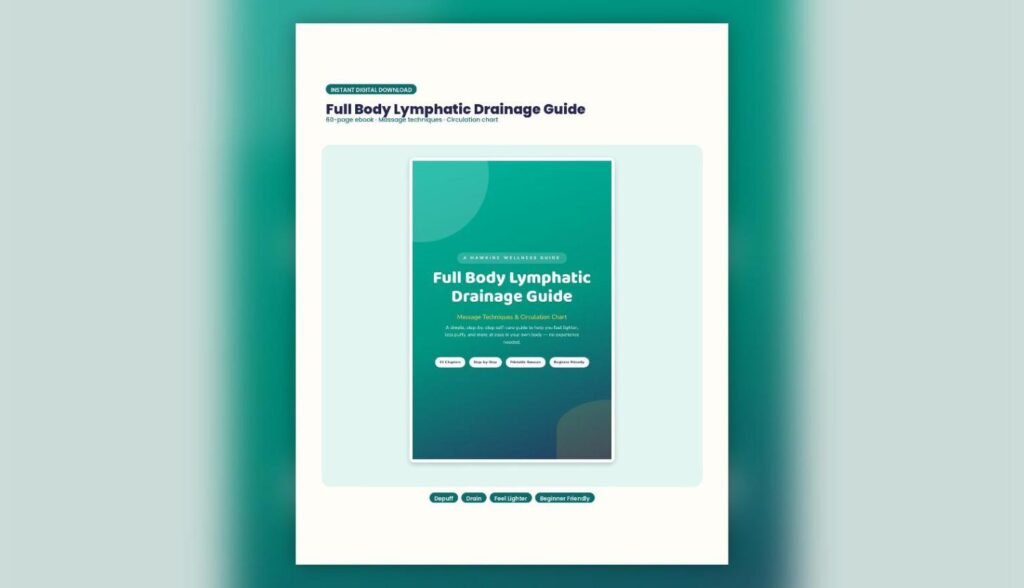
Full Body Lymphatic Drainage Guide – every step in this routine as an illustrated plate, plus a printable full-body chart for your wall. USD 5.39 (regular USD 8.99).
How much pressure should you use for lymphatic drainage?
Use about the weight of a coin resting on the skin: just enough to stretch the skin, never enough to feel the muscle underneath. Your hand should move the skin, not slide over it, which is why oils and creams are left off. Macmillan gives a simple test: if your skin is red when you finish, the movement was too much.
Go slowly as well. Each stroke takes about two seconds, followed by a short release so the skin returns to its starting point. If anything aches, stings or tingles, stop and lighten your touch the next time.
How often should you do lymphatic drainage, and how long until you notice anything?
For general self-care, once a day or a few times a week for 15 to 20 minutes is a sensible routine; no official schedule exists for healthy people. If you have lymphoedema, your specialist will set the frequency for you. Results are subtle and gradual, and many people mostly notice that they feel calmer and less puffy in the morning.
Here is a sample first week that builds the routine slowly, so you learn the order before you try the full sequence. It is the kind of progression the printable guide breaks into separate body-region routines.
| Day | What to do | Time |
|---|---|---|
| 1–2 | Breathing, collarbones, neck and armpits only | 5 minutes |
| 3–4 | Add the arms and the belly | 10 minutes |
| 5 | Add the groin and the legs | 15 minutes |
| 6 | Full routine, including the optional face step | 20 minutes |
| 7 | Rest day, or a short neck and breathing session | 5 minutes |
Pair the routine with habits that support fluid balance in general: regular movement, comfortable clothes, and enough to drink. Our free water intake calculator gives you a daily starting point. If you like a calm evening practice, it also sits well alongside gentle yoga for anxiety or these seated chair exercises.
Frequently asked questions
Does lymphatic drainage massage actually work?
For lymphoedema, manual lymphatic drainage is a recognised part of care when done with compression and specialist advice. For healthy people the evidence is limited; Cleveland Clinic notes you may see no meaningful benefit without lymphoedema. It can still be a relaxing self-care routine, but it is not a detox, weight-loss or cellulite treatment.
Should you drink water after lymphatic drainage massage?
A glass of water afterwards is a pleasant habit, but there is no good evidence that it flushes anything out or that you need extra water because of the massage. Simply drinking enough through the day matters more. A water intake calculator can help you estimate a sensible daily amount for your size and activity.
Which direction do you massage for lymphatic drainage?
Always stroke toward the nearest cleared lymph node area. On the neck that means down toward the collarbones; on the arms, up toward the armpit; on the legs, up toward the groin. The face is drained outward toward the ears and then down the neck. Clear the node areas first, then work outwards.
Can lymphatic drainage massage make you feel tired or unwell?
Most people feel relaxed afterwards. Cleveland Clinic notes that a few people report tiredness, headache or nausea after a session. If that happens, use a lighter touch and shorter sessions next time, and tell your doctor if it keeps happening or if you notice new swelling, redness or pain.
Can I do lymphatic drainage with a dry brush or tool?
You can, but you do not need to. Your hands are enough, and the strokes must stay very light. Macmillan suggests talking to a specialist before buying hand-held massagers if you have lymphoedema. If you like dry brushing, choose a soft brush and follow the same direction and order as the hand routine.
How long does a full body lymphatic drainage routine take?
A full self routine takes about 15 to 20 minutes: around five minutes to breathe and clear the neck and armpits, five to eight minutes for the arms and belly, and five to seven minutes for the groin and legs. On busy days a five-minute neck and breathing session is still worth doing.
Get the printable full body routine
Full Body Lymphatic Drainage Guide – 60 illustrated pages, 16 technique plates, 7 body-region routines and a full-body circulation chart. USD 5.39 (regular USD 8.99).
Looking for more calm, practical printables? Browse the health and wellness hub or see the 30 Day Gentle Yoga Plan.
This guide is for general information and is not medical advice; talk to your doctor before starting a new exercise or health routine.